
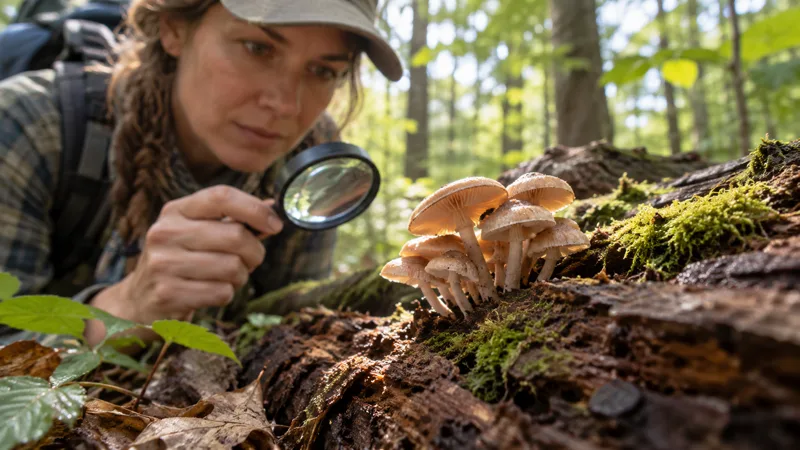
A plant walk can teach careful observation without a harvest
A guided plant and mushroom walk is most useful when it changes how you notice the landscape. You may learn to look at relationships between features, record questions accurately, and recognize how much you have not yet established. Those are valuable outcomes even if you collect nothing and eat nothing. For a beginner, an observation notebook can be a better first project than a basket of specimens brought home with uncertain names.
This archived listing records Wild Edible and Useful Plant and Mushroom Walks – September for September 19, 2026, in Brentwood, Maryland. The date is past as of October 7, 2026. The directory identifies Ancestral Knowledge as the host. This article offers an independent learning approach, not a species identification guide or a report of what grew along that particular walk. It does not establish which plants or mushrooms participants encountered.
Saved September event details
- Event: Wild Edible and Useful Plant and Mushroom Walks – September.
- Recorded date: September 19, 2026.
- Recorded location: Brentwood, MD, USA.
- Listing source: FeralSkills.
- Directory host: Ancestral Knowledge.
- Status: archived date; later sessions need separate confirmation.
Read the historical event source. Ask the organizer of a future walk for its actual meeting point, access requirements, age rules, and collection policy. A city name and a class title do not establish permission to harvest. Treat any older pricing or schedule information as historical until the organizer confirms current terms.
Keep edible and identified as separate questions
Recognizing a name is not enough to establish that an organism is appropriate to eat. Identification, suitability for a particular person, preparation, and the context of collection are distinct matters. For beginners, the safest learning boundary is simple: do not taste or consume unfamiliar wild plants or mushrooms. Seek expert instruction and retain uncertainty rather than trying to resolve it by a photograph, an app suggestion, or resemblance to something from another place.
The Centers for Disease Control and Prevention warns that accidental poisonous mushroom ingestion can cause severe illness and advises that wild mushrooms not be consumed unless identified by an expert. That guidance belongs at the center of a beginner learning plan. This article supplies no edible-species list, shortcut test, or preparation method. Observation can be rewarding without turning a learning walk into an unsupervised food experiment.
Create a page that records what you actually saw
Give each observation a date, location description, and a temporary label such as “specimen A.” A temporary label is useful because it avoids committing to a name too early. Write visible characteristics in plain language, following the instructor's directions about what may be examined safely. If a feature was not visible, say so. A blank or unresolved field is more honest than a guessed detail added to make the page look complete.
Separate the instructor's identification from your own observation. You might record that the instructor named an example, while noting which features you personally saw and which required explanation. This distinction helps when reviewing the notebook later. Otherwise, a remembered name can make you believe that you independently recognized more than you did. The page should show the learning process, including the questions still needing supervised clarification.
Sketch to notice, not to prove
A simple sketch can slow your attention and reveal missing details. It does not need to be artistic. Draw the general arrangement and label the parts the instructor points out, without touching or altering an organism unless instructed and permitted. If you cannot draw a feature clearly, write a question beside it. The purpose is to learn how to observe, not to produce an illustration that certifies identity.
Photographs can support a record but have similar limits. Ask permission before photographing participants or working close to another person's space. Follow the organizer's guidance about views and context, and avoid disturbing the site for a more dramatic image. A photograph may omit information needed by an expert. Do not treat a confident image-recognition result as permission to consume a wild specimen. Keep your record for discussion with qualified people.
Ask about differences rather than shortcuts
A productive question is “Which features are important here, and what have I failed to observe?” It invites the instructor to explain reasoning. A less useful question asks for one universal trick to separate safe from unsafe organisms. Such a trick can create dangerous confidence. Ask instead how the instructor evaluates uncertainty and what a learner should do when necessary information is unavailable.
You can also ask how a beginner should continue studying without collecting or consuming. The answer may involve reading a regional reference, returning for another guided walk, or learning terminology that makes observations easier to describe. Do not demand an immediate conclusion for every example. An expert's willingness to leave something unidentified is a lesson in responsible limits. The notebook should preserve that uncertainty rather than replace it later with an internet guess.
Permission belongs before collection
Ask the organizer and relevant land manager what participants are allowed to handle or remove. Different sites have different rules, and a guided class does not automatically suspend them. The National Park Service Leave No Trace reference emphasizes reducing impacts and leaving natural features as found. Use it as a general ethical framework, then follow the specific site's rules. If observation alone serves your learning goal, collection may be unnecessary.
Consider the effect of a group stopping around one example. Stay where the instructor directs, avoid blocking a path, and do not crowd the organism merely to get a closer view. Let others observe without competing for access. A respectful walk protects the setting as well as the learning environment. Ask how to report an interesting observation without sharing a sensitive location more broadly than appropriate.
Useful does not necessarily mean food or medicine
The word useful can invite broad assumptions. A plant may have a documented traditional use, a role in an ecosystem, or value as a teaching example without being something you should ingest or apply to your skin. Ask the instructor which sense is intended. Keep historical discussion distinct from a recommendation for personal use. A story about past practices does not establish that a beginner can safely reproduce them.
If a subject involves health, consult qualified medical advice rather than substituting plant material for treatment. This guide makes no medicinal claims. You can learn about relationships, terminology, and cultural context while respecting the limits of your experience. When recording a traditional use, identify the source and avoid presenting it as a universal fact about all communities or as evidence that the method is appropriate for you.
Prepare for the walk, not an imagined foraging expedition
Obtain the actual equipment list from the organizer of your booked session. Comfortable movement, weather-appropriate clothing, personal necessities, and a manageable note-taking arrangement may matter more than specialized collecting equipment. Confirm the expected distance, terrain, restroom access, and pace. A title that says walk does not establish accessibility. Discuss relevant needs ahead of time so you can choose a suitable format.
Keep your own food separate and bring familiar refreshments appropriate to the session's rules. That reduces pressure to treat something encountered along the route as a snack. Follow the instructor's no-tasting and handling boundaries. If children participate, ensure the supervising adult understands those boundaries and the current age requirements. A child can learn to sketch, compare, and ask questions without being encouraged to put unfamiliar material in their mouth.
Have a professional response to accidental ingestion
If someone may have swallowed a wild mushroom or another unfamiliar substance, seek professional help promptly rather than waiting to decide whether it was probably harmless. Poison Control provides immediate guidance in the United States through 1-800-222-1222. For a severe emergency, contact emergency services. Follow the professional's directions; this article does not provide a home treatment or a way to judge safety from symptoms.
Do not let embarrassment about an uncertain identification delay that call. Provide the information the professional requests, and tell the organizer if the incident happens during a class. Poison Control's mushroom warning explains why expert help matters. Reading that resource before a learning walk can clarify the seriousness of the no-tasting boundary without turning the event into a fearful exercise. Prevention and a clear professional contact are both practical parts of preparation.
Review the notebook before searching for names
After a walk, first check the accuracy of your own notes. Which features did you see? Which came from the instructor? What was left unresolved? If you use a reference to learn terminology, keep that separate from an identification claim. An internet search can return a visually appealing match that does not answer the necessary questions. Bring unresolved observations back to a qualified instructor rather than allowing a search result to erase uncertainty.
Choose a small follow-up project, such as improving the description of one feature or making a clearer location sketch. Revisit ordinary observation in permitted places without collecting. That builds patience and vocabulary, both of which support later instruction. You do not need to turn every outing into a harvest to make progress. Knowing what cannot yet be identified is an important part of learning to recognize what can.
Sources and the next learning step
For safety guidance read CDC's report on accidental poisonous mushroom ingestion and Poison Control's wild-mushroom warning. For general impact awareness see the National Park Service Leave No Trace reference. These resources support a cautious learning approach, not an edible-species checklist.
The September 19 listing remains a historical reference. Confirm another session through its organizer and choose an objective centered on observation, clear questions, and responsible limits. A successful plant walk can leave you with a fuller notebook and greater respect for uncertainty, even when everything you encountered remains exactly where it grew.