Archived event: These dates have passed as of October 7, 2026. This page retains the original listing for reference; consult the provider for later offerings.
Fall Edible & Medicinal Plant Class was listed for September 19, 2026 in Seven Hills, Ohio, USA.
This is an archived event listing. These dates have passed; do not use this page as confirmation of a future edition.
Event details
- Dates: September 19, 2026
- Location: Seven Hills, Ohio, USA
- Type: Food & Storage
View the event source and registration information
Treat the autumn class as a beginning, not permission to experiment
The September 19, 2026 Fall Edible & Medicinal Plant Class in Seven Hills, Ohio, is an archived event. The school page also marks that session as passed. Its historical listing describes an autumn plant class, including observation and other plant-related topics. The school is the place to ask about later sessions and their scope. The editorial material here concerns learning habits, documentation, and responsible questions. It does not identify a plant for consumption, establish medicinal effectiveness, or offer preparation and dosing instructions. A class title can describe an interest without making every associated claim safe or well supported.
A useful goal for an introductory walk is to leave with a better process for recognizing uncertainty. You might learn the vocabulary needed to describe a leaf or understand which features an instructor compares. That is progress even if you do not collect anything. Avoid setting a goal of gathering a meal on your first outing. Identification, permission, environmental condition, and food safety are separate questions. Each needs an appropriate answer. Keeping them distinct helps prevent enthusiasm for a new subject from becoming misplaced confidence about a particular specimen or its intended use.
Begin a notebook of observations
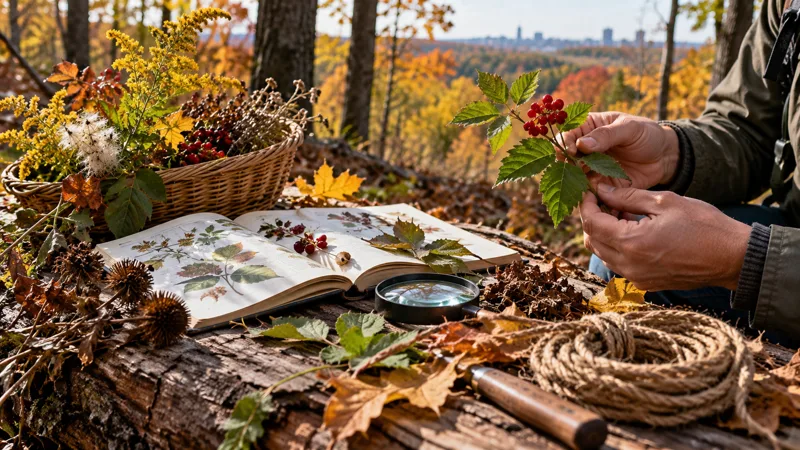
Give each observation its own page or clearly labeled entry. Record the date, general area, and the instructor's explanation of what you are seeing. Distinguish your own tentative guess from an identification supplied by a qualified person. A notebook that merges the two can become misleading later. Include the questions still unresolved. If a name is unfamiliar, ask for spelling and the form used in the course materials. Do not silently replace it with a similar common name. Different people may use the same everyday name in different ways, and that ambiguity matters.
Describe the features you actually observed instead of relying only on a photograph. Ask what additional features the instructor needed and whether the plant's stage of growth limits the conclusion. You are learning how evidence supports identification. A single image can omit important information, and an app's suggestion does not settle the question. Keep photographs linked to the correct note so that a later review does not accidentally pair one image with another plant's name. Good organization is not glamorous, but it is one of the simplest ways to keep your learning record honest and useful.
Learn the value of leaving something unnamed
An unresolved observation is not a failure. It tells you which information or expertise is missing. Write “not identified” plainly when necessary and keep the entry separate from confirmed educational examples. Ask an instructor what would be required to continue the investigation responsibly. The answer may be a clearer view, another season, or a specialist. It should not be a dare to taste, handle, or prepare the specimen. Do not use improvised edibility tests. Uncertainty is a reason to stop and seek expert guidance, not a prompt to see whether a small experiment seems harmless.
The National Capital Poison Center warns that plants can cause harm through ingestion or contact and that mistaken identification can have serious consequences. Its safety resource is an appropriate reference for the importance of expert help, not a substitute for a local identification lesson. If an exposure occurs, seek prompt professional guidance through Poison Control or emergency services as appropriate. In the United States, Poison Control can be reached at 1-800-222-1222. Keep that resource separate from your field notebook so that an urgent situation is not delayed by searching through pages of uncertain botanical observations.
Ask what changes with the season
An autumn class offers a chance to understand why an observation made in one month may not transfer neatly to another. Ask which features remain visible and which have changed since spring or summer. Compare the instructor's description with the actual specimen rather than memorizing a colorful image from a guidebook. Do not infer that a plant is absent just because it looks different from your expectation. Conversely, do not force an unfamiliar plant into a familiar identity because the setting feels plausible. Seasonal context is evidence to consider, not a shortcut that replaces careful observation.
Plan a later observational visit to an appropriate public or permitted area, without collection or consumption. Bring your questions and record what you can recognize confidently and what you cannot. If an earlier observation remains unclear, ask a qualified local instructor rather than expanding a guess. Over time, this method can create a useful seasonal record. The purpose is to understand change, not to accumulate a list of plants you believe you can use. A patient learner often gains more from revisiting a small area than from moving quickly through many places with no consistent documentation.
Keep medicinal discussion separate from medical care
A traditional use, a modern product claim, and evidence for a medical benefit are different kinds of information. Ask which kind is being discussed. Do not turn a historical account into a treatment recommendation. The National Center for Complementary and Integrative Health advises careful use of supplements and communication with health professionals. Plants and related products can raise questions about effects, interactions, and suitability for an individual. Those questions belong with a qualified clinician or pharmacist. This article does not recommend replacing prescribed care, selecting a remedy, or experimenting with a homemade medicinal preparation.
In your notes, use labels such as “historical discussion” or “question for clinician” when appropriate. That makes the context clear when you review the page months later. Avoid recording a confident health claim without its qualifications or evidence. If you are interested in the cultural history of a plant, study that history respectfully and cite the source. If you are interested in a health concern, obtain professional medical advice. Both interests can be legitimate, but they should not be blended into a casual assumption that something described as natural must be harmless or effective for every person.
Collection rules are an independent subject
Seeing a plant during a lesson does not establish permission to take it. Ask the landowner or relevant land manager about applicable rules before any collection. An instructor's educational use of a sample may involve permission or conditions that do not apply to students elsewhere. Consider the effect on the site as well as whether an action is allowed. It is often possible to learn through observation and photography without removing material. That approach also avoids the practical problem of taking home a specimen you cannot confidently identify or store appropriately.
Do not publish precise locations of sensitive plants simply to demonstrate that you found them. Ask the instructor how to share observations responsibly. A general area may be sufficient for a learning record. If a later project requires material, discuss suitable permitted sources rather than assuming wild collection is necessary. A controlled educational example can be more useful than an uncertain harvest. The strongest learning routine leaves the place in good condition and keeps your notes meaningful. It should not depend on carrying away increasing quantities of material each time you become curious about another species.
Evaluate a source before using its advice
A plant guide, school page, social post, and medical reference serve different purposes. Read the author's qualifications, the region covered, and the date of the information. Ask whether the source distinguishes identification from use and whether it openly addresses uncertainty. A confident style is not proof of reliable guidance. Be cautious about content that promises simple universal rules or dismisses the need for expert confirmation. When several sources disagree, record the disagreement and seek clarification. Do not choose the answer that makes the planned activity easiest or most exciting simply because it fits your preference.
Keep a small reference list rather than saving hundreds of disconnected screenshots. Note what each reference is for: regional botanical study, provider logistics, poison information, or medical questions. This division prevents a school advertisement from carrying more authority than it has. It also helps you recognize when the source you need is not yet in the collection. A well-organized reference list should make uncertainty visible. You can say which question remains unanswered and who is qualified to answer it. That is a better basis for responsible learning than treating every attractive guide as equally applicable.
Prepare for a walk that supports attention
Use the provider's current instructions for footwear, weather clothing, accessibility, and what to bring. The archived school page mentions notes and photography, but confirm the arrangements of any new session. Ask about the amount of walking, terrain, breaks, and whether the class uses indoor space. Bring personal necessities and ordinary food rather than expecting a plant lesson to supply your meal. A comfortable participant can concentrate on careful observation. Someone distracted by wet feet, an empty bottle, or an uncertain meeting point may miss the qualifications that make the instruction meaningful.
During the walk, remain with the teaching group and respect the pace of the explanation. Ask permission before handling samples or moving around a demonstration. If you bring children, confirm the provider's policy and explain that nothing is to be tasted or collected without the appropriate guidance and permission. Their participation can emphasize questions, drawing, and noticing differences. Do not make identification into a competitive game that rewards fast guesses. The best educational atmosphere rewards accuracy, restraint, and willingness to admit that a feature is still unfamiliar.
Make your next step an observational project
After class, choose a modest project such as reviewing a few clearly labeled photographs with your notes or asking the instructor about one unresolved observation. Avoid immediately expanding into food or medicinal preparation. The project should strengthen the process you learned: accurate records, appropriate expert confirmation, and honest boundaries. If you find a note that sounds like an instruction but lacks context, mark it for clarification. This review is particularly useful after a fast-moving field session, when several names and explanations may have been introduced in a short period.
The archived Seven Hills entry can remain useful without pretending the past session is open for attendance. Readers interested in another class should use the school's current calendar, while those interested in health or an exposure should use professional medical and poison resources. A responsible plant learner can appreciate ecology, seasonal change, craft materials, and cultural history without turning every observation into something to eat or apply. The lasting skill is disciplined curiosity: knowing what you saw, knowing what you did not establish, and choosing the right source of help before making a consequential decision.