
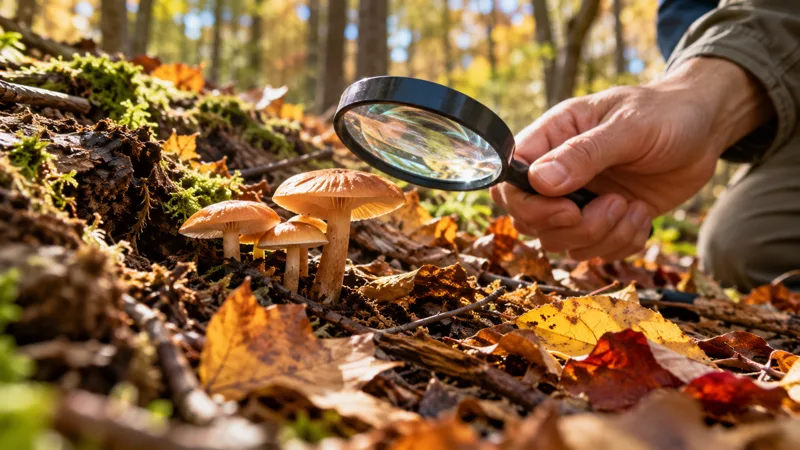
Wild Edible and Useful Plant and Mushroom Walks - October is recorded in this listing for October 17, 2026, in Brentwood, Maryland. As of October 7, that date is still upcoming. There is an important location discrepancy to resolve before traveling: the linked FeralSkills directory identifies Brentwood, but Ancestral Knowledge's own registration page identifies Lanham, Maryland. Treat the organizer's written meeting instructions as the deciding information, and obtain the exact trail entrance or gathering point rather than driving to an administrative address.
The October walk and its source information
- Recorded date: October 17, 2026.
- Recorded location: Brentwood, MD, USA; the organizer registration page currently says Lanham, MD.
- Organizer identified by the sources: Ancestral Knowledge.
- Source links: FeralSkills event listing and Ancestral Knowledge registration.
The organizer describes a nature walk that introduces plants, identification, ecology, traditional uses, and harvest considerations. Its registration page gives October 18 as a rain date and says participants younger than sixteen need a parent present. The directory and organizer also show different prices and time formatting, so this article does not resolve those differences into a promised fee or departure time. Confirm the session you are booking, its weather decision process, and the final arrival instructions directly with Ancestral Knowledge.
Make observation the main harvest
The strongest beginner goal for a guided walk is learning how to notice a plant carefully. A basket of gathered food is a poor measure of progress because it rewards speed before judgment has developed. A notebook containing a few accurately observed specimens can be much more useful. You can revisit those records, compare them with a regional reference, and ask a knowledgeable teacher to explain the features you overlooked. Learning to leave an uncertain specimen alone is an achievement, not a failed outing.
Arrive with a question about your own attention. Perhaps you recognize trees only when they have flowers, or you confuse the edge of a leaf with the overall shape. Another person may want to understand how a plant's surroundings contribute to an identification. Keep that question narrow enough to investigate during a walk. “How do I describe this leaf arrangement?” invites a useful demonstration. “Which plants can I survive on?” is too broad and can encourage an unwarranted sense of readiness.
A useful page has room for a sketch, a location description, the date, and unanswered questions. Separate what you saw from what somebody interpreted. For example, record that a specimen was beside a fallen log before writing a possible name underneath. If the teacher explains a distinguishing feature, mark that feature on the sketch rather than merely copying the name. A label can be forgotten quickly; a record of the comparison gives you something concrete to practice looking for later.
Identification is more than matching a picture
Photographs help preserve observations, but a single attractive picture often excludes the detail that matters most. Ask the guide which views would support later study without damaging the organism. A wide photograph can show habitat; a closer image can show structure. Include something that makes scale understandable when permitted, and keep your own notes connected to the correct images. Ten unlabeled closeups are less useful than three clear photographs tied to a careful notebook entry and a specific question.
Phone identification tools can suggest possibilities, but suggestions should remain prompts for study. Do not let an app result become permission to eat a wild plant or mushroom. The cost of an identification mistake is not comparable to the cost of a wrong bird name. Keep food decisions separate from recreational recognition, and ask the instructor how beginners should obtain competent local verification. If the answer involves a photograph alone, request clarification about what the photograph cannot establish.
The Poison Control mushroom warning explains why poisonous mushrooms cannot be screened out by simple folk rules and why cooking does not make every poisonous mushroom safe. This walk should be approached as supervised education, not a shortcut to independent mushroom consumption. Do not taste an uncertain specimen to identify it. If a possible poisoning occurs, seek Poison Control guidance immediately at 1-800-222-1222 in the United States; call emergency services for serious symptoms or a person who is unresponsive.
Keep children involved through observation tasks rather than tasting tasks. A child can compare textures visually, count features, draw an outline, or describe where an organism was growing. Adults should make the boundary explicit before the group starts: nothing found on the walk goes into a mouth without the organizer's appropriate supervision and a verified food-safety decision. Pack ordinary snacks so curiosity and hunger do not become mixed together. Ask how the organizer handles allergies and any optional food demonstrations.
October gives a different set of questions
Season changes what is available to observe. Instead of expecting every plant to present the familiar features of a summer field guide, ask which evidence is useful at this time of year. The lesson may involve comparing stages of growth or recognizing what information is missing. This is a good reason to return to the same place across seasons. A confident identification in one setting should not be copied automatically onto something that merely resembles it in another setting.
Use the walk to investigate relationships rather than compiling a menu. Why is one specimen at the edge of the path while another is in a shaded area? What changes when the surrounding ground is disturbed? Which observations would you need before answering? These questions build a habit of attending to context. They also help keep the discussion grounded: a guide can explain what is known about the particular example without suggesting that one morning provides mastery of the whole landscape.
The word “useful” deserves attention of its own. A plant may have cultural, craft, ecological, or historical significance without being appropriate for home medical use or food. Record the type of use being discussed and the limits of that explanation. Traditional knowledge should be treated respectfully and attributed when the teacher provides its origin. Do not turn a discussion of medicinal history into advice to replace prescribed treatment, combine herbs with medication, or prepare remedies for children.
Leave room for permissions and restraint
Knowing a name does not establish permission to collect. Before handling or removing anything, learn the site's rules and the organizer's instructions. Ask whether the activity is observation only, whether any specimens are gathered for teaching, and who has authorized that gathering. A public-looking green space may have specific restrictions, and a privately organized walk does not automatically grant harvesting rights elsewhere. Keeping those distinctions clear is part of becoming a reliable outdoor learner.
There is also a difference between permission and good judgment. If a group of learners each removes a specimen, the combined effect can be much larger than any individual imagines. Ask how the guide chooses a teaching example, how much handling is appropriate, and when a photograph or drawing is preferable. Avoid publishing precise locations of sensitive organisms as an incidental social post. A personal nature journal can preserve your learning without directing repeated collecting pressure toward a small patch.
A comfortable walking kit supports better questions
Choose clothing for the actual forecast and surface conditions rather than for an imagined expedition. Shoes that already fit well will let you concentrate on the explanation instead of a blister. A light rain layer, water, a charged phone, and a notebook are practical starting points, subject to the organizer's final instructions. Ask about distance, pace, rest opportunities, toilets, and accessibility. Those details determine whether the session is a good fit far more reliably than the word “walk” by itself.
Protect the notebook from rain in a simple reusable pouch, and keep a pencil or second pen handy. A small magnifier might support observation if the teacher welcomes it, but buying specialized equipment before understanding the activity can distract from learning. Similarly, a collecting knife or large basket may be unnecessary and may conflict with site rules. Bring the organizer's requested equipment first. Any additional item should have a clear purpose that you can explain in one sentence.
Plan the meeting point as carefully as the learning. Because Lanham and Brentwood are different places, get a street address or map pin from the organizer and ask whether parking is at the same point as the walk's start. Save the information before leaving home. Share the expected finish with whoever needs to know your plans, and account for traffic and finding the correct entrance. An early arrival buffer is useful only after the destination itself has been verified.
Turn a single morning into a careful study practice
After the walk, choose two or three records to improve while your memory is fresh. Add the missing details you can recall honestly, and mark anything uncertain as uncertain. Do not make the notes look complete by guessing. Look up the teacher's recommended reference and compare its descriptions with your observations. If they conflict, preserve the conflict as a question for a future guided session. The purpose is to develop better evidence, not to force every encounter into a final label.
A useful follow-up outing can be entirely observational. Return with a friend, stay on permitted routes, and see whether you can describe a familiar specimen before checking your notes. You need not collect anything or demonstrate edibility. If you cannot explain the distinguishing features in your own words, that identifies the next learning task. Practice should also include recognizing the limits of your notes: a record of one individual does not authorize a decision about every similar-looking individual.
Consider a household preparedness connection that does not depend on foraged calories. Accurate observation, patience, and respectful use of references are useful habits in gardens, pantry planning, and outdoor travel. The practical value of this event can be learning to ask a better question before acting. Conventional food supplies and safe drinking water remain the dependable basis of an emergency plan. A plant walk complements that preparation through education and environmental awareness rather than replacing it with uncertain food acquisition.
Before October 17, settle the Lanham-versus-Brentwood location difference and the organizer's current booking details. Then choose a modest learning target, pack for a comfortable morning, and arrive ready to listen. Leave with observations you can defend, questions you can articulate, and a clear boundary between recognition and consumption. For additional opportunities, browse event listings or explore Survival Skills; each future class should be evaluated on its own confirmed instructions.