
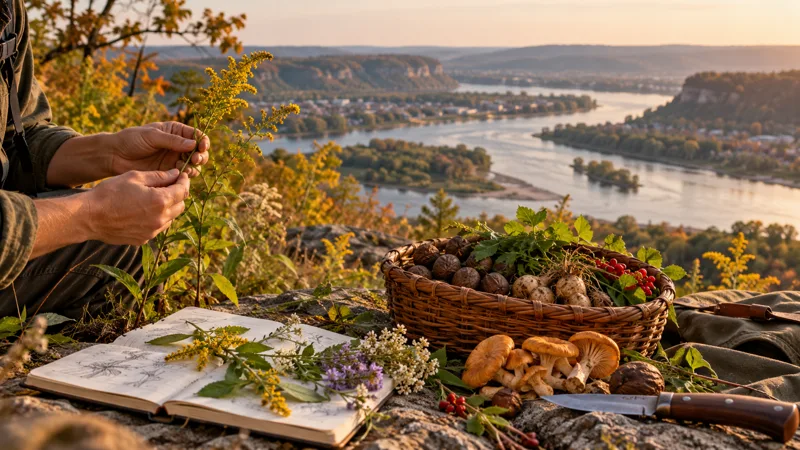
A harvest festival is a place to learn carefully, not a permission slip to gather
Midwest Wild Harvest Fest was listed for September 11–13, 2026, in Prairie du Chien, WI, USA. Those dates have passed as of October 7, 2026. This is an archived listing; anyone seeking another gathering should consult the festival's own current information. The original directory link remains useful for historical context, but it should not be mistaken for available registration. The editorial guide below focuses on learning habits, observation, and responsible questions for wild-food education. It does not claim that a named instructor delivered these lessons during the recorded weekend.
The festival's official website describes a gathering built around wild-food education and provides its own grounds rules. One particularly important rule distinguishes educational harvests under staff supervision from independent collecting elsewhere on the property. That distinction belongs at the center of a visitor's thinking. Seeing a plant used during a demonstration does not authorize gathering it from a different location. A learning environment may operate under special arrangements that do not extend to participants after they leave. Check the current organizer instructions and the land manager's rules wherever a later outing takes place.
Learn the questions before collecting the answers
A newcomer can prepare by writing a few specific questions: how does an instructor distinguish a specimen from similar species, which features must be visible, and what information makes identification uncertain? Those questions encourage a process rather than a list of memorized names. Ask how season, growth stage, and habitat affect what can be observed. A picture taken from one angle may leave out a critical feature. The most useful lesson may be recognizing that the evidence is incomplete and choosing not to make a claim.
Do not eat an unidentified specimen or use this article as an identification key. Wild-food identification and preparation require qualified, locally relevant instruction. An app suggestion, a confident social comment, or a resemblance to something purchased in a shop is not adequate assurance. The discussion here deliberately avoids a catalog of edible species because a brief article cannot establish the necessary details for safe consumption. Instead, use it to organize learning, record uncertainties, and recognize the point at which an expert needs to examine the actual material.
Separate observing from tasting
Observation can be valuable without harvesting or eating. A student can notice growth patterns, sketch visible features, compare permitted reference material, and ask an instructor to explain what they are looking at. That approach reduces the pressure to turn every encounter into food. If a class offers a tasting, confirm the ingredients, preparation, and dietary information with the people responsible. Participation should remain voluntary. A person with allergies, medical dietary needs, or other concerns should seek appropriate advice and should not feel obliged to taste something to prove interest or commitment.
Make the same distinction when traveling with children. Children can learn to observe closely and ask an adult before touching or eating unfamiliar material. Give them a clear boundary between food offered through the event's supervised arrangements and anything encountered elsewhere. Do not let a game reward collecting the largest amount or tasting the most unusual item. Curiosity is better served by patient observation and accurate explanation. Discuss the organizer's current child supervision requirements in advance rather than assuming an activity listing means parents can leave children unattended.
A useful field notebook records uncertainty
Choose a notebook format you will actually maintain. Reserve space for the date, location at an appropriate level of privacy, observable features, questions, and the person or reference responsible for an identification. Mark uncertain records clearly. A note that says probably is not a later authorization to eat. Distinguish what you saw from what someone told you, and distinguish the specimen itself from a photograph of it. These simple habits prevent memory from converting a tentative conversation into a confident conclusion weeks afterwards.
Photographs can support notes when permitted, but they should not replace expert examination. Ask what views are useful for learning and whether photography is appropriate during the session. Avoid removing or damaging a specimen just to improve a photograph. Some teaching materials may be the instructor's property or require specific handling. Keep location information responsible as well. Publicly sharing an exact spot can increase pressure on a sensitive place. The point of the record is to improve your own understanding, not to publish a map inviting unlimited collecting by strangers.
Permission comes before the basket
Before any independent foraging activity, establish who manages the land and what is allowed. Private land requires appropriate permission; public land has its own rules that may vary by place, species, purpose, and activity. Obtain current instructions directly from the responsible manager rather than relying on another visitor's experience. A previous event's supervised exception may no longer apply. If the rule is unclear, leave the material in place and ask. Being able to identify a plant is separate from being permitted to collect it.
Think about the impact of repeated visitors. A small harvest by one person can seem insignificant, while many people following the same suggestion can create a very different result. Ask educators how they approach conservation, vulnerable populations, and places where collecting should not occur. Do not request a universal percentage that supposedly makes every harvest sustainable. Ecological context matters, and a simplified rule can conceal it. Learning to recognize a reason to refrain from gathering is part of responsible knowledge, not a failure to make use of the landscape.
Food handling is a separate subject from identification
Correct naming does not answer every food-safety question. Ask qualified instructors how preparation, storage, handling, and intended use affect their teaching examples. Keep recipe notes separate from identification notes. A process described for one ingredient should not be transferred casually to another. When you have medical questions, allergies, or uncertainty about whether something is suitable to eat, consult the appropriate professional. Do not assume that a tradition, a cooked appearance, or another person's tolerance establishes safety for you.
A cooking demonstration is an opportunity to observe organization as well as flavor. Notice how ingredients are labeled, how people explain substitutions, and how dietary questions are handled. Do not take unlabeled leftovers or mixed specimens home with the assumption that someone can identify them later. Ask what materials, if any, participants are allowed to keep. Where a recipe is provided, preserve its provenance and instructions accurately. Changing an ingredient may change more than the taste. Treat unfamiliar wild ingredients with greater care than an ordinary experiment using known supermarket foods.
Follow the event's facilities information
For a future visit, use the organizer's current lodging, meal, and grounds instructions. The official site describes particular facility arrangements, but an archived listing cannot guarantee that they will be identical in another year. Confirm bedding, personal supplies, food arrangements, accessibility, and any restrictions before paying or traveling. A participant with specific dietary needs should communicate directly with the organizer and bring appropriate backup food if advised. Do not rely on a general description such as meals included to answer every individual requirement.
Prepare ordinary travel details separately from the educational program. Save directions and contact information, plan arrival time, and understand where parking is permitted. If camping is offered, verify the actual arrangement instead of assuming a festival ticket grants access to every nearby site. Keep weather-appropriate clothing and comfortable footwear suited to the scheduled activities. The practical goal is to arrive able to concentrate. A person who spends the first morning solving a forgotten sleeping arrangement or a dietary problem loses time that could have supported careful learning.
Listen for the limits of an explanation
A strong question asks not only how an educator knows, but what would make the educator stop short of identifying something. This reveals the boundary of the method. Ask which characteristics are essential and which are merely suggestive. An explanation that depends on local experience should be recognized as such. Keep regional differences explicit. A familiar common name can cover different species or be used differently by different communities, so ask for precise terminology without treating terminology alone as proof that you understand the specimen.
Be respectful when comparing instructors or approaches. Different presentations may focus on different tasks, and a short discussion may not capture the whole teaching method. Record a question and seek clarification rather than announcing a contradiction from partial notes. Avoid turning an educational gathering into a competition to be the most adventurous eater or the most confident identifier. Careful learners can say they do not know. That attitude protects the quality of the discussion and makes it easier for a novice to ask an important question before making a mistake.
Continue with a modest learning project
After a gathering, choose a small observation project that does not depend on consuming wild food. For example, revisit a permitted walking route through changing seasons, compare notes with a qualified educator, or improve the way you photograph visible features without disturbing the site. A focused project gives you a reason to return to the same questions and notice what changes. Keep identification uncertainty visible throughout. Repeated observation can strengthen knowledge, but the number of times you have seen something does not independently establish edibility.
Use the archived September listing as a record of the event and the organizer's current site as the starting point for later opportunities. Retain notes about what you learned, who supplied the information, and what still needs confirmation. The most valuable result of a wild-harvest gathering may be a more disciplined relationship with uncertainty: knowing when to ask, when to document, when to seek professional advice, and when to leave a specimen untouched. That is a practical skill that remains useful long after a festival weekend ends, even for someone whose next meal comes entirely from a grocery store.