
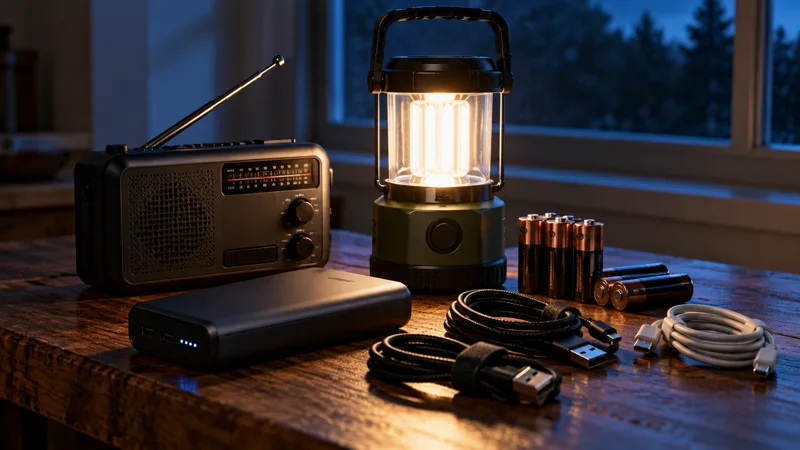
A grid-down plan should identify what actually stops working
Electricity is often treated as one household service, but its loss can affect many separate routines. Lighting, charging, communication, and some building systems may each require a different response. The first planning task is to identify those dependencies accurately. A large backup purchase made before that review may solve only the most visible problem while leaving the household unsure about what to do next.
This listing records Michigan Grid-Down Survival for October 10, 2026, with the location described as West, Michigan. The source calls it a one-day intensive and identifies Arcturus Primitive Skills Institute as the host. West, Michigan, is not a usable arrival address. This article provides an independent household planning guide; it does not claim which activities will be taught, which equipment will be supplied, or whether a place remains available.
Recorded course information
- Event: Michigan Grid-Down Survival.
- Source title: Michigan Grid-Down Survival (1-Day Intensive).
- Recorded date: October 10, 2026.
- Recorded location: West, Michigan, USA.
- Category: Preparedness & Emergency.
- Listing source: FeralSkills.
- Directory host: Arcturus Primitive Skills Institute.
Check the listing and registration link. Confirm the exact venue, start time, duration, equipment requirements, and current terms with the school before travel. The directory contains midnight timing fields and a broad location label, so those fields should not be interpreted as precise participant instructions.
Walk through an ordinary evening on paper
List the things that happen during a normal evening, from entering the home to going to bed. Beside each task, write what it depends on. You may notice that one action relies on a charged phone, another on an automatic device, and another on information stored only online. The exercise is not a prediction of a particular outage. It is a way to discover where familiar routines conceal dependencies.
Ask another household member to make their own list before comparing. Different people may rely on the same service for different reasons. A household plan should account for those differences rather than assuming the person purchasing equipment has identified every need. Combine the lists into a short set of priorities. Where a need involves health or specialized support, consult the relevant qualified provider for appropriate contingency arrangements.
Choose a usable first layer
The first layer of preparation can be organizational. Place familiar lights where intended users can find them, keep essential contacts in an accessible format, and assign responsibility for checking existing supplies. Follow equipment storage and use directions. These changes do not require a dramatic scenario or expensive purchase. They help the household manage a simple interruption without spending attention on searching and guessing.
Have someone who did not design the arrangement try to locate the needed item or information. Ask where the wording or location was unclear. Revise it. A system that depends on remembering an explanation from months ago is less useful than one that is understandable when needed. Labels, consistent locations, and short instructions can matter as much as the item itself.
Discuss essential needs with the right provider
Some household needs cannot be addressed through generic preparedness advice. Medical equipment, medication storage, access requirements, or personal support arrangements may need individualized professional guidance. Contact the relevant provider before relying on a backup plan. Ask what arrangements are appropriate and how to reach assistance if the usual service is unavailable. Protect private information and share it only with people who need it for their role.
This article does not recommend equipment capacities or provide medical procedures. A seller's statement that a device can power something is not a substitute for the advice necessary for a safety-sensitive use. Record the professional guidance and the responsibility for acting on it. A household dependency is not resolved until the people involved understand the arrangement and its limits.
Keep energy equipment separate from improvisation
Fuel-powered generators and other energy systems have important hazards. The Consumer Product Safety Commission warns against operating portable fuel-powered generators inside homes, garages, basements, and similar spaces, even with doors or windows open. Obtain current official guidance, follow manufacturer instructions, and use qualified professionals for appropriate electrical connections and installation. Do not improvise a setup from a course summary or a brief demonstration.
Before buying any proposed backup, ask what the complete arrangement requires and who is qualified to advise on its suitability. Include installation, maintenance, storage, and user training in the decision. This planning guide offers no wiring directions or generator operation protocol. A safer plan may involve changing a routine or arranging assistance rather than adding unfamiliar equipment whose responsibilities have not been understood.
Make communication independent of one person's memory
Write down the essential contact arrangement in plain language. Who needs an update? Which channel is preferred? What happens if that channel is unavailable? Keep the procedure short enough to use and discuss it with everyone affected. A list of numbers alone does not establish who should call or what message should be sent. Responsibilities should be explicit.
Practice a simple message such as a changed pickup or delayed return. Have the recipient explain what they understood. If the message leaves a decision unresolved, revise the format. Avoid unnecessary personal details in group messages, and do not assume every person can access the same app. A good household plan accounts for the communication methods its actual users can understand and operate.
Recognize information that requires confirmation
During an interruption, unverified updates can spread quickly. Before changing a plan, identify the source, location, and time of a notice. Utility information, public-safety instructions, and a neighbor's personal observation have different purposes. Use current official sources for official decisions. A report that was accurate earlier may no longer describe the situation, and a notice for a nearby community may not apply to yours.
Save the appropriate official links and contact details before they are needed. Label them by purpose. Ask household members to find them during a calm review. If internet access becomes unavailable, know which official alternatives are appropriate to your area and circumstances. Do not build the entire information plan around one person searching online while everyone else waits for interpretation.
Consider shared housing and rented space
A renter or resident of shared housing may not control the building's systems. Clarify responsibilities with the property manager and relevant authorities rather than assuming you may make permanent changes. Ask how residents receive notices and what assistance arrangements exist. Keep your own preparation within permissions and safety requirements. A product marketed for independence does not automatically fit every dwelling.
Coordinate with housemates about storage and access. Shared supplies need an agreed location and a person responsible for inspection. Avoid placing equipment where it obstructs ordinary movement or creates confusion. Technical storage and installation requirements should come from qualified guidance. A smaller arrangement that everyone understands may be more useful than an ambitious system that cannot appropriately be used in the property.
Ask a course provider about practical outcomes
Before attending the listed intensive, ask what participants should expect to learn and what prior experience is assumed. Clarify whether activities are discussion, demonstration, or supervised practice. Ask which subjects require separate professional advice after the course. A useful program description identifies limits rather than implying that one day establishes complete readiness for every interruption.
Bring a few questions from your household dependency review. A question about a real routine is easier to use than a request for the single best prepper product. Ask how to evaluate a recommendation and where its current primary documentation can be found. Do not assume a brand-specific example is the only possible solution. Keep notes on the reasoning so you can discuss the idea with the people who will use it.
Run a calm tabletop review
Choose a fictional evening interruption and talk through the first few decisions. Do not turn off essential services or create discomfort for realism. Each household member explains what they would locate, whom they would tell, and which information they would consult. Listen for conflicting assumptions. If two people both expect someone else to contact a relative, resolve the responsibility while the exercise is easy.
Finish with one completed correction and one question requiring professional or official guidance. A tabletop review should create practical work, not a long list of frightening possibilities. Repeat it briefly after the correction. You are checking shared understanding rather than endurance. This is a useful exercise even if no course is attended and no purchase is made.
Account for the tasks usually done automatically
Automatic reminders and routine online transactions deserve attention in the review. Ask which task would be missed if its usual notification did not arrive. Keep a suitable calendar or record for the essential commitments, and decide who checks it. This is especially useful when responsibility is shared, because an automatic system may have been masking an unclear handoff. A backup reminder should identify an action and an owner rather than merely repeat the fact that a service is unavailable.
Maintain the arrangement after the initial effort
Set a realistic review date for supplies, contacts, and equipment according to relevant instructions. Changes in household membership, personal needs, or living space can make an old plan inaccurate. Ask who is responsible for updating it. Preparation is not finished when a bag is packed; it remains useful through maintenance and communication. Keep records simple enough that the responsible person will actually use them.
Read CPSC guidance on generators and engine-driven tools for primary safety information. Confirm current course details through the event source before attending on October 10. The most valuable result of a grid-down planning exercise is a household with clearer priorities, appropriate professional advice, and an understandable next action when an ordinary service becomes unavailable.