
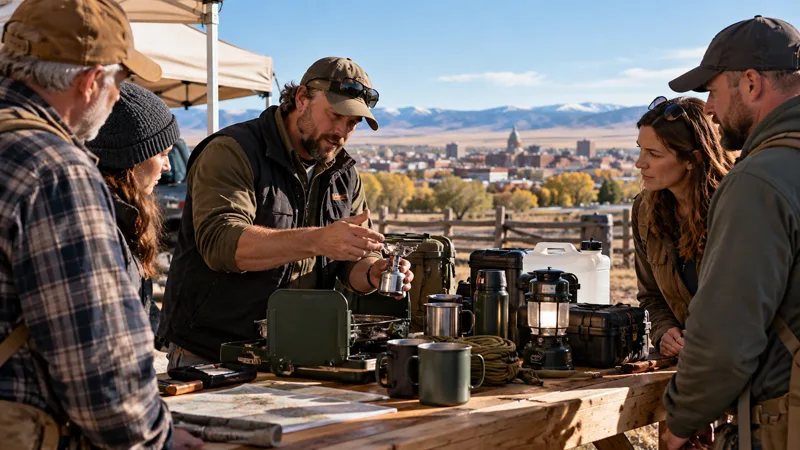
Cheyenne's recorded expo date and what remains unverified
Cheyenne Prepper Expo is recorded in this listing for November 7, 2026, in Cheyenne, Wyoming, USA. As of October 7, that date is upcoming. The original source link is the PrepperShowsUSA homepage, rather than a dedicated organizer registration page. An independent current organizer page confirming this particular expo, its venue, or its admission arrangements was not located during this review. Treat the recorded date and city as leads that require confirmation, not sufficient grounds for a nonrefundable journey.
This distinction matters because an expo is a specific gathering, while a city name is only a broad destination. Before making plans, obtain the organizer's identity, exact venue, event hours, contact information, registration route, and cancellation policy from a reliable current source. Ask whether the name refers to a public expo or a different type of activity. No exhibitors, speakers, classes, ticket prices, or certifications are established here. The preparation guide below is independent advice for evaluating household readiness and vendor claims.
Start with an ordinary disruption in an ordinary household
Useful preparedness begins with a concrete situation. Imagine that electricity stops during the evening, roads become difficult, and the next day's appointments are uncertain. Which household tasks fail first? Someone may need a charged phone, a powered medical device, a warm place to sleep, water for an infant's food, or transport to work. A single imagined scenario reveals more than a long shopping list because it forces you to connect supplies with people and routines.
Write the sequence in plain language. The lights go out; you retrieve a lantern; you check official information; you contact a family member; you decide whether remaining home is suitable. Now examine each transition. Is the lantern accessible? Does the information source depend on the router? Does the relative know the agreed check-in method? Is there a reachable destination if the house cannot remain comfortably occupied? These are the gaps to investigate at any preparedness expo you eventually attend.
Wyoming travel adds another planning layer, but do not infer a particular forecast from a November date. Evaluate the actual route and current conditions when travel is confirmed. A household in town and a household separated from services by a longer drive will face different dependencies. The same product may therefore have different value. Your situation should decide which questions receive time at a booth.
Create a needs sheet vendors can answer
A needs sheet is a short description of the job you want equipment to perform. For lighting, state the room size, desired portability, storage location, and who will operate it. For communications, identify the people who must receive information and the systems they already use. For water storage, consider available space, container handling, and the household's ability to inspect and rotate supplies. The sheet should capture constraints, not just desired features.
Bring measurements where they help. The width of a storage shelf can matter more than the color of a container. The weight a family member can safely lift can rule out a large filled vessel. A rechargeable device can be convenient if you already maintain compatible chargers, while replaceable batteries may suit another household's routines. Neither arrangement is inherently superior. Compatibility and upkeep determine whether the device will remain ready.
Include two questions that expose limitations: “What does this not do?” and “What must I already have for it to work?” A seller's answer can reveal required accessories, a subscription, a replacement part, a power supply, or a restricted operating environment. Ask for written instructions and specifications. If the answer depends on a medical requirement, building installation, or legally regulated use, seek the relevant qualified professional rather than treating a sales conversation as authoritative advice.
A power display is not a household energy plan
Portable power equipment can look reassuring because its capacity is presented as a large number. The practical question is whether it supports your intended appliance for the required period under its manufacturer's conditions. Record the appliance's actual specifications, operating pattern, and startup needs. Ask the seller to explain the difference between storage capacity and output capability in ordinary language. Avoid assuming that a device shown powering one small item can operate a room heater or an entire house.
Distinguish essential loads from comfortable extras. Keeping communications available is a different task from supplying every appliance. If a medical device is involved, ask its clinician, supplier, or manufacturer for an appropriate contingency plan. A generic power product demonstration cannot establish suitability for treatment. Likewise, connecting power equipment to household wiring belongs with a qualified electrician and approved equipment, not an improvised cable arrangement learned from a booth conversation.
Combustion equipment introduces additional hazards. The National Weather Service winter-preparedness guidance warns about carbon monoxide and unsafe alternative heating during outages. Follow current manufacturer and public-safety instructions; never operate a generator inside an occupied building or attached garage. A safe outdoor operating location, maintenance, fuel handling, and protection from weather all need consideration before purchase. Battery lighting is a simpler first improvement for many households.
Assess food systems by usability rather than shelf appearance
Food displays often emphasize longevity, package size, and dramatic scenarios. Ask how the product fits a week of real household meals. Who can eat it, how much preparation does it need, and what water, heat, utensils, and cleanup does it require? A meal that depends on several missing resources may offer less immediate value than familiar foods requiring little preparation. Special diets and allergies belong in the decision from the outset.
A practical buying test is to obtain a small quantity and use it under ordinary conditions before committing to a large supply. Evaluate taste, packaging access, portion size, and compatibility with other food. Do not conduct an unsafe deprivation exercise. The purpose is to learn whether the food is useful, not to prove toughness. Keep manufacturer storage instructions and an inventory that supports rotation. A cupboard full of items nobody tolerates is a weak food system even if the labels promise a long shelf life.
Think about those who may be absent during an outage. A teenager arriving home alone should be able to locate and prepare an appropriate snack without opening unfamiliar equipment. A visiting relative may not know where utensils are kept. Written labels and familiar packaging can make supplies more useful. Food readiness is partly a household communication problem, and that problem can often be improved without expensive purchases.
Water questions should separate source, storage, and treatment
These are different jobs. Stored water provides a known reserve; containers determine how that reserve is handled; treatment equipment addresses particular problems with a water source. Ask sellers to identify exactly which job a product performs. A filter's presence does not prove that any available water can be made suitable for drinking. Follow public-health advice, local advisories, and product instructions rather than extrapolating from a clear-looking demonstration sample.
For household storage, discuss the everyday practicalities: filling, carrying, pouring, cleaning, access, and inspection. A person with limited hand strength may need a different arrangement than the one displayed. Containers kept in a vehicle face conditions unlike those on an indoor shelf. Store only as directed by the manufacturer and appropriate public-health guidance. Do not repurpose an unknown chemical container because its shape appears convenient.
For an expo comparison, write down the source-water assumptions, replacement schedule, consumable availability, and freezing or storage limitations described by the manufacturer. Request the relevant documentation and review it later. Avoid selecting a treatment device solely because it is small or heavily advertised. The right choice depends on the actual hazard and intended use, sometimes requiring advice beyond a product seller.
Plan communications that the household will actually use
The Ready.gov preparedness site links household planning, emergency information, and supplies. Use that general framework to review your own communication arrangements. Who receives alerts, who checks on someone living alone, and where is the contact list if a phone becomes unavailable? A battery radio can support information access, but it does not replace knowing which official sources cover the place you live.
Practice a calm check-in during an ordinary week. Ask family members to find the agreed contact information and send a simple status message. Observe difficulties rather than blaming anyone. Small text, forgotten passwords, inconsistent names, and a device left uncharged may all interfere. Change the plan so that it fits the people, including language and accessibility needs. Written instructions can help, but they must be short enough to use under stress.
Keep privacy in mind when speaking at an expo. You need not disclose the location of stored valuables, detailed medical information, or an entire household schedule to receive product guidance. Describe the requirement at an appropriate level. For example, asking about accessible controls does not require explaining a person's diagnosis to every exhibitor.
Use an expo visit as a comparison exercise
If the Cheyenne event is independently confirmed, allocate time to evaluate similar products and ask consistent questions. Record the seller, model, documentation link, total cost, replacement requirements, and unresolved issue. Take time after the event to compare the notes. A strong presentation can be enjoyable without settling whether the product is right for you. Purchase pressure should not substitute for evidence or an understood need.
Arrange the visit around practical constraints: parking, accessibility, breaks, food, and the return drive. Confirm whether demonstrations require reservations and whether children may participate before bringing a family. Keep a small notebook and a charged phone rather than packing a wilderness kit for an indoor event unless the organizer requires it. The event's category does not establish its venue or activities.
The first useful action is therefore verification. November 7, 2026, and Cheyenne remain the recorded facts of this listing, but the missing organizer confirmation is a material limitation. While resolving that uncertainty, a household can still map dependencies, rehearse communication, and make targeted improvements. Those steps turn preparedness into work that supports real people, regardless of whether this particular expo ultimately fits your plans.