
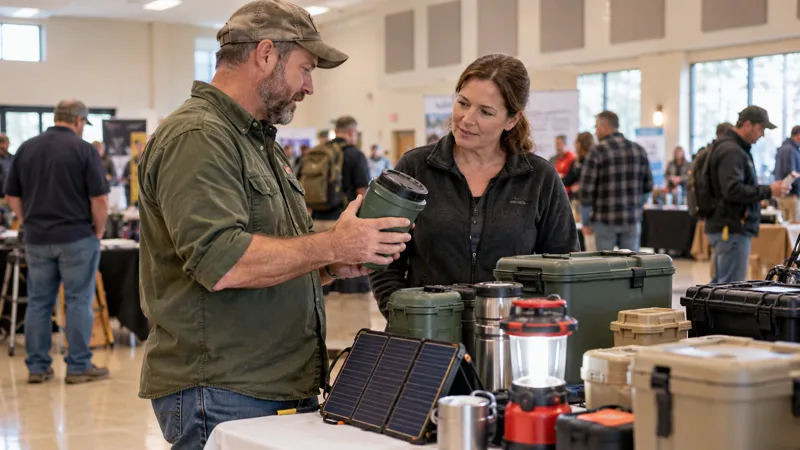
Kearney Prepper Expo is recorded for October 17, 2026, in Kearney, Nebraska, USA. It is upcoming as of October 7. The original PrepperShowsUSA source shows the event on October 17. Its individual event page contains conflicting date information: the descriptive text says October 17–18, while the date field shows October 17 only. Confirm the final duration and hours directly before planning attendance on either day.
That page identifies Buffalo County Fairgrounds, 3807 Avenue N, Kearney, Nebraska 68847, and gives descriptive hours of 9 a.m.–5 p.m. on the first day and 10 a.m.–4 p.m. on the second. Treat those as source information requiring confirmation, not as a resolved schedule. The listing does not establish current exhibitors, speakers, admission prices, or specific classes. The independent guide below is about making useful comparisons at a preparedness expo without letting the variety of products decide your household priorities.
Bring a problem statement rather than a shopping list
Before visiting, describe one or two practical problems in your home. Perhaps lights are difficult to find during a power interruption. Perhaps the household has food but no clear way to prepare it under the relevant conditions. Perhaps an older relative needs an easier way to receive alerts. A problem statement tells you what a product must achieve. A shopping list based only on product names can make every attractive demonstration feel like a reason to buy.
Write the setting beside the problem: apartment, detached house, vehicle, workplace, or travel. Add who will use the item, where it will be stored, and how often it will be maintained. These details affect suitability more than the broad label preparedness. An item that works well for a hobbyist who enjoys frequent maintenance may not suit a household that needs simple controls. The aim is to leave with clearer choices, even if that means making no purchase at the event.
Resolve logistics before comparing equipment
Because the source's date fields disagree, confirm the expo's actual days, opening hours, and admission arrangements. Ask about parking, accessibility, payment methods, re-entry, and any restrictions on bags or equipment. A fairgrounds address does not identify the exact building or entrance. Obtain that detail if you need a particular drop-off point or an accessible route. If a workshop interests you, ask whether it has separate registration or limited capacity rather than assuming entry includes it.
Plan the day at a realistic pace. Allow breaks and time to review notes away from the busiest areas. If several household members are attending, agree which questions each person will ask and how you will reconnect. Keep a source contact available for unexpected changes. The event category does not establish camping or overnight facilities. Book travel or accommodation only after the schedule is resolved, particularly if the trip depends on a Sunday program.
Ask what a demonstration actually proves
A booth demonstration can show how controls feel, how an item is assembled, or how large it is. It rarely reproduces every condition in which you might use it. Ask which assumptions make the demonstration successful: a charged battery, a particular water source, level ground, calm weather, or an operator with experience. Understanding those assumptions makes the display more useful. It also prevents a polished presentation from becoming evidence of performance that was never tested.
Request product documentation and inspect it later. Look for limits, maintenance requirements, approved uses, and any independent testing relevant to the claim. If an explanation depends on a technical term you do not understand, ask for a plain-language description. A good question is what the equipment does not address. The answer helps define the purchase more accurately than a broad promise of readiness. Keep claims and your own impressions separate in your notes.
Compare total ownership, not just the price tag
The initial price is only part of an equipment decision. Consumables, replacement batteries, proprietary cables, filters, fuel, repair parts, and storage needs can change the practical cost. Ask how often a part is replaced, whether common alternatives are compatible, and how to obtain service. A low price can be attractive while still creating a difficult maintenance burden. A higher price does not automatically prove durability or suitability either.
Consider how the item fits equipment you already own. Standard connections and familiar controls may simplify use, while a specialized system may offer benefits that justify learning something new. The tradeoff should be explicit. If you cannot explain why a feature matters to your household, take time to investigate rather than making a same-day decision. Keep receipts and written terms for any purchase, and read the return and warranty information rather than relying only on a verbal conversation.
Lighting provides a manageable comparison exercise
Lighting is a useful category for learning how to compare equipment because the household can describe the task clearly. Do you need to walk safely, find supplies, read instructions, or light a stationary area? A headlamp can free hands, a flashlight can be simple to share, and an area light can support a common room. The same device may not serve each job equally well. Handle the controls and consider the intended user's vision and dexterity.
Ask about battery type, charging requirements, replacement availability, and how brightness settings affect useful operation. Avoid comparing only the largest number on a package. Weight, accessibility, and accidental activation also matter. A bright light stored somewhere unknown is a weak household solution. After buying, place it consistently and teach others how it works. That final step may contribute more to actual readiness than moving to a more expensive model.
Power equipment needs a defined load
For backup power, identify the devices you need to support and obtain their actual requirements. A phone-charging need differs from refrigeration, household wiring, or essential medical equipment. Consult qualified professionals for installation and medically necessary power arrangements. Ask vendors to explain how their claimed capacity relates to your intended devices, connections, and operating time. Do not treat a general marketing statement as confirmation that an entire household can continue normally.
Fuel-burning generators present carbon-monoxide risks. The CDC's carbon-monoxide guidance is an authoritative safety resource; operate equipment only with appropriate outdoor placement and manufacturer directions, and seek professional help for electrical connections. An expo is not a setting to improvise installation advice. Battery systems also require appropriate handling, charging, storage, and compatibility. The useful comparison includes safe operation and maintenance, not just how impressive the equipment looks on display.
Food products must fit eating and storage routines
A shelf-stable food display can be appealing, but ask whether the household will actually eat the product and how it is prepared. Consider allergies, dietary needs, water requirements, cooking access, portion sizes, and storage space. Buy a small familiarization quantity before committing to a large supply where practical. A food system is easier to maintain when it connects with ordinary meals and rotation rather than depending on a separate menu nobody has tried.
Food safety remains important during an interruption. The FDA's outage and flood food-safety guidance explains why official instructions matter when refrigeration or contamination is involved. Do not rely on tasting questionable food or a vendor's general preparedness slogan. For personal medical dietary requirements, seek appropriate professional advice. The purpose of comparing food is dependable nourishment, not simply accumulating the largest number of packages.
Water devices deserve questions about limitations
If you examine treatment products, ask what hazards the method is designed to address and what it cannot remove. Request the manual and relevant testing information. Different methods can have different applications, maintenance tasks, and container requirements. Avoid assuming that a clear demonstration liquid represents the water you may encounter. A product's suitability depends on the source and official guidance, not merely on an appealing description of versatility.
Also compare the less dramatic parts of water planning: container weight, ease of cleaning, closures, storage instructions, and who can lift or pour from them. A large container can reduce the number of units to inspect but create handling difficulties. Smaller containers may be easier to share while requiring more organization. Seek qualified guidance for uncertain treatment decisions and follow local public-health notices. A vendor conversation should help you identify what needs verification, not replace that verification.
Training claims are different from product claims
An expo may advertise educational activity, but a short presentation does not automatically provide competence or certification. Ask who is teaching, which experience or credentials are relevant, what supervised practice is included, and which limits apply afterward. A first-aid demonstration can help you identify further training needs; it should not be treated as permission to perform unfamiliar medical procedures. Professional instruction and appropriate recognized courses remain important for health and safety subjects.
Similarly, tool, electrical, food, or communications topics may involve specialized knowledge and rules. Learn the scope of the session and seek current authoritative guidance when the question requires it. Record the instructor or organization so you can verify details later. Be cautious about turning a brief anecdote into a household rule. The most productive education often leaves you with a better question and a reliable place to seek the answer.
Finish with a decision you can explain
After the visit, sort notes into confirmed facts, vendor claims to verify, and your own observations. Choose the next action that addresses the original household problem. It might be testing an existing light, labeling supplies, arranging professional advice, or purchasing a specific item after comparison. Assign time for learning and maintenance if you buy something. Equipment left unopened or unfamiliar does not deliver the benefit imagined at the booth.
Retain the Kearney listing's October 17 date while resolving the source's October 17–18 descriptive range directly. Confirm the fairgrounds entrance and any program details before traveling. A worthwhile expo visit does not require filling a vehicle with purchases. It can leave you with clearer priorities, a more informed comparison, and one practical improvement that the household knows how to use.