
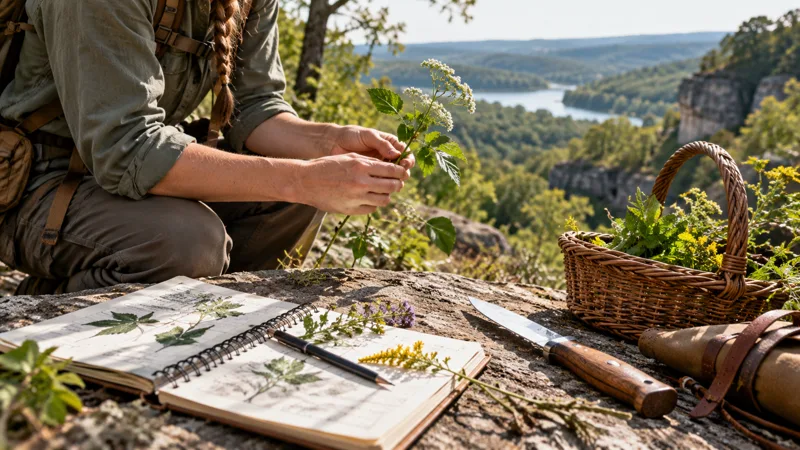
The Wild Crafter: archived September 5–7, 2026 session
The Wild Crafter was listed for September 5–7, 2026, in Lebanon, Missouri, USA. Those dates have passed as of October 7, 2026. This is an archived event listing and must not be used as confirmation of current availability. The original source was the September FeralSkills listing. The corresponding Sigma 3 Survival School course page independently names September 5–7 as a 2026 session in Lebanon.
The school's page also names October 27–29, 2026, as a separate fall session. That later range does not replace the archived September dates here. Anyone interested in a later class should confirm current arrangements directly with the school. Its general description centers on plant knowledge and practical applications, but this listing does not verify what an individual participant experienced, certify competence or endorse health claims made in promotional material.
Plant learning starts with uncertainty
The independent guide below is about becoming a more careful student of plants and materials. It is not a species identification guide, a recipe collection or an herbal treatment manual. A useful beginner skill is learning to say what remains unknown. Seeing a familiar leaf shape is a starting observation, not proof of a plant's identity, food safety or suitability for a particular person.
That distinction changes the way a student approaches a class. Instead of asking only which plants are useful, ask how a qualified instructor reaches an identification and which evidence could overturn it. A learning goal might be recognizing several kinds of observable features and recording them clearly. The goal should not be returning home with a list of plants that you now assume can be eaten wherever they appear.
Create a field record instead of a memory test
A notebook can preserve the details that memory compresses. Record the observation date, general habitat, visible features and the questions that arose. Photograph only where permitted, and ask an instructor which views are helpful without disturbing the plant. Keep the record organized enough that a later reviewer can understand what you saw. A close photograph without context may leave an identification question unresolved.
Separate the words “observed,” “suggested identification” and “confirmed under instruction.” These labels make the notebook honest. If two observations seem similar, retain their differences rather than merging them because a name feels plausible. The habit is broadly useful for natural history: good records allow you to learn from uncertainty instead of hiding it behind a confident label.
Ask about lookalikes without building your own shortcut
During qualified instruction, ask what features distinguish an example from confusing alternatives and what cannot be decided from a photograph. Avoid inventing a rule based on one memorable characteristic. A statement about a family, a habitat or a seasonal appearance can help organize study, but it should not become a private test for whether something is safe to consume.
For later practice, choose observation-only walks with reliable field references and appropriate expert support. Bring ordinary food and water so the exercise never depends on collection. Keep uncertain specimens untouched, and avoid taste testing or home experiments intended to prove safety. This preserves the learning opportunity while removing pressure to transform an incomplete identification into a meal.
Understand permission before gathering
Knowing a plant's name does not establish a right to remove it. Land ownership, protected areas, permits and local restrictions can all affect what is allowed. Ask the land manager or owner about the specific activity before taking materials. Permission for a supervised class on one site should not be assumed to extend to another location, another season or independent practice afterward.
The National Park Service discussion of leaving what you find explains why natural objects belong to a living place rather than simply being free craft supplies. Flowers, fallen materials and other items can support ecological functions and other visitors' experience. Use that principle as a reason to prefer photographs and notes unless a permitted, responsibly supervised activity specifically requires collection.
Choose a non-ingestion learning goal
Plant interests need not lead immediately to food or medicine. A student can study observation, vocabulary, habitat, historical uses or a craft using legally obtained material. These paths still require appropriate instruction, but they can make progress visible without asking the learner to assess ingestion risks. Choose a goal small enough to explain clearly and revisit safely.
For example, a craft learner might focus on documenting how an instructor evaluates prepared material for a demonstration. That does not establish that the learner can harvest or prepare the same material independently. They can practice a permitted technique using supplied materials and ask for feedback on their work. Keeping the supply decision separate from the hand skill avoids combining several unfamiliar tasks into one unsupervised experiment.
Handle tools as a separate training subject
If a future class involves cutting or processing tools, ask about required equipment and supervision before bringing anything specialized. A familiar-looking tool can still be inappropriate for the lesson or the participant's experience. Follow the organizer's handling rules, stop when attention is compromised and request instruction before trying an unfamiliar movement. This article provides no cutting procedure.
Before travel, inspect only the normal service condition of equipment you are already trained to use, following its instructions. Pack it in the required protective arrangement and keep it separate from casually accessed supplies. The learning focus is reducing avoidable handling problems, not showing how much equipment you own. A notebook, comfortable clothing and a clear question may contribute more to the day than another specialized tool.
Do not equate natural with medically suitable
A course description about plant remedies should not be interpreted as medical advice for every participant. Discuss health questions, allergies, interactions and any proposed use with an appropriate clinician or pharmacist. Do not replace prescribed treatment or delay necessary care because a demonstration sounded convincing. The ability to observe a historical or craft process without adopting a medical claim is a valuable boundary.
If you have personal concerns about contact or ingestion during instruction, raise them privately with the organizer in advance and ask whether observation is possible. An informed choice requires knowing what participation involves. It does not require disclosing private health details to other students. Keep medical records and medication arrangements separate from a general learning notebook that may be shared.
Make outdoor comfort support attention
Field learning can involve standing, moving slowly, bending or writing outside. Ask the organizer about the expected setting, access, breaks and physical demands for a future session. Choose suitable clothing, familiar footwear and ordinary provisions according to current requirements. Avoid assuming that the word “craft” means an indoor workshop or that the regional location identifies every activity site.
The National Park Service Ten Essentials offers a general framework for outdoor supplies. Adapt that framework to the verified class requirements rather than treating it as a complete packing list. Test your notebook arrangement, light and clothing in a modest setting near home. Removing minor discomfort helps you pay attention to instruction and ask better questions.
Keep local knowledge local
A lesson delivered in Missouri should not create confidence that similar-looking plants elsewhere have the same identity, availability or permitted use. When traveling to another region, begin again with local sources and qualified instruction. Record the place associated with an observation so that the notebook does not become a collection of decontextualized names. A comparison is a question to investigate, not proof that knowledge transfers unchanged.
Season also affects what can be observed. A plant record made in one part of the year may show features that are absent later. Instead of guessing from an incomplete view, note what additional evidence or professional review would be needed. This makes repeated observation useful while keeping the decision boundary clear: an unresolved identification stays unresolved.
Review learning without overstating ability
After a supervised session, choose three notes: one observation you can describe accurately, one technique you practiced with feedback and one uncertainty that needs further study. Avoid presenting these as a qualification to teach others, recommend treatment or lead a foraging outing. A short course can begin a learning process without completing every assessment required for independent competence.
If you share photographs or notes, include the context and uncertainty. Do not caption a specimen as safe food simply because you remember it from class. A useful shared record may invite expert review or describe a permitted observation exercise. It should not encourage a friend to collect and ingest something based on a brief message.
What this archive preserves
This listing retains the September session's name, date range, location and source trail. It does not function as a reservation page for the separate fall session or a guarantee about future teaching arrangements. For later participation, verify the exact site, equipment requirements, food and lodging arrangements, accessibility and policies directly with the school.
The durable value of wildcraft learning lies in patient observation and well-defined boundaries. Knowing what to ask, what to leave in place and when to seek a qualified opinion can be more useful than memorizing a long list of possible uses. Approach the subject as a continuing study supported by responsible instruction, careful records and respect for both the landscape and personal health.
Store records so they remain useful
Back up field photographs and connect each image to its notebook entry while the observation is still recent. Keep uncertain records in a clearly marked group so they cannot later be mistaken for confirmed examples. If a qualified reviewer corrects a name, retain the correction and the reason rather than silently replacing the original note. This preserves the learning history and shows which feature changed the conclusion. Over time, the record can reveal recurring observation gaps that deserve attention in your next supervised lesson.