
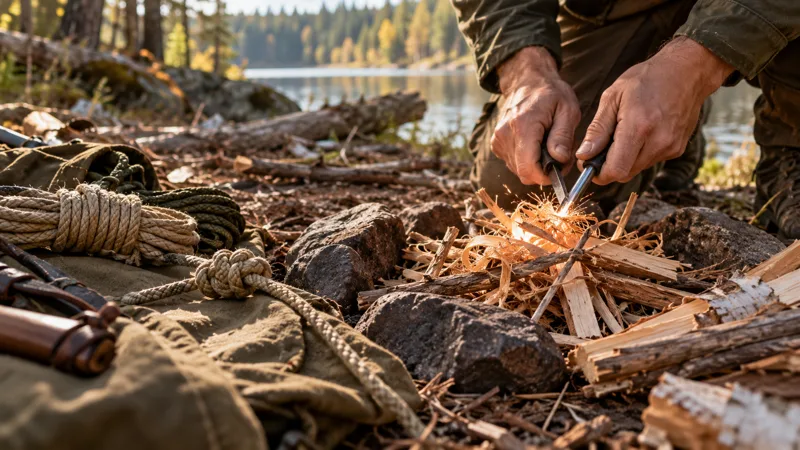
Archived event: These dates have passed as of October 7, 2026. This page retains the original listing for reference; consult the provider for later offerings.
Knots & Fire Mastery Workshop was listed for October 3, 2026 in West, MI, USA.
This is an archived event listing. These dates have passed; do not use this page as confirmation of a future edition.
Event details
- Dates: October 3, 2026
- Location: West, MI, USA
- Type: Primitive Skills
View the event source and registration information
Read the workshop as an archived introduction
Knots & Fire Mastery Workshop was listed for October 3, 2026, in West, Michigan. The date has passed, and this page is an archive. The directory identifies Arcturus Primitive Skills Institute and links to its website. At the time of review, that provider link displayed a suspended-account page, so readers should obtain independent current contact and enrollment confirmation before planning another offering. The entry's town field is not a complete venue address. The guidance below is an independent study framework. It does not establish future availability or provide unsupervised fire-building and load-bearing rope instructions.
Two subjects in one workshop invite a useful question: what does “mastery” mean in the actual teaching context? A title may express ambition, while a single session can only introduce or develop selected skills. Ask the provider what participants will observe, practice under supervision, and be expected to understand afterward. Keep those outcomes separate. You can learn valuable principles without becoming competent in every application. This distinction is especially important for tasks where a small mistake can create a serious hazard. Reliable judgment includes recognizing what a short workshop did not teach you.
Name the task before selecting a knot
A knot is part of a task involving a particular material and purpose. Before learning names, ask what problem the instructor intends the example to solve. Is the lesson about an ordinary camp organization task, a demonstration of a principle, or another defined use? The answer matters. Do not transfer an example into climbing, rescue, securing a person, or another consequential application without specialized qualified instruction. A casual workshop and a professional standard are different contexts. A memorable name or a neat finished shape does not establish suitability for every situation in which rope appears useful.
Write the purpose beside the knot's name in your notes. Include the material used, the instructor's qualifications about its use, and the inspection points actually taught. If you cannot explain the intended application, ask before continuing. This makes the lesson more concrete than a list of knots to memorize. It also helps you recognize when a later task differs from the demonstration. The useful question is not “Which knot do I know?” but “What requirements does this task have, and do I have the appropriate instruction to select and use a connection responsibly?”
Learn to describe a result without trusting appearances
A finished example can look tidy while a beginner still misunderstands the process. During supervised practice, ask the instructor to check your work and explain what they are inspecting. Take notes about the checks rather than treating approval of one attempt as permanent competence. If you make a mistake, record where it occurred and how the instructor identified it. You are learning a verification habit. Do not assume that a photograph of the correct example will let you identify every error later, especially if the material or intended task changes.
Use permitted low-risk practice exercises recommended by the instructor, and keep their limitations attached to the notes. Avoid testing a connection by putting a person or valuable equipment at risk. A beginner's review can focus on vocabulary, material familiarity, or the ability to explain the lesson. If your intended use becomes more consequential, obtain the relevant specialist training rather than stretching a simple workshop exercise beyond its scope. The point of a careful introductory record is to prevent an attractive demonstration from becoming an unsupported promise that you can now handle every rope-related situation.
Fire learning begins with permission and conditions
Before any fire activity, the responsible instructor must establish what is allowed at the site and how the exercise will be supervised. A course registration does not grant general permission to make a fire elsewhere. Land managers and local authorities may impose restrictions, and the applicable rules can change. Ask how the provider verifies them and which activities are canceled or modified when conditions are unsuitable. Learning to accept that decision is part of responsible participation. A demonstration that cannot proceed safely is an opportunity to discuss alternatives, not a challenge to find a loophole.
This article does not supply an ignition procedure. For practical instruction, use the provider's supervision and the relevant land manager's current guidance. Record the decision-making questions: what permission is required, what conditions matter, who is responsible, and how the area is left safe afterward? These questions connect the subject with real responsibilities. They are more useful than measuring success only by whether a flame appeared. A responsible learner understands that the surrounding site and other people matter throughout the activity, including the period after the most visible part of the lesson is complete.
Keep fuel, tools, and personal gear within class rules
Ask the provider what materials and equipment students should bring. Do not add an unfamiliar tool or substance because it appears in an online demonstration. The instructor may have selected particular materials to support the teaching method and control the exercise. Substitutions can change those conditions. If you already own equipment, describe it and ask whether it is appropriate. Keep personal items organized so that they do not enter an active work area accidentally. A clear separation between ordinary pack contents and class materials makes supervision and clean-up easier for everyone involved.
If the provider supplies materials, handle them only as directed and return unused portions according to the event's procedure. Ask which observations are important before beginning and what indicates that a material is unsuitable. You do not need to gather anything from nearby land to answer those questions. Collection rights are separate from learning permission. Record the origin and condition of teaching materials if the instructor says it is relevant. That record helps explain why an exercise behaved as it did without encouraging you to repeat it with whatever unfamiliar material you find elsewhere.
Look for the common planning principle
Knots and fire appear to be different subjects, but both can teach the same disciplined sequence: define the task, verify the conditions, select appropriate materials, follow supervised instruction, inspect the result, and recognize limits. This sequence is an editorial way to organize learning, not a substitute for the provider's actual procedures. Use it to ask where your understanding is incomplete. You may know the middle action yet have no idea how to assess the beginning or end. That gap deserves attention before independent practice, especially when the consequences of a mistake extend beyond an untidy project.
During the workshop, compare how the instructor handles uncertainty in each subject. Do they pause to inspect a component, ask for clarification, or change the exercise when circumstances differ? Those behaviors can be as instructive as the technique itself. Write down one decision that surprised you and ask about the reasoning. A learner who remembers why a plan changed gains a transferable habit. A learner who remembers only the original plan may reproduce it later without noticing that the circumstances that made it appropriate are absent.
Arrange your notes for review rather than display
Keep a compact set of notes for each subject with clearly labeled questions. Do not fill gaps in memory with plausible instructions from another source. A mixed record can make it impossible to tell what the instructor actually taught. If you photograph a demonstration, ask permission and identify who made the example. Separate that image from your own attempt. Include the date and context. A notebook is a tool for accurate follow-up, not evidence that you have mastered a subject. It should make uncertainty easier to find, not hide it behind confident wording and attractive pictures.
After the session, ask the provider which parts can be reviewed independently and which require supervision. A suspended website may complicate finding later course information, but it does not justify guessing. Use a verified contact or wait until the provider's current arrangements can be established. For practical fire rules, consult the relevant authority for the actual place and date. For consequential rope applications, seek the appropriate specialist instruction. Keep those sources distinct. A workshop listing, a land-use rule, and a professional training standard answer different questions even when all concern outdoor activity.
Let patience replace a speed contest
Repeated practice can become a race to reproduce an example quickly. Before pursuing speed, ask whether you can explain the purpose and verify the result. A slower correct understanding is more useful than a fast movement performed without context. If you find yourself making the same error, ask for a different explanation instead of simply repeating it harder. A controlled lesson gives you access to feedback; use that advantage. Comparing yourself with someone who has practiced for years rarely identifies what you need to change. A precise observation and a focused question are better tools.
The same restraint applies to choosing the next challenge. You do not need to increase difficulty immediately after a successful supervised attempt. Ask how an instructor recommends progressing and what conditions must remain in place. A small low-risk review may be the right next step. If a subject turns out to be more complex than expected, that is useful information rather than a disappointing result. The archived October workshop can still introduce readers to that learning path without pretending a past registration remains open or that an ambitious title removes the need for continued qualified guidance.
Evaluate the outcome by what you understand
A meaningful after-class review asks whether you can describe the task, explain a material choice, name a limitation, and identify the appropriate source of further help. Those are practical outcomes. You may also discover that you should retire an unsuitable item, clarify a permission question, or seek a different course for your intended application. Record the action and a realistic time to address it. This keeps the learning connected to responsible decisions instead of ending with a claim that you attended a “mastery” workshop and therefore no longer need to ask questions.
Keep the event's original October 3 date, Michigan location field, and source link attached to the archive. Treat current provider availability as something to verify, particularly while the linked site is unavailable. The editorial lesson remains useful: select a task, preserve the limits of instruction, respect permissions, and review accurately. These habits support both subjects without offering risky shortcuts. A successful learner leaves better able to recognize the questions that matter and less likely to confuse a neat knot or a brief demonstration with universal readiness for every outdoor situation.