
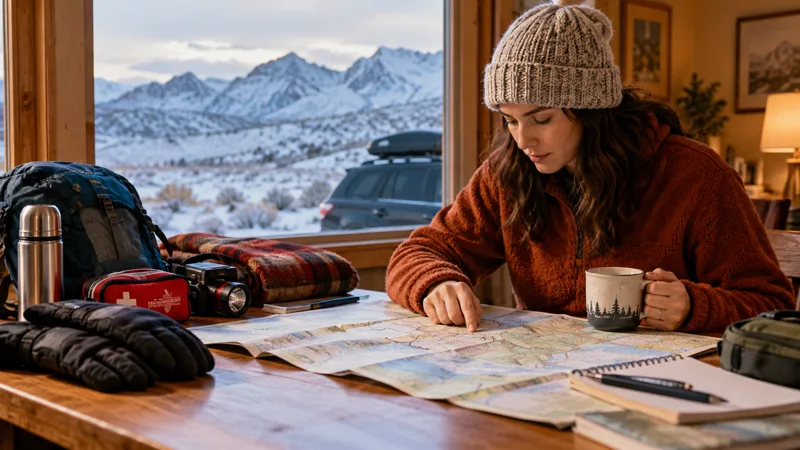
Winter Storm Awareness in Nevada: plan for the entire route
Winter Storm Awareness is listed in the supplied Survival Scout record for November 15–December 31, 2026, in Nevada, USA. The original link leads to the National Weather Service winter safety resource. That page supports weather education but does not, by itself, establish a Nevada meeting, registration process, or scheduled series of classes. Retain the listed awareness period as a planning reminder and confirm any local campaign dates through current official announcements. The following discussion is an independent travel and household readiness guide, not an organizer's promised curriculum.
A statewide weather label can hide the practical differences between home and destination. A person may begin a journey in conditions that feel ordinary and finish somewhere much colder or less accessible. The useful planning unit is the route, including the places where a delay might occur. You do not need to predict every possible winter problem. You need enough information to recognize when the original trip no longer fits the forecast, your vehicle, or the needs of the people traveling with you.
Describe the trip in terms of exposure
Start by writing three simple facts: where you will travel, when you expect to return, and how long you could reasonably wait if the trip is interrupted. A short local appointment and a long drive to a mountain destination are different undertakings even if both are called a day trip. Add the expected walking portion. A vehicle may deliver you to a parking area, but it cannot keep you comfortable during an unexpected walk, a building closure, or time spent waiting for another ride.
Ask whether everybody in the group has an appropriate option if the destination becomes unavailable. A confirmed reservation, another staffed destination, or permission to postpone may be more useful than another piece of gear. Avoid a plan that depends on finding an open business by chance late at night. Think of your itinerary as a set of commitments that can be adjusted. A clear alternative makes changing direction easier before you have invested fuel, daylight, and emotional energy in reaching the original goal.
Check information at the scale of your journey
Review official forecasts for the destination and relevant locations along the route, rather than looking only at a home screen weather icon. Save the state transportation agency's current road information resource and learn how it presents closures or restrictions. The exact information system can change, so verify the current official service before departure. A forecast describes anticipated conditions; a road report describes the transportation situation. Neither is a guarantee that a particular vehicle or driver can safely complete a journey.
Choose a review time that allows action. Looking at the forecast once after packing does not help much if leaving has already become a fixed expectation. Recheck before departure and make another review part of the return plan. If you are hosting visitors, share that arrangement in advance. Guests should know that postponement is acceptable when their route is affected. Hospitality includes removing the pressure to arrive on time at any cost, particularly when people are unfamiliar with the area they are crossing.
Create a turnaround decision that everybody understands
A group needs an agreed reason to stop pursuing the destination. It might be an official closure, conditions beyond the driver's comfort, an unexpected delay that consumes the available daylight, or a vehicle problem. State that threshold plainly before leaving. The purpose is not to write a universal winter driving rule. It is to make sure that one person's concern will be heard rather than dismissed because everybody else is eager to continue. A destination will still exist after a postponed trip.
Discuss who has authority to change plans when several households travel together. Following another vehicle can create false confidence, especially if the first driver's equipment and experience differ. Each driver should retain the right to stop or return. Share the meeting location and contact method, then accept that the group may arrive at different times or not arrive at all. Good coordination reduces confusion while preserving individual judgment; it does not require everyone to copy the most confident person's choice.
Pack around a realistic delay
Use the National Weather Service winter preparation resource as a starting point for home and vehicle readiness. It emphasizes the possibility of disrupted heat, power, communications, and access to supplies. For your own journey, translate those broad concerns into specific needs. An extra layer has a clear use if you must wait in a cool building. A charged power bank helps when updating relatives. A written address and contact number remain readable when a phone is unavailable. Supplies should support your actual itinerary.
Personal requirements deserve space before specialized gadgets. Consider routine medication timing, glasses, mobility equipment, food restrictions, and childcare needs. Keep these items where the responsible person can access them. If the group changes vehicles, transfer essentials deliberately rather than assuming another driver carries the same supplies. A winter kit is not proof that travel is safe. It is support for a delay after a careful departure decision, and it should never become the justification for ignoring a closure or warning.
Separate vehicle maintenance from shopping
Arrange inspection or maintenance according to the vehicle manufacturer's guidance. Ask a qualified technician about anything you do not understand, especially a warning light, worn tires, poor heating, or compromised visibility. Buying accessories cannot resolve an unreliable vehicle. Make sure the driver knows the controls and can use ordinary functions without searching through a manual during a stressful situation. Put the manual in the vehicle and review unfamiliar features before the season rather than discovering them on a difficult road.
Keep a written maintenance note with the date, issue, and next action. This is particularly useful when several family members share the car. “Somebody checked it” is not a dependable maintenance record. Review roadside assistance contact details and the terms of your coverage. Do not assume that every location or type of service is included. If the plan depends on assistance, understand how to request it and what information you will need to give. Clarifying those details at home is easier than doing so during a breakdown.
At home, identify the first dependency to fail
Winter household planning begins with the services your everyday routines depend upon. Heating, lighting, water access, communications, and transportation may all be involved, but the consequences differ between homes. Walk through an ordinary evening and imagine that the power is unavailable. Which task becomes difficult first? Preparing a meal, reaching an upstairs room, or charging a medical device may be the immediate issue. Record the answer and seek a suitable backup rather than buying a generic bundle of supplies.
Have fuel burning equipment installed, inspected, and used according to manufacturer instructions and applicable professional guidance. The National Weather Service warns against running a generator in an enclosed space. Do not improvise an indoor heat source from equipment intended for outdoor use. If a proposed backup requires installation or electrical work, arrange qualified help. Household resilience is strongest when the alternative has been safely prepared and understood; an unfamiliar appliance brought out during an outage introduces a separate problem.
Help visitors interpret unfamiliar conditions
A visitor may judge a journey by the weather at an airport, hotel, or city center. Give them practical context without pretending to provide a live road forecast. Send the destination address, the official forecast and road resources, and your preferred procedure for postponement. Tell them when you will check in. If an activity requires outdoor clothing or footwear, say so before they pack. A brief, accurate message can prevent a family from arriving with assumptions that do not fit the planned outing.
Do the same when you are the visitor. Ask the host about transportation access, parking, and the consequences of cancellation. Confirm whether the activity is actually outdoors or whether you will only walk between buildings. Those details affect preparation more than an appealing photograph of the destination. Avoid relying on a social media comment from another season. Current official information and the host's current logistical instructions serve different roles, and both should be easy to find when you make the final travel decision.
Use the awareness period as a sequence of small projects
The listed November to December period gives you time to work through readiness without turning one weekend into a shopping marathon. In the first session, review contact information and alert settings. In another, inspect clothing and ordinary vehicle supplies. Arrange professional maintenance where needed. Then rehearse an interrupted trip with the household: who calls the destination, who informs relatives, and where does the driver wait? Keep each session short enough that everybody involved can participate and remember the result.
Record what you finish and what remains unresolved. A task awaiting another person's decision should not be mistaken for a completed plan. Before holiday travel, revisit the unresolved items and choose a simpler itinerary if necessary. After the first winter disruption, review actual experience: which information was useful, which supply was hard to reach, and which assumption proved wrong? That review turns the awareness period into a practical improvement in everyday judgment. The objective is a household that can calmly change plans, not a household that feels obliged to conquer every storm.
Further reading
Read the original National Weather Service winter resource and its before the storm preparation page. These resources explain hazards and readiness; consult current Nevada announcements to verify the listing's campaign period. See weather information and other event listings when planning your next activity.