
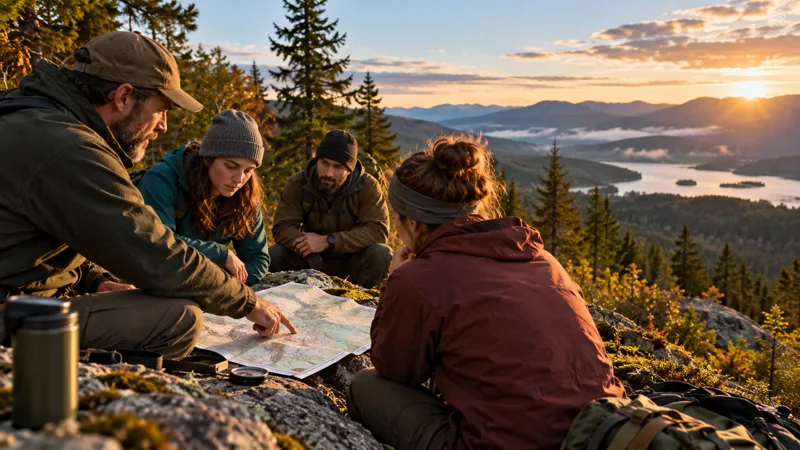
A wilderness weekend is a chance to improve group habits
Time outdoors with other people reveals problems that solitary gear practice cannot. One person may think the group is stopping while another keeps walking. A shared item may be carried by the person least likely to need it first. Everyone may assume that someone else saved the directions. These are ordinary coordination errors, not evidence that the group lacks toughness. A weekend learning environment can provide a reason to notice and correct them before they affect a more demanding outing.
This article accompanies the archived Wilderness Weekend 9/4–9/6 listing. The supplied record gives September 4–6, 2026, and leaves the location as “See event listing.” The source now marks the event concluded and likewise does not publish a location. Those dates are past as of October 7, 2026. The article offers an independent guide to partner learning and group preparation; it does not report what participants experienced or establish a curriculum for a future session.
Archived record, with the location unresolved
- Event title: Wilderness Weekend 9/4–9/6.
- Dates recorded: September 4–6, 2026.
- Location in this listing: See event listing.
- Category recorded: Bushcraft & Wilderness.
- Source: FeralSkills.
- Current source status at review: concluded listing retained for reference.
Read the archived source. The directory names Mountain Scout Survival School as the host but does not identify a published arrival location. Anyone considering another session should get the location, access instructions, and current terms directly from that session's organizer. Do not infer a campsite or overnight arrangement from the word weekend.
Discuss what a good weekend means to each person
Group preparation begins with expectations. One participant may want a demanding practical lesson while another wants an introduction at a comfortable pace. Neither goal is wrong, but the difference matters when choosing instruction. Have each person name something they hope to learn and something that would make participation difficult. Discuss these privately with the organizer as appropriate. A broad event title is not enough to decide whether the actual activities suit everyone.
Separate personal goals from group goals. Someone may want to improve a particular knot, while the group may want a clearer way to pause and regroup. Write both down. A weekend is easier to review when success is not defined solely by completing every activity. Asking a better question, observing safely, or understanding why a technique is unsuitable can also be progress. Those outcomes are especially useful for beginners who are still learning what they need.
Shared equipment needs a named owner
When a group shares gear, assign responsibility for carrying, checking, and returning each item. Ownership in this sense does not mean financial ownership; it means knowing who currently has the task. A shared light stored in a bag somewhere in the group is different from a light whose location everyone knows. Ask whether group arrangements are permitted for the course, since some organizers require individual equipment for instruction or safety.
Before a future outing, have the responsible person demonstrate where the item is and how it is accessed. Others should know how to ask for it without emptying bags or guessing. After use, return it to its agreed place. If responsibility changes during the day, say so clearly. This small handoff habit can prevent lost time and misplaced supplies, particularly when several similar bags or containers are gathered in the same work area.
Choose partners who can give useful feedback
A learning partner should be able to describe an observation without turning it into a judgment about your character. “You had to put the pack down to reach that pocket” is more useful than “you are disorganized.” Agree to focus on actions you can change. Ask permission before offering advice, and let the instructor resolve technical disagreements. A peer's confidence does not necessarily mean the peer understands the demonstrated method.
Take turns as learner and observer during activities where the instructor permits it. The observer can note sequence, access, and communication while the learner concentrates on the task. Keep the notes brief. Too much commentary can distract or interfere with supervision. Afterward, choose one observation to discuss and one improvement to try. A partner relationship should help each person notice detail, not create an audience that pressures people to perform beyond their ability.
Use a pause that everyone recognizes
Before entering a learning area or beginning a group exercise, ask the instructor how to signal a pause. Follow that procedure rather than inventing competing signals. Outside a course, agree on a simple way for any participant to request a stop and be heard. The phrase or gesture matters less than the agreement that it will receive attention. People should not have to justify discomfort while the rest of the group keeps moving.
When stopped, identify the problem before proposing a solution. A participant may need to adjust clothing, retrieve a personal item, or clarify directions. Ask what has changed and what options remain. Avoid treating every stop as an emergency; that can make people reluctant to speak. Equally, avoid rushing a person whose concern affects safe participation. A useful group habit makes small corrections normal, reducing the chance that an unspoken difficulty becomes more complicated.
Organize a work area, not just a backpack
Outdoor instruction often involves temporarily removing items from bags. Decide where unused equipment goes and how to avoid mixing personal belongings. Keep pathways and designated work areas clear, and follow the instructor's rules about tools and materials. A tidy arrangement is not about appearance. It helps participants see what is available, notice something missing, and concentrate on the lesson without stepping around avoidable clutter.
If permission is given to take notes or photographs, do so from an appropriate position. Do not move into another person's working space to get a better view. Ask the instructor where observers should stand and when questions are welcome. Respect other participants' privacy before photographing them. These habits make a class more useful for everyone and transfer well to group camping, where individual convenience must fit shared space.
Keep uncertainty visible
In a group, uncertainty can spread quietly. One person hears part of an instruction, repeats it with confidence, and another acts on the simplified version. Interrupt that process by saying when you are not sure. Repeat a key instruction back to the instructor when appropriate and ask for correction. A clear question takes less time than undoing a misunderstanding. The goal is reliable information, not looking knowledgeable to your companions.
Write your notes so that confirmed instruction and personal interpretation are separate. If you think a technique might work in another setting, mark that as a question for further learning. Do not present your inference as the instructor's advice. This distinction is particularly important for activities involving fire, edged tools, water, or unfamiliar materials. Their safe use depends on context that a quick note may leave out. Further supervised instruction is often the correct next step.
Pack with another person's access in mind
The National Park Service Ten Essentials provides a general framework for considering outdoor equipment systems. Review it alongside the specific course list, not as a replacement for that list. For a group, consider whether someone can identify your essential personal supplies if you ask for help retrieving them. You need not expose private information to everyone. You can simply show a trusted partner where an appropriately labeled pouch belongs and how the bag opens.
Use distinct labels or other identification that remains understandable when bags look alike. Avoid elaborate coding that only you remember. A familiar arrangement also makes unpacking faster at home, where damp or used equipment needs appropriate care before storage. Shared practice should reveal whether the organization helps other people, not just whether it seems logical to its designer. If a label confuses your partner, revise the label rather than expecting them to memorize the problem.
Review disagreement without making it personal
A weekend with a group may reveal different attitudes toward pace, discomfort, or expense. Discuss those differences after a calm break rather than during a difficult task. Ask what each person noticed and what arrangement would work better next time. You may discover that an assumed commitment was never actually agreed on. Naming the assumption is more constructive than arguing about who should have understood it.
Sometimes the best result is choosing separate activities or different instruction levels for a future visit. Group preparedness does not require everyone to have identical interests. It requires clear expectations about the activities you do share. Keep responsibility for dependents and transportation explicit, especially if the group divides. Do not leave a participant relying on a ride or contact arrangement that changed without their knowledge.
Carry one team habit into ordinary outings
After a future weekend course, ask each person to name one habit worth keeping. Choose something that can be observed on the next uncomplicated outing: announcing equipment handoffs, using a clear pause request, or checking that everyone has the same directions. Practice the habit in comfortable circumstances. You do not need to create hardship to discover whether a group can communicate reliably.
Keep the archived September listing as a record, and confirm any later session independently. A successful learning weekend should leave the group with fewer assumptions and clearer responsibilities. Those changes are useful whether the next activity is a short walk or a longer camping trip. For general equipment categories see the National Park Service reference; for current opportunities, consult event listings rather than this concluded session.