
Everglades bushcraft preparation starts with the booked arrangements
Bushcraft 101 - Florida Everglades is listed for October 8–11, 2026, in Florida, USA. As of October 7, 2026, those dates are upcoming, but that does not establish an available place. The provider's current Self Reliance Outfitters page identifies the October session as sold out and states that registration closes before the start. Anyone without a confirmed booking should contact the school rather than travel on the assumption that attendance can be arranged at arrival. The original FeralSkills listing remains linked. This editorial guide supports preparation questions; it does not replace the instructions supplied to registered participants.
The provider describes a multi-night course and a group boat transfer to the training setting. Those details make logistical preparation especially important. Confirm the current meeting point, time, transport arrangement, and equipment list directly through the school. The listing's broad location is not sufficient arrival information. This article deliberately does not reproduce every instruction, because participants need the current version and a way to ask questions. A clear booking and arrival plan should come before any discussion of tools, natural materials, or camp techniques.
Think about a wet environment as an organizational challenge
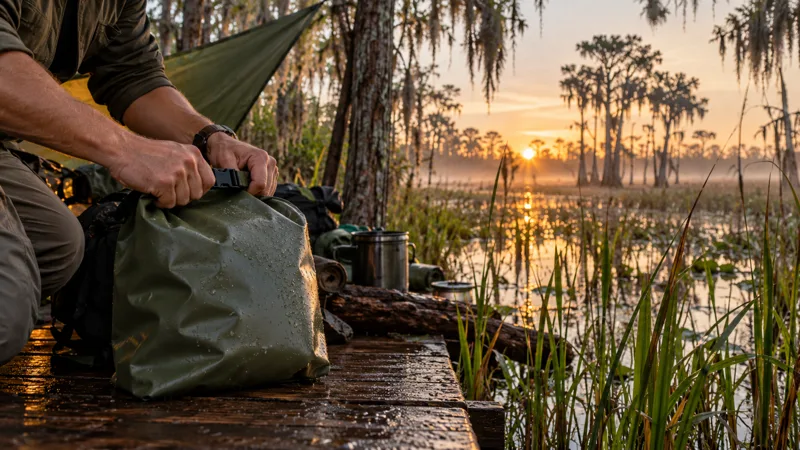
Equipment preparation should account for how items remain usable when moisture, handling, and frequent packing changes are part of the day. Ask the provider how personal belongings are stored and what protection is required for critical items. Do not assume that a bag described as water resistant offers the same protection as a system approved for the actual activity. Inspect closures and learn their operation before travel. Keep essential documents and electronics protected according to their needs while following the school's instructions for access and loading.
Practice organizing the bag on dry land. Can you locate necessary personal items without unloading everything? Are separate items identifiable? Does a frequently used object return to the same place after use? These questions are ordinary, but a dependable routine reduces avoidable confusion in an unfamiliar setting. Avoid making attachment or packing modifications for a boat transfer without the provider's guidance. The correct arrangement depends on the transport and safety system, not merely on whether an item looks tidy when hanging from a strap.
Tropical preparation should use current local guidance
The National Park Service's Everglades safety page discusses the importance of preparing for subtropical conditions, seasonal changes, insects, and wildlife. That is useful regional background, but it does not establish that this private course takes place inside Everglades National Park or that park access rules define the school's site. Follow the actual provider and relevant land manager. Review current forecasts, required clothing, and personal preparation. The general word Florida cannot answer the detailed questions that matter for a particular group on particular dates.
If you have health concerns related to exertion, heat, humidity, insects, or an overnight arrangement, discuss them with a qualified clinician and the course provider before arrival. This guide does not prescribe a medical threshold or prevention regimen. Use products according to their labels and seek appropriate advice for individual needs. Do not test an unfamiliar personal-care product for the first time during an extended activity if an ordinary advance check is possible. Responsible preparation reduces uncertainty without pretending that one recommendation fits every participant.
Wildlife observation should not become interaction
Respect the site's wildlife instructions and keep animals' behavior undisturbed. The National Park Service warns against feeding or harassing wildlife in the Everglades. For the course's actual location, obtain the specific instructions from the responsible staff and authorities. Do not approach an animal for a photograph, throw objects toward it, or assume that apparent stillness means it is safe to touch. Keep equipment and food organized as directed. A learning activity should not become an excuse to create an encounter the group did not intend.
Ask how staff communicate wildlife concerns and where participants may move independently. Follow the agreed boundaries. A student unfamiliar with the landscape should not explore beyond them to make the experience more authentic. Regional familiarity is valuable, but it does not remove the need to follow current site instructions. Observation can be rewarding from an appropriate location and distance. The aim is to learn how people use knowledge responsibly, not collect a dramatic image that required changing the animal's behavior or the group's plan.
Tools belong to supervised tasks
The course's current description includes tool-related learning, but participants should use the actual equipment requirements and staff guidance. Confirm what to bring, what is provided, and how practice is supervised. Do not add a specialized cutting tool because a video suggested it is essential. An unnecessary item can complicate transport and create handling problems. Inspect required equipment according to manufacturer instructions and ask about any concern. Keep tools secured in the approved arrangement rather than leaving them loose among personal supplies.
During instruction, understand the work area before handling anything. Ask where to stand, which materials may be used, and how the instructor wants a task begun or stopped. Respect another participant's equipment and space. If a technique is unfamiliar or could cause injury, do not recreate it independently from notes after one demonstration. Seek further supervised practice. A student gains useful knowledge by understanding a tool's appropriate function and limits, even when the first physical attempt is slow or requires correction.
Natural materials come with permissions and consequences
Bushcraft learning may involve observing or working with natural materials under a site's arrangements. That does not grant permission to collect similar material elsewhere. Ask the provider which areas and resources may be used and what must remain untouched. Follow the actual land manager's current rules for independent recreation. Do not cut, harvest, or remove something merely because it appears plentiful. The instructor may be working within specific permissions or a prepared teaching arrangement that a visitor cannot assume applies outside the course.
Learn how the selection decision is explained. What makes material appropriate for the permitted task? What evidence would make the instructor leave it alone? Record those questions rather than building a universal rule from one example. A resource that serves one purpose may be unsuitable for another. Recognizing that boundary improves learning and reduces waste. A finished camp object is not the only worthwhile outcome; understanding why a particular material was chosen, and why another was rejected, is often the more transferable lesson.
Plant discussions must keep health claims separate
If a lesson introduces useful or medicinal plants, identification and medical suitability remain separate subjects. Do not eat unidentified material or use an app or resemblance as proof of safety. Qualified local instruction is necessary for identification and handling, and an article cannot provide a reliable key. If a health claim is discussed, ask for its evidence and seek appropriate professional advice before using anything for treatment. Natural origin does not establish safety, effectiveness, or compatibility with a person's medicines and health conditions.
Keep notes about what was actually stated. Distinguish a cultural or historical use from a recommendation for modern treatment. Do not turn an interesting demonstration into a remedy for friends or family, and do not replace prescribed care or delay urgent treatment based on a course anecdote. A responsible student can appreciate knowledge while preserving those boundaries. Questions about health should be answered through qualified care and authoritative sources, not by trying to make a broad course title carry more authority than it establishes.
Fishing requirements need official confirmation
The provider states a fishing-license requirement for this course. Registered participants should confirm the current requirement directly and consult the relevant Florida wildlife agency for the applicable license and rules. A course booking does not itself establish legal authorization for every method, species, place, or date. Do not assume that equipment used in a supervised demonstration may be deployed independently elsewhere. This guide provides no construction or use instructions for traps, gigs, or other hazardous or regulated methods.
If food handling is part of teaching, follow qualified instruction and applicable food-safety guidance. Identification, lawful collection, preparation, and storage are different responsibilities. Keep them distinct when reviewing what a demonstration shows. Do not improvise preservation or cooking protocols from a brief explanation, especially when conditions or ingredients differ. The practical learning opportunity is to ask how the instructor manages the complete system and what further training is required. That approach is more useful than leaving with confidence unsupported by detailed knowledge.
Clarify the overnight routine
For a confirmed place, ask about sleeping arrangements, personal equipment, meals, hygiene, communication, and the procedure for reporting a concern. A multi-night setting may require items that a day class does not. Do not infer facilities from photographs. Communicate dietary or accessibility needs early and confirm whether the arrangements are appropriate. Keep essential personal supplies available and tell only the relevant staff the private information they need. A clear conversation before travel allows more options than discovering a mismatch after the group has transferred to the activity site.
Ordinary routines deserve attention: returning shared equipment, keeping belongings organized, respecting rest periods, and communicating when a task is incomplete. Follow the provider's expectations rather than assuming your personal camping habits are the group's system. Ask why a routine exists if you are unsure. It may address time, access, conservation, or a safety concern you have not noticed. Learning those reasons can be as useful as the more memorable field activity, because routines are what keep a multi-day group functioning reliably.
Leave with specific learning, not a claim of universal readiness
After the course, distinguish the tasks you practiced from the tasks you merely observed. Record feedback and the conditions under which practice occurred. Ask which activities can be continued safely in an ordinary permitted setting and which require further supervision. Inspect, clean, and store equipment according to instructions. Use observations to guide any later purchase rather than buying a duplicate of every item you saw. A useful outcome is knowing the next appropriate learning step and the reasons behind it.
Keep October 8–11 as the listing's dates while respecting the current sold-out status and advance registration requirement. Use the original directory, the provider's current course page, and authoritative regional guidance with their different roles clearly understood. The Everglades title makes the event sound distinctive, but preparation still depends on concrete details: a confirmed booking, correct arrival information, suitable equipment, responsible supervision, permissions, and a willingness to ask about limits. Those details allow a participant to concentrate on learning instead of resolving assumptions that should have been checked before travel.