
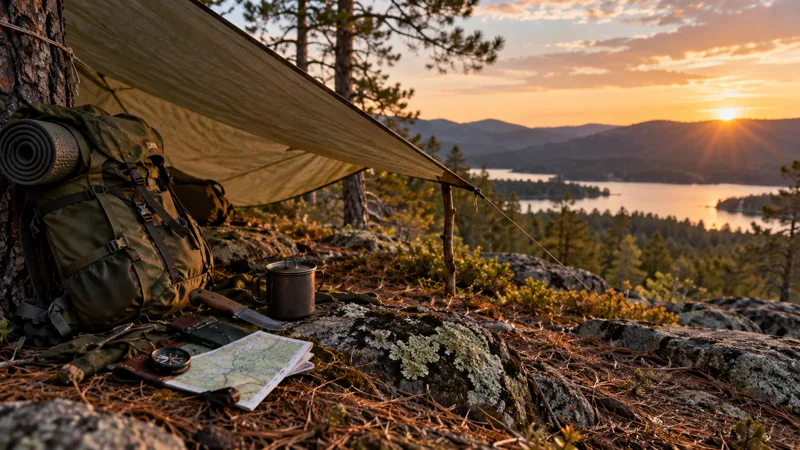
Wilderness Weekend 10/2-10/4 was recorded for October 2–4, 2026. The session is now archived because those dates have passed. The location in this listing was recorded as “See event listing”; no exact training venue should be inferred from that wording.
A weekend with an unresolved venue
- Dates retained: October 2–4, 2026.
- Location retained: see the event listing and confirm directly.
- Category: wilderness survival.
- Reference: Wilderness Weekend on FeralSkills.
The source marks the session concluded, identifies Mountain Scout Survival School as the host, and lists broad skill categories that include bushcraft, wilderness survival, and tracking. Its location field says that a published location is unavailable. It does not provide enough information to establish the precise curriculum, participant requirements, or arrangements for a future weekend.
The following guide is an independent discussion of how to make a short outdoor learning experience coherent. It does not claim that these exercises occurred at the archived session. Its central question is practical: how can a learner use a limited weekend to develop habits that remain useful after returning home?
Choose a question small enough to answer
A weekend can introduce many subjects, but it cannot give every participant deep competence in all of them. Before enrolling in a future course, decide which question you most want help answering. You might want to understand how instructors select a camp area, how to notice evidence without jumping to a conclusion, or how to organize a day pack so you can find important items without repeated unpacking.
A narrow question gives your attention a useful anchor. If your interest is campsite judgment, you can observe how weather, ground conditions, access, and group needs influence choices throughout the weekend. You do not need to ignore other lessons. Instead, you can connect them to the question that brought you there. This helps prevent a varied course from becoming a collection of entertaining but disconnected demonstrations.
Be realistic about what an answer looks like. Understanding the factors an instructor considers is a meaningful result, even if you are not ready to make the same decision independently. Seeing how a task is explained may reveal that you need more foundational instruction. That discovery is valuable. A brief class should help you identify a path for practice rather than encourage you to declare a subject mastered.
Friday begins before the meeting time
For a residential weekend, arrival arrangements can determine how useful the first evening feels. Ask where the group meets, whether arrival involves walking or transport to a separate site, and what you need immediately accessible. Keep directions, contact details, and essential arrival information available without relying entirely on live mobile service. A school name or regional address should not replace the confirmed meeting instructions.
Clarify what happens if travel is delayed. Does the provider have a latest arrival time, a check-in method, or a policy for missing the introductory briefing? Do not assume you can join an unfamiliar group at an outdoor site after dark. A good travel plan contains enough margin to arrive ready to listen and enough information to respond if the journey changes.
Also ask whether the first evening includes food, equipment inspection, or setting up accommodation. The source page's limited detail does not answer those questions. If you arrive expecting a meal that is not supplied, or leave sleeping equipment inaccessible at the bottom of a tightly packed bag, a manageable evening can become unnecessarily distracting. Packing for the first hour is as useful as packing for the entire weekend.
Make transitions part of your learning
Outdoor courses often move between discussion, demonstrations, walking, and hands-on activity. Each transition tests a different habit. Do you know where your belongings are? Have you left the previous area tidy? Do you understand where the group is going next? These questions may seem secondary to the headline skill, but repeated small losses of attention can reduce the time available for meaningful practice.
Use a consistent personal inventory at natural pauses. It need not be elaborate: know where your navigation information, light, water, clothing layer, and any required course items are located. The aim is to avoid searching for the same object several times. If an item repeatedly migrates to an awkward place, change its storage method while the problem is visible rather than waiting until the final day.
Ask before wandering away to investigate something interesting. A learner following tracks, taking photographs, or searching for a better view may unintentionally leave the group's supervision. Curiosity is welcome in outdoor education, but it works best within clear boundaries. Find out which areas are open for independent exploration, whether a partner is required, and how the group accounts for participants.
Observation before interpretation
Tracking offers a useful example of disciplined attention. A mark on soft ground might seem to tell a complete story, yet a responsible learner first records what is actually visible. Shape, position, direction, and surrounding conditions are observations; the identity and behavior of an animal are interpretations that may need further evidence. This guide does not supply identification rules or claim that any specific tracking exercise was taught.
You can practice the distinction safely with ordinary scenes near home. Describe a muddy patch, a disturbed leaf, or a worn path without assigning a cause immediately. Then list several plausible explanations. The exercise is about noticing uncertainty, not solving a mystery. Keep the notes descriptive enough that another person can understand what you saw without sharing your initial assumption. If a photograph is appropriate and permitted, use it to support that description, while remembering that a single view can omit the surrounding context that an instructor would want to examine. In a class, a qualified instructor can show which observations are relevant and which conclusions exceed the available evidence.
Avoid disturbing wildlife or sensitive places to improve a view. Do not handle unknown animal remains, approach a den, or collect natural objects simply because they might be educational. Ask about the site's rules and the appropriate observation distance. Sometimes the best record is a note made from the established path, with the uncertain part left unresolved for later discussion.
Comfort frees attention for instruction
Basic comfort is not a distraction from serious learning. If your footwear rubs, your pack slips, or your clothing leaves you continually adjusting layers, less attention remains for the instructor's explanation. Test the equipment you plan to bring on an ordinary local outing. A familiar item in good condition is often more useful than a recent purchase whose controls and fit you have not explored.
Sleep arrangements deserve particular attention on a short residential course because there is little time to recover from a poorly planned first night. Confirm whether the setting involves tents, shelters, cabins, or another arrangement. Ask which items are supplied and how the provider describes the expected conditions. Do not select sleeping equipment from the event category alone or assume an autumn weekend will have mild nights.
The National Park Service's Ten Essentials overview can help frame questions about basic outdoor support. It should sit alongside the organizer's actual instructions, not override them. Use it to notice categories you might have forgotten, then ask how those needs are met within the course setting. A supplied item, a shared resource, and a personal responsibility are different arrangements.
Know the boundary around hands-on activities
Before participating in an exercise, understand what direct supervision covers. A demonstration involving fire or sharp tools should include site permissions, working distances, and a clear way to pause. Do not copy a task later merely because it looked simple from the audience. The instructor may have prepared materials, checked conditions, or removed hazards that were not obvious to you.
Plant-related activities require careful separation between learning and use. Local identification teaching can be valuable, but a memorable name or a photograph is not sufficient grounds for consuming an unfamiliar plant. If a future course discusses edible or medicinal uses, ask how verification, allergies, legal collection, and professional medical boundaries are handled. Participation should never depend on tasting something you cannot confidently and appropriately identify.
Be equally deliberate about personal limits. Tell staff promptly if an activity creates a health concern or if you have not understood the instructions. Asking to watch a second demonstration or practice a simpler step can produce better learning than rushing to keep pace. A useful weekend leaves participants able to explain their uncertainties, not embarrassed to admit that some tasks need further support.
Sunday should produce a practice plan
Before leaving, identify one skill to revisit and one planning habit to retain. A skill might need another supervised lesson. A planning habit might be easier to apply immediately, such as confirming a meeting point, keeping a light consistently accessible, or writing a clearer trip note for a trusted contact. Distinguishing the two prevents the follow-up from becoming either too ambitious or too vague.
Review your notes soon after returning while the context remains fresh. Mark which activities you observed and which you personally attempted. Add the conditions that supported them: prepared materials, a selected practice area, instructor feedback, or group assistance. Those details prevent a successful classroom moment from being misremembered as evidence that the same task will work anywhere.
If you want to attend a later Wilderness Weekend, use the host's current information to verify the venue, dates, prerequisites, and practical arrangements. This archived October session provides a reference point, not a promise of continuity. Browse other outdoor learning events with a clear question in mind, and use the skills collection to organize what you want to ask a qualified instructor next.