
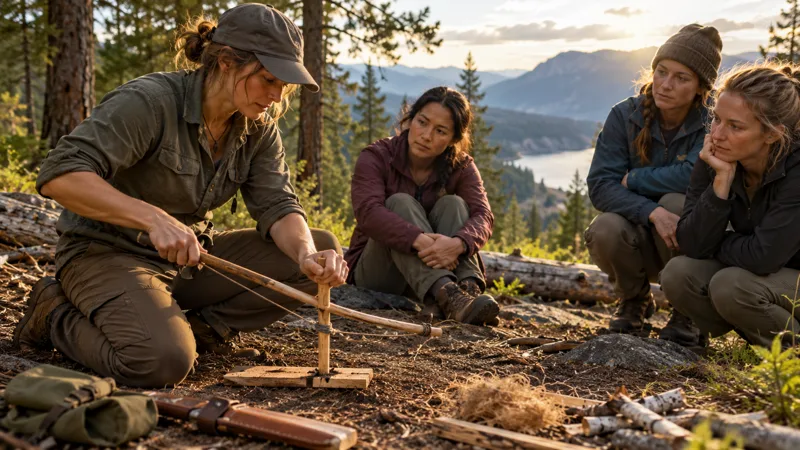
Wilderness Skills for Women: choose a learning environment that supports questions
Wilderness Skills for Women was listed for September 12–13, 2026, in Pennsylvania, USA. Those dates have passed, so this page is an archived event reference and an independent guide to beginning or returning to outdoor learning. The original FeralSkills entry points to Coalcracker Bushcraft. Verify current courses, exact location, registration terms, and requirements directly with the school. This article does not claim that a particular instructor, exercise, or accommodation was provided in the archived session.
A class aimed at women can be appealing for many reasons: learning alongside peers, trying a subject without an established role in a mixed group, or finding a comfortable setting for practical questions. No single reason applies to everyone. Experience, confidence, physical needs, and interests vary within any audience. The useful starting point is your own learning goal. A suitable environment should help you ask questions and practice appropriately without asking you to prove that you fit a stereotype of an outdoor participant.
Define the skill gap without judging yourself
Describe what you want to understand, using a task rather than an identity label. “I want to learn how to organize my own day pack” is more useful than “I am bad at the outdoors.” The task gives an instructor something concrete to address. It also allows you to notice progress. If you have prior experience, identify the question that remains unclear rather than assuming the class is only for complete beginners. Familiarity with one activity does not automatically transfer to every other field skill.
Choose a goal that can begin during a short course and continue afterward. A weekend can introduce concepts, expose equipment questions, and show where supervised practice is needed. It cannot honestly guarantee readiness for every outdoor situation. Treat a course as part of a learning path rather than a transformation that must happen on schedule. This removes pressure to appear competent immediately and makes it easier to admit when a demonstration did not yet make sense.
Ask the organizer about participation before booking
Confirm the current meeting point, format, duration, equipment requirements, and any prerequisites. Ask how much of the course takes place outdoors and what ordinary facilities or arrangements are available. Do not assume details from an archived description. If a personal requirement affects participation, discuss it directly with the organizer. Clear information helps you decide whether the offering fits, instead of arriving with a concern that could have been resolved before travel.
Ask specific accommodation questions where relevant. Describe the practical need rather than allowing someone else to guess from a broad label. The organizer should explain what can and cannot be provided. If an arrangement remains unconfirmed, treat it as unresolved rather than hoping it will be addressed at arrival. A course should be chosen for its actual fit with your needs and goals. Selecting another offering or format is a sensible decision when the current one does not meet them.
Distinguish comfort from the absence of challenge
A supportive learning environment can still ask you to attempt an unfamiliar task. The important distinction is whether the challenge has an appropriate purpose, instruction, and safety boundary. You should be able to ask what the exercise is intended to teach and how concerns are handled. Avoid an expectation that useful learning must involve embarrassment or unnecessary discomfort. A skill can be demanding without becoming a performance where questions are treated as weakness.
Decide how you prefer to receive feedback. Some learners benefit from watching a demonstration again; others need a verbal explanation or time to describe what they understood. Tell the instructor when possible. You do not need to apologize for learning differently from another participant. Appropriate feedback focuses on the task and the next correction, rather than comparing personalities. A clear question such as “Which part should I change first?” often produces more useful guidance than asking whether you are doing everything wrong.
Prepare equipment as a user, not as an audience for marketing
Follow the organizer's current list and read the instructions for anything you will bring. Try on and adjust ordinary clothing or a pack under normal safe conditions before the class. Identify what you cannot operate and bring that question to the instructor. An unfamiliar product does not become suitable because it is promoted for survival. Avoid buying a large collection merely to feel ready. A modest set of required items you understand can support learning more effectively than an overloaded bag of uncertain purpose.
Evaluate equipment according to the actual user. Fit, accessibility, controls, and compatibility with other items matter. A product category or gendered label does not prove that it fits your body or activity. Ask what function you need and how the item meets it. If borrowed equipment is used, learn the relevant instructions and confirm its condition with the responsible person. A confident owner may overlook what a new user needs to know. Take the time to ask before relying on the item.
Build a notebook around decisions
Record more than a list of technique names. Note why an instructor chose an approach, what assumptions it depended upon, and when they would choose another option. If a demonstration is photographed with permission, add context while it is still fresh. An image can show what the result looked like without explaining how it was evaluated. Keep uncertain notes marked as questions. A learning record is useful precisely because it distinguishes what you understand from what you still need to clarify.
After a task, explain the reasoning to yourself in plain language. If you cannot, ask for another explanation. Avoid memorizing a sequence merely to appear finished. Your notes should help you resume appropriate practice later, not encourage unsupervised attempts at a task beyond your competence. For specialized subjects such as medical care, plant identification, or hazardous tool use, seek suitable qualified instruction and current authoritative guidance. An introductory mention does not establish mastery of an entire field.
Participate without surrendering your judgment
Follow legitimate instructor safety directions and tell the instructor when an issue affects your participation. At the same time, retain the ability to raise a concern or decline a task that does not fit your needs. A group can unintentionally pressure a learner who does not want to slow others. Recognize that possibility before the course. Asking for clarification is a normal part of instruction, and an appropriate pause can reveal a misunderstanding that would otherwise remain hidden.
Do not compare your progress only with the fastest person. Participants arrive with different experience and may be working on different goals. A quick demonstration is not proof of sound judgment, just as a careful learner is not automatically unskilled. Focus on whether you can explain the purpose and limitations of the task more accurately than before. That is a meaningful measure of growth. It makes practice less dependent on praise and more connected to the skill you came to learn.
Choose a next step that matches your current ability
After the course, identify one modest, permitted practice within your competence, with suitable supervision or support where needed. Keep the consequences low and an appropriate alternative available. The first practice is for understanding the lesson, not proving toughness. Review your notes and equipment beforehand. If an instruction remains unclear, ask the school or seek further qualified help instead of filling the gap with a guess from a short video.
Set a realistic time for practice. A specific short session is more likely to happen than a vague intention to become an expert. Record the observation afterward: what became easier, what remained uncertain, and what needs another lesson. Avoid judging the whole course by one successful or unsuccessful attempt. Learning is cumulative and uneven. A useful next step can be attending a more focused class, revisiting a basic task, or deciding that a different outdoor activity fits your interests better.
Find peers who value responsible learning
If you remain in contact with classmates, agree on the purpose of any future meet up. A social outing is different from qualified instruction. Do not let mutual enthusiasm turn into unsupported teaching of hazardous techniques. Choose activities within the group's competence and follow current land manager rules. Keep expectations clear about pace, transport, and changing plans. A dependable peer group makes room for concerns and avoids treating attendance or difficult conditions as a test of belonging.
Notice whether the group welcomes honest uncertainty. Someone who says “I do not know” can be a useful partner if they seek reliable guidance. Someone who promises universal readiness may be overlooking important limits. Responsible confidence includes the ability to choose a simpler plan. That attitude is especially valuable for learners who previously felt excluded or judged. The goal is to create access to good outdoor experiences, not replace one intimidating culture with another.
What the archived listing can still offer
The September 2026 listing remains a reference to an opportunity that has passed. Use it to discover the school and ask about future offerings rather than assuming the same dates or format repeat. The independent learning principles in this article do not depend on attending that particular session. A clear goal, suitable instruction, equipment familiarity, and a realistic next practice can improve any outdoor learning experience. They keep the focus on useful ability rather than a promised identity change.
Women interested in wilderness skills deserve the same careful information and honest safety boundaries as any other learners. A welcoming class can help, but your own questions matter. Ask for the details that determine fit, keep uncertainty visible, and measure progress through understanding. You do not need to rush toward a difficult expedition to prove that the learning counted. A well planned ordinary outing, completed with a clearer sense of your decisions and limits, is a substantial result.
Archived source and organizer
Read the original Wilderness Skills for Women listing and visit Coalcracker Bushcraft for current information. Explore new events and related skills guides.