
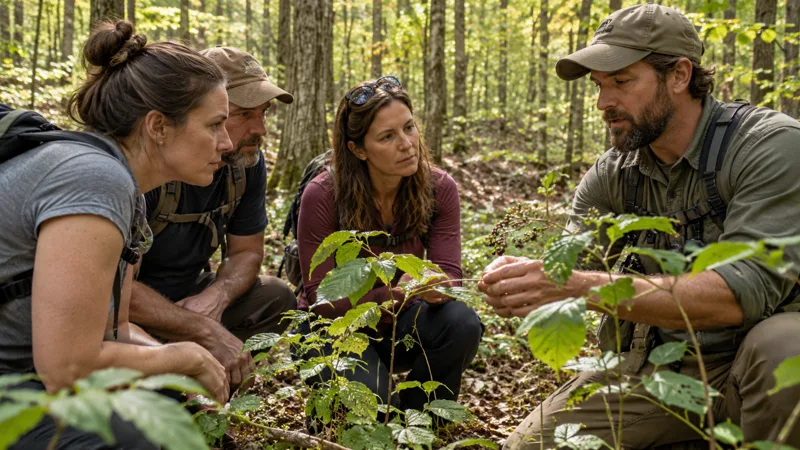
Wilderness judgment begins with what you actually notice
Wild Wisdom was listed for September 25–27, 2026, with Madison, GA, USA as its general location. The dates are past as of October 7, 2026, and the directory retains the concluded event for reference. Its current page directs readers to Byron Kerns Survival School for the exact class location rather than publishing a meeting point. Do not use the general city or a business address as arrival instructions for a later course. This archived guide explores observation and decision-making as editorial topics, without claiming a confirmed curriculum for the recorded weekend.
The title invites a useful distinction between information and judgment. Information tells you a tool's name or a forecast number. Judgment concerns what that information means for the situation in front of you. An outdoor learner may know many terms yet still overlook a changing condition or hesitate to ask an important question. A preparation exercise can begin with ordinary observation: describe what you see, identify what remains uncertain, and consider where a dependable answer would come from. None of those steps requires staging an emergency or taking unnecessary risks.
Description comes before interpretation
On a permitted, ordinary walk, notice how often an interpretation arrives before a description. A person might say the weather is fine when they mean that it is not currently raining. Someone might call a path easy because they have walked it before, without considering another participant's needs. Practice replacing broad labels with specific observations. What is visible? What information has been checked? What does the label leave out? This habit makes conversations clearer and reduces the chance that two people use the same reassuring word while imagining different conditions.
Keep the exercise modest and safe. Stay within current access rules and an activity appropriate to the group. Do not approach wildlife, enter hazardous terrain, or inspect unfamiliar objects merely to make the observation more interesting. The point is improving how you think and communicate, not collecting dramatic material. Ask qualified instructors how they separate observation from inference during their teaching. A student can then recognize when a conclusion relies on local experience, specialist knowledge, or information that is not yet available.
Notice the assumption behind a plan
Every outdoor plan contains assumptions: transport will arrive, a device will work, an entrance will remain open, or everyone has understood the route. Write down the ones that matter most to your own outing. Some can be checked directly. Others need a backup or a decision about whether the uncertainty is acceptable. Avoid treating every assumption as a catastrophe waiting to happen. Prioritize those that could change the activity or affect a participant's safety. A short, useful list encourages action; an endless collection of remote possibilities can make a plan impossible to use.
Ask what evidence would change your mind. If the plan depends on a current forecast, which official update will you consult and when? If it depends on a provider's equipment list, have you received the current version? If it depends on another participant's assistance, has that person agreed? These questions prevent intention from masquerading as confirmation. A careful learner does not need to distrust everyone. They need to recognize the difference between an expectation and a checked arrangement, especially when several people share responsibility.
The pace of a group can hide information
People do not all move, observe, or ask questions at the same speed. A participant may remain quiet because they are concentrating, embarrassed, or unsure who to approach. Establish with the provider how questions and concerns should be raised. During an agreed group activity, communicate changes plainly instead of assuming that silence means everything is understood. Respect the instructor's role in setting procedures. Avoid turning your personal preference into an instruction for others simply because you are comfortable speaking first.
Watch for the difference between a shared decision and a decision everyone merely followed. Ask whether each person understands the next step and the information supporting it. That can be done respectfully without conducting a formal interrogation. In a learning environment, making uncertainty visible is valuable. A student who says they do not understand may reveal a problem that several others also have. The group benefits when the response is clarification rather than mockery. Good judgment becomes easier when people can report what they actually know.
Equipment can create false reassurance
An object can change how confident you feel without changing what you can do reliably. A new navigation device may still require maps, power, configuration, and practice. A large first-aid kit does not establish medical competence. A specialist tool does not grant permission to use it on every property. For each significant item, ask what task it supports, what preparation it requires, and what its limitations are. This connects equipment to a real function instead of allowing ownership to become a substitute for learning.
Choose one item and explain its ordinary workflow. Where is it stored? How do you inspect it? What instruction applies? Who knows how to operate it? What will you do if it is unavailable? Seek qualified guidance for safety-critical uses. A precise answer may reveal that the existing item is suitable but poorly organized, or that a simpler arrangement would serve your needs better. The exercise is especially useful before shopping. It gives a purchase a problem to solve and makes sales language easier to evaluate without relying on excitement alone.
Learning from a mistake without romanticizing it
A supervised exercise can expose a small error while help is available. Ask how the provider structures feedback and what safety limits apply. Do not create an unsupervised hazard to obtain a more memorable lesson. The fact that a mistake taught someone something does not mean it was a good idea to make it deliberately. Prevention remains worthwhile. A learner can gain insight from observing an instructor's correction, reviewing a plan, or identifying a gap in equipment without needing a difficult experience to validate the knowledge.
When reviewing an error, describe the sequence honestly. What did you believe at the time? What information did you overlook or misunderstand? What changed the result? Avoid rewriting the story so that the outcome seems obvious from the beginning. That kind of hindsight can prevent useful learning. A record that preserves the original uncertainty is more valuable. Discuss it with the instructor and identify a practical correction, such as a clearer check, a revised storage habit, or a question that should be asked before proceeding.
A pause can be an active decision
People sometimes regard stopping as the absence of action. In planning and supervised learning, a pause can serve a clear purpose: obtaining information, checking a concern, or preventing a confused task from continuing. Ask instructors how they teach those decisions within the course's actual scope. Do not derive a universal emergency response from this general idea. The appropriate action in a real incident depends on the circumstances and official guidance. The editorial point is that speed alone does not demonstrate judgment.
For an ordinary outing, decide in advance how optional goals will be reconsidered. A scenic destination, a photograph, or a schedule preference should not become so important that the group ignores relevant changes. Discuss the possibility of a shorter activity before leaving, when nobody feels they have already invested too much effort. This makes a revised plan easier to accept. A successful day can be one in which the group changes its mind for a sound reason and returns with clear understanding rather than completing every original intention.
Keep specialist subjects connected to specialist guidance
A wilderness knowledge course may introduce several fields, but each has its own boundaries. Medical care requires appropriate training and professional advice. Wild-food identification should not be improvised from resemblance or an app. Fire and tool practice depend on permissions, conditions, and supervision. Wildlife, land access, and collection rules must be checked through the responsible authorities. Ask the provider which subjects are discussed and how students are expected to continue learning. A broad title does not remove the need for more focused instruction.
Do not confuse a story about a traditional practice with evidence that it is suitable for your circumstances. Historical interest, cultural knowledge, and modern practical use can be related without being identical. Ask what claim is being made and how it is supported. When health or legal questions are involved, consult the appropriate professional or official source rather than relying on a short demonstration. Respectful curiosity includes recognizing the limits of an explanation and avoiding a claim that goes beyond what the instructor actually established.
Use notes to connect meetings with everyday life
Record observations in a format you can revisit. Include the question, the context, the explanation received, and the part that remains uncertain. Distinguish your own reasoning from the instructor's direct guidance. Later, choose an ordinary example where the same thinking habit applies, such as checking a route closure or clarifying who holds shared equipment. This makes the lesson transferable without requiring you to recreate a field scenario. The notebook becomes a record of improving decisions rather than a collection of impressive terms.
Set a realistic review date. It is easy to leave a course excited and then forget the notes until another event appears. A short review can identify one action to complete, one question to ask, and one appropriate practice opportunity. Use the provider's recommendations for continued work and avoid hazardous independent experiments. Sustained learning does not need to consume every weekend. A dependable routine may be more effective than a single ambitious plan that never happens because ordinary life remains busy.
An archived event can still sharpen the next question
For Wild Wisdom, keep September 25–27 as the historical date range and Madison as the general location associated with the listing. Consult Byron Kerns Survival directly for current arrangements and an exact venue. The provider's own site is a stronger starting point for present information than an old directory summary. A prospective student should ask about course scope, prerequisites, learning conditions, and supervision before deciding whether it matches their needs. These are questions for the provider, not details that this editorial article invents.
The lasting theme is simple enough to practice on an ordinary day: describe accurately, identify assumptions, seek reliable information, and communicate what remains uncertain. Those habits do not replace technical skills, but they help you decide when and how those skills belong in a plan. Wilderness wisdom is more useful when it can be explained in plain terms. A person who knows the limits of their information and can ask the next responsible question has a stronger foundation than someone who feels certain because the equipment, vocabulary, or story sounds impressive.