
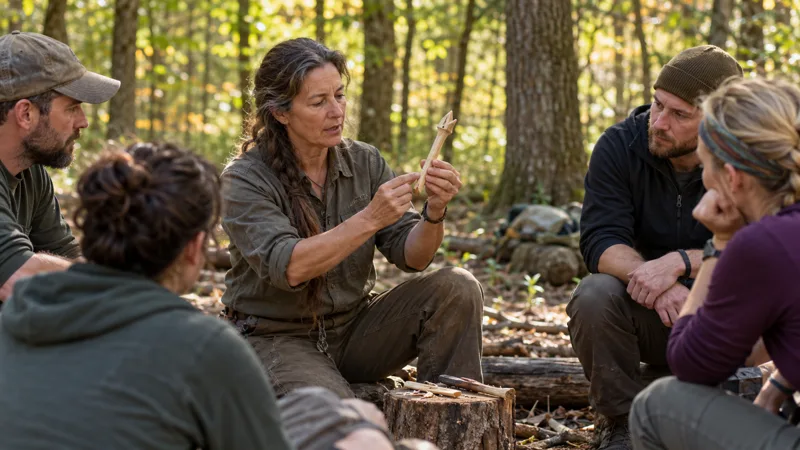
Survival Instructor Certifications is recorded for October 5–November 18, 2026, in Lebanon, Missouri, USA. On October 7, the recorded range has begun and has not ended. This is therefore an ongoing date range, not an archived completed session and not evidence that late enrollment is available.
The listing and its present limits
- Recorded range: October 5–November 18, 2026.
- Recorded location: Lebanon, MO, USA.
- Category: bushcraft and wilderness.
- Original source: Survival Instructor Certifications listing.
- Corroborating directory: FeralSkills certification-course index.
The direct event page could not be retrieved during this review. The current certification-course index does list the same title, date range, and Lebanon location, associated with Sigma 3 Survival School. That corroboration does not independently establish the attendance calendar, assessment criteria, credential scope, or admission arrangements. Obtain those details directly from the provider rather than inferring them from the title or duration.
This independent guide focuses on evaluating instructor development. It does not claim that the following teaching methods form this course's curriculum, nor that completing the recorded program grants any particular legal permission, professional status, or externally recognized qualification.
Teaching a skill is a separate task
A person can perform a field skill confidently and still find it difficult to teach. Teaching requires breaking a task into understandable parts, noticing what learners misunderstand, and deciding when an exercise should be simplified or stopped. It also requires explaining the conditions that made a successful demonstration possible. The strongest performance in front of a group is not always the clearest lesson.
Consider a hypothetical instructor explaining equipment organization. They could empty a polished personal pack and describe every item, leaving learners impressed but unsure how to adapt the example. Alternatively, they could ask learners what they need to access quickly, show a few relevant choices, and observe how each person arranges their own equipment. The second approach makes the reasoning visible and creates opportunities for feedback.
When evaluating an instructor course, ask how it develops that reasoning. Does the provider assess explanations as well as practical performance? Are participants observed while teaching? Is feedback specific enough to guide improvement? These questions help determine whether the program addresses educational competence or primarily extends a participant's personal outdoor experience.
Ask what the credential actually means
The word certification can describe different arrangements. It may refer to a provider's own assessment, a credential aligned with an outside organization, or another defined standard. Do not assume which applies here. Request the exact credential name, the issuing body, the assessed competencies, and any renewal conditions. Ask whether employers or organizations you hope to work with accept it for the role you have in mind.
Recognition is best checked with the intended recipient of the qualification, not only the seller. If you want to teach for a particular organization, ask that organization what training, experience, insurance, or other requirements apply. This article provides no legal advice and does not establish professional permissions. Where the role involves regulated activities or legal obligations, consult the appropriate authority or qualified adviser.
Also distinguish course completion from demonstrated teaching competence. Ask whether everyone who attends receives the same document, what happens if a participant does not meet an assessment standard, and whether reassessment is available. Clear answers make it easier to evaluate the program honestly. They also help you avoid representing a credential more broadly than the issuer intends.
Safety planning should be teachable
An instructor needs to explain how activities remain within appropriate limits. That includes site permissions, participant readiness, equipment condition, weather decisions, supervision, and access to help. Ask a training provider how those decisions are practiced and assessed. A written policy is useful, but prospective instructors also need opportunities to recognize situations where the policy changes the planned lesson.
Imagine a class arriving at a practice area to find conditions different from the briefing. The educational question is not simply whether the instructor can complete the original task. It is whether they can identify the relevant change, select a suitable alternative, and explain the decision without making learners feel that safety has spoiled the experience. A responsible adaptation can itself become the lesson.
Health-related instruction requires appropriate qualifications and boundaries. A survival instructor credential should not be assumed to authorize medical diagnosis or treatment. If a program discusses first aid, ask what separate training or recognized qualification is involved and how its scope is described. Participants with health concerns should obtain appropriate professional guidance before strenuous or extended field activity.
Observation is more useful than a dramatic test
Assessment should gather evidence relevant to the intended teaching role. A dramatic challenge may demonstrate persistence, but it does not automatically show whether someone can brief a beginner, manage a group, or identify a misunderstanding. Ask how the provider evaluates those ordinary responsibilities. A well-designed assessment can be demanding without making discomfort the primary measure of success.
Specific feedback might describe unclear instructions, an overlooked check, or a mismatch between the stated goal and the exercise. These are actionable findings. A vague judgment that someone needs more confidence may be harder to use and can encourage stronger presentation without better reasoning. Seek a program that can explain what satisfactory performance looks like and which evidence supports that judgment.
If you are considering this ongoing range, do not assume that some modules can be joined independently or that the remaining dates are open to newcomers. A long date range may contain a structured sequence or other attendance requirements not apparent from a directory entry. Ask whether the current session admits additional participants and whether missing its beginning would make participation inappropriate.
Prepare for an extended commitment
October 5 to November 18 spans a substantial period, but the listing alone does not establish continuous attendance every day. Request the actual calendar, rest arrangements, travel expectations, and accommodation information. Those details affect employment, family responsibilities, transport, and finances. Planning from the endpoints alone can create commitments that conflict with the provider's real requirements.
Ask about meals, sanitation, laundry, communication access, and the equipment responsibilities for each part of the program. Longer attendance introduces practical needs that a weekend packing list may not address. Confirm how damaged or missing equipment is handled and whether participants have access to ordinary supplies between activities. Do not infer support arrangements from the word certification.
Budget for the whole commitment, including travel and time away from work where relevant. Ask for current written terms covering payment, cancellation, withdrawal, and any reassessment. This guide does not quote a fee because a directory amount would not establish your complete cost or the terms applicable to enrollment. Compare programs using verified current information and the specific professional objective you want to achieve.
Equipment should serve the lesson
An aspiring instructor may be tempted to build an impressive equipment collection. A better question is whether each item helps learners understand and practice the task. Clear controls, readable markings, durable components, and accessible instructions may be more useful than specialist features. Ask the provider what is required, what is supplied, and whether teaching demonstrations use equipment different from personal field kits.
Practice handling and maintaining required items before arrival under ordinary safe conditions. Knowing an item's limitations helps you explain them accurately. Do not claim broad effectiveness from one successful use, and do not improvise hazardous tests to prove durability. Manufacturer instructions, qualified guidance, and relevant evidence should support what you tell a learner.
The National Park Service's Ten Essentials overview provides an example of organizing outdoor needs into an understandable framework. It is not an instructor qualification or a complete lesson plan. Its relevance is educational: a useful structure helps learners see relationships, while the teacher still has to explain local context, responsibilities, and limitations.
Make room for different learners
Ask how the program prepares instructors to work with participants who learn at different speeds or use different ways of communicating. A demonstration that is clear from one viewing position may be difficult to follow from another. Someone may understand an explanation better after seeing a diagram, handling an approved item, or hearing the purpose before the procedure. These differences should inform teaching choices.
Accessibility questions belong early in planning. Prospective instructors should learn to ask about relevant needs respectfully and avoid promising accommodations they cannot provide. Clear information about the terrain, physical demands, and available alternatives helps a learner make an informed decision. It also gives the instructor an opportunity to seek appropriate support rather than improvise beyond their competence.
Build a record of growth, not a sales biography
During any instructor development program, keep notes about feedback and subsequent changes. Record the task, the observed issue, the adjustment, and the result of another supervised attempt. This creates a more honest picture of progress than collecting only successful moments. It also shows which subjects still require mentoring or further instruction.
Afterward, represent your training precisely. Name the credential as issued, describe the experience you actually have, and avoid suggesting authority in unrelated disciplines. Seek supervised opportunities to teach within your competence and obtain the professional advice necessary for the role. A certificate can be one part of preparation; it should not replace ongoing feedback, current knowledge, or sound judgment.
The Lebanon listing provides a date and location reference for a range currently underway. Its practical value depends on further verification with the provider. For another program, compare assessment clarity, feedback quality, support arrangements, and credential relevance before committing. Browse additional training listings with those questions in hand, and choose development that makes your teaching more accurate, understandable, and appropriately bounded.