
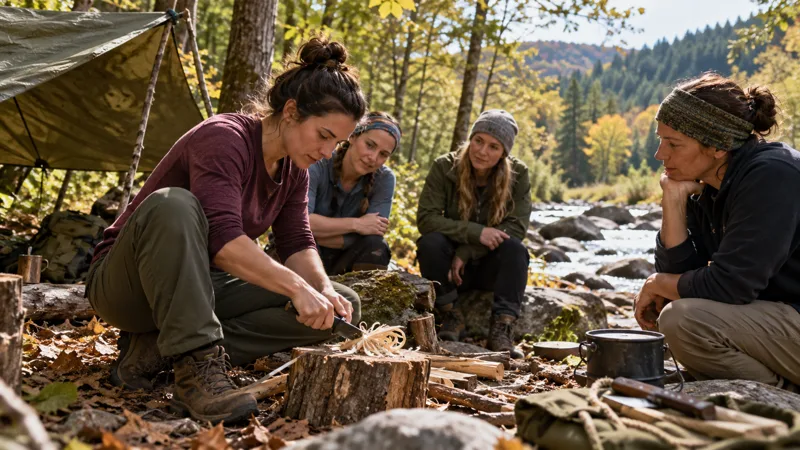
Survival Essentials – Women: an archived listing and a guide to choosing a learning environment
Survival Essentials – Women was listed for September 12–14, 2026. Those dates have passed, making this an archived event. The location field says “See event listing”; confirm an exact venue directly for any future session. The FeralSkills entry identifies Mountain Shepherd Wilderness Survival School and describes the event as a class. Its historical information should not be treated as current admission or equipment requirements. The independent guide below focuses on choosing a supportive course and making outdoor preparation fit the individual participant. It does not infer that all women have the same experience, needs or learning goals.
Define what you want to become more comfortable doing
Start with a situation from your own life. You may want to plan a day hike without leaving every decision to a companion, organize a practical overnight kit or understand how to respond when an outing changes unexpectedly. A concrete goal gives the instructor useful information. It also keeps the course from becoming a vague test of whether you are an outdoors person. Confidence can grow through modest, repeatable tasks. You do not need to adopt someone else's idea of adventure to benefit from learning.
Describe your current experience honestly. Familiarity with a trail, time spent camping with family and formal instruction are different kinds of knowledge. Each can be valuable, but none should be exaggerated. If you have avoided a subject because previous instruction felt intimidating, explain that privately to the provider. Ask how beginners are supported and how feedback is delivered. A suitable learning environment should make questions possible. The most productive course is one in which you can expose a gap in understanding without feeling compelled to hide it.
Ask what the course actually includes
A broad survival title does not tell you how much time is spent on each subject, which exercises are hands-on or what prerequisites apply. Obtain the current participant information from the provider. Ask about physical demands, sleeping arrangements, meals, hygiene facilities, outdoor exposure and the process for raising a concern. If age requirements matter, confirm them directly rather than assuming that a historical listing carries forward unchanged. Clarifying logistics is a legitimate part of choosing training, especially for a multi-day event.
Also ask who teaches and how supervision works. A class can introduce navigation, outdoor planning or first-aid topics without conferring professional competence in each one. If a credential is offered, learn who issues it and what assessment is required. If no credential is offered, the course may still be valuable practical education, but describe the result accurately. Keep the distinction between attendance, supervised practice and independently reliable skill. It helps you make appropriate decisions about what to attempt after the course and where further instruction is needed.
Choose equipment by fit and function
Outdoor gear should work with your body and task. A pack that suits a friend may press uncomfortably on you, and a glove that looks suitable may interfere with a tool grip. When possible, try equipment with the clothing and load you expect to use. Adjust it under qualified guidance if needed. A label aimed at women is not a substitute for checking fit. Equally, equipment need not belong to a particular marketing category to suit you. Compare comfort, access, control and the actual required function.
Ask which items the school provides before buying. If a specialized tool is needed only for one supervised lesson, purchasing it early may not be useful. For personal clothing and footwear, familiarity can matter more than novelty. Avoid arriving in untested boots because they appear more serious than the pair you know. Follow the current required list and ask about uncertain substitutions. Keep a record of what caused friction during the course so future purchases respond to a specific need rather than to the general feeling that your kit should look more complete.
Make personal logistics part of the plan
Comfort and privacy arrangements deserve practical questions. Ask about bathrooms, washing, sleeping spaces and how personal supplies can be stored. Participants have different preferences and needs; the provider cannot answer a question that remains unspoken. For menstrual supplies, medication or other personal requirements, plan around the actual duration and facilities. Obtain health advice from a qualified professional where appropriate. Do not depend on an instructor improvising arrangements on arrival. A clear plan reduces distraction and allows more attention for learning.
Consider travel independently of the field activities. Arrange arrival times, accommodation if needed and a contact who knows your itinerary. If you are attending with a friend, discuss which plans are shared and what happens if one person cannot complete the course. A supportive companion can help with logistics without becoming the person who answers every question for you. Leave room for individual learning goals. The aim is to build your own understanding while knowing how to ask for help when it is appropriate.
Practice speaking your plan aloud
Before the event, choose a familiar local outing and explain its route, expected duration and return arrangement to a trusted person. Identify the decision you would make if conditions changed. You do not need to perform a difficult field exercise to practice this. Talking through a plan reveals vague assumptions and makes information easier to share. The National Park Service trip-planning guide provides an official framework for organizing a trip and emergency information. Adapt it to the land manager and activity you actually use.
During class, ask to explain a technique back to the instructor when the format permits. Repeating it in your own words can reveal whether you understood the reasoning or merely remembered the movements. If you are uncertain, identify the precise point where understanding breaks down. “I can follow the demonstration, but I do not know how to check my result” is a useful question. Clear requests for feedback make instruction more efficient and reduce the pressure to pretend that everything became obvious the first time.
Let boundaries support independence
Independence includes knowing when to stop, ask or change a plan. Ask how participants can decline or pause an activity and how safety concerns are communicated. Do not interpret an uncomfortable interaction as something you must endure to prove resilience. A professional learning environment should distinguish appropriate challenge from avoidable pressure. Physical effort, unfamiliar tasks and honest feedback may be part of learning, but they do not require surrendering judgment. You remain responsible for communicating needs and respecting the course's safety rules.
Apply the same principle to outdoor ambitions after class. A new skill may support a familiar day trip before it supports a remote solo outing. Choose progression based on demonstrated ability, current conditions and suitable support. It is reasonable to postpone a plan while you obtain more instruction. Confidence should not be measured by how far you can travel without telling anyone. A well-organized itinerary, clear contact arrangements and an honest assessment of limits can make an outing more independent precisely because fewer assumptions are left to chance.
Approach tools as taught skills
If the program includes cutting tools or fire-related activities, follow the instructor's supervision and local rules. Ask about the purpose of the technique, the workspace and the conditions under which it should not be used. Do not attempt an unfamiliar tool task at home based only on a remembered demonstration. Equipment control and safe setup are part of the lesson, not details to skip while copying the visible result. A useful practice plan specifies permission, appropriate conditions and further instruction where necessary.
Traditional or improvised methods should be compared with ordinary alternatives. Ask why a technique is being taught and what assumptions it makes about time, materials and weather. You may learn an interesting craft while deciding that a commercially made shelter or other familiar item is the better choice for your normal trips. That does not diminish the lesson. Understanding tradeoffs is more valuable than replacing every modern tool to appear more capable. Buy or carry equipment because it suits the task and you can use it responsibly.
Treat first aid as a training pathway
A survival course may discuss emergency care, but determine exactly what instruction and recognition are included. The American Red Cross wilderness training resources are an official starting point for exploring further remote first-aid education. They do not verify this particular event or replace its provider information. Medical procedures require appropriate training, and actual health concerns belong with qualified professionals. Ask the course where its coverage ends and which next course would match the outings you intend to undertake.
Meanwhile, improve the organizational parts of an emergency plan: contact information, route knowledge and accessible supplies. These tasks are useful without assuming clinical competence. Check that another person can find the itinerary and knows the agreed return time. Learn how to report a concern clearly and seek help promptly. A beginner who communicates accurately can support a trained person more effectively than someone who improvises unfamiliar care. Keep your own medical information private and share relevant details through the provider's appropriate process.
Measure progress with a small next outing
After the course, choose a manageable activity that lets you apply planning skills without introducing unnecessary hazards. You might organize the day bag, explain the route or manage the check-in arrangement. Ask a companion for feedback on the clarity of the plan. Note which equipment you could find easily and which tasks still required help. Treat those observations as a practice list. Avoid interpreting one smooth trip as proof that every more demanding outing will be equally straightforward.
The archived Survival Essentials – Women listing can help readers investigate an educational setting that suits their goals. Its durable lesson is individual preparation: ask clear questions, choose suitable fit, make personal logistics explicit and build competence through honest feedback. There is no single model of the capable outdoor participant. A successful course helps you understand your own decisions and limits more clearly. Carry that understanding into modest, well-planned practice, and let future ambitions grow from evidence rather than from pressure to match someone else's confidence.