Survival Advanced Standard is recorded for October 11–15, 2026, in Lebanon, Missouri. This is a future five-day listing as of October 7. The linked FeralSkills page is a directory entry, and its specific event details could not be independently retrieved during review. Preserve the dates as planning information, but obtain confirmation from the actual provider before making commitments. The word advanced does not establish a prerequisite, an assessment standard, a deprivation exercise, or a qualification.
Open the recorded event source. Ask that source to identify the current organizer and its own booking page. The discussion below is an independent guide to preparing for extended outdoor learning; it is not a description of this event's curriculum, facilities, instructors, or promised outcomes.
Five days change the planning problem
A short demonstration can end before small discomforts matter. Over several days, wet clothing, a poor sleeping arrangement, an awkward pack, or an unreliable charging routine can interrupt learning repeatedly. Preparing for a longer course therefore means looking beyond individual objects. Consider how equipment dries, where personal items remain accessible, how consumables are replenished, and what happens when an ordinary routine takes longer than expected. A system that is easy to reset after each day gives more attention back to instruction.
Make two lists: uncertainties about the program and uncertainties about your own equipment. The first belongs in a conversation with the organizer; the second belongs in a quiet practice session at home. Keeping them separate prevents a familiar mistake: buying another tool to compensate for not knowing what an event actually requires. A request for a packing list can resolve more uncertainty than an expensive shopping trip. A request for the daily physical demands can also reveal whether this is the right course for your current circumstances.
Ask what advanced means here
Course titles have no universal meaning. Ask which previous experience is required and how the provider checks it. If prior completion of a particular class is expected, request the exact name and accepted alternatives. Ask whether participants spend nights outside, whether they carry their entire kit between locations, and whether activities are demonstrations, supervised practice, or independent exercises. These questions identify the setting without presuming any of those features are part of the Lebanon event.
It is useful to describe your experience concretely. Saying that you have camped for three weekends tells an instructor more than calling yourself experienced. Explain which navigation tools you use, whether you have slept outdoors in rain, and whether you need an accommodation for a task. Do not exaggerate to meet the label on the course. A suitable learning group depends on honest information, and a provider may be able to recommend a different session when expectations do not match.
A arrival plan that survives a delay
Lebanon is the recorded city, not an exact meeting point. Obtain an address, directions for the final approach, an arrival window, and a contact method for delayed travelers. A rural training site may differ from the provider's postal address. Confirm whether the first day begins with instruction or an evening check-in, and whether the last day ends early enough for your onward journey. None of those details can be inferred from a five-day date range.
Separate travel supplies from learning supplies. Water and food for the drive, roadside lighting, a charger, and appropriate vehicle provisions should remain available without unpacking the field bag. Save essential directions offline and leave the confirmed itinerary with a trusted person. If you are flying, clarify tool restrictions and whether rental or loan equipment exists before putting prohibited items into luggage. For a long drive after several nights outdoors, consider whether an additional rest stop or overnight stay is sensible.
Build a kit around functions
The National Park Service's Ten Essentials overview provides a broad starting point for outdoor preparation, including navigation, lighting, insulation, hydration, food, and emergency shelter. It is a framework rather than this course's equipment list. Use it to notice missing functions, then defer to the provider on the exact items required. Avoid taking a category checklist as permission to introduce equipment or techniques outside the class rules.
For each important function, ask three practical questions. Can I locate the item with cold hands or poor light? Have I used it successfully in ordinary conditions? What is my reasonable fallback if it stops working? A headlamp that is buried beneath the sleeping bag is less helpful than one in a consistent pocket. Spare batteries are useful only if they fit. A backup navigation method becomes meaningful when you know how to read it, rather than merely owning it.
The weight question is also a learning question
A heavier kit can offer comfort and redundancy, but it also demands more effort to carry and manage. An extremely stripped kit may save weight while leaving no margin for weather or a damaged item. Instead of choosing one philosophy in advance, ask what the exercise requires. If the provider supplies certain group items, duplicating them may be unnecessary. If you are responsible for your overnight system, a lightweight day bag may be wholly inadequate.
Lay out the entire proposed kit and weigh it before departure. Then wear the loaded pack on a modest, familiar walk. Notice pressure points, balance, straps that slip, and pockets you cannot reach. This is a fitting exercise, not a fitness challenge. Correcting one painful shoulder strap before travel can matter more than removing a few ounces. Keep accessibility in mind when packing: rain protection, lighting, personal medications, and instructions should not require emptying the whole bag to retrieve.
Prepare for wet gear without predicting the weather
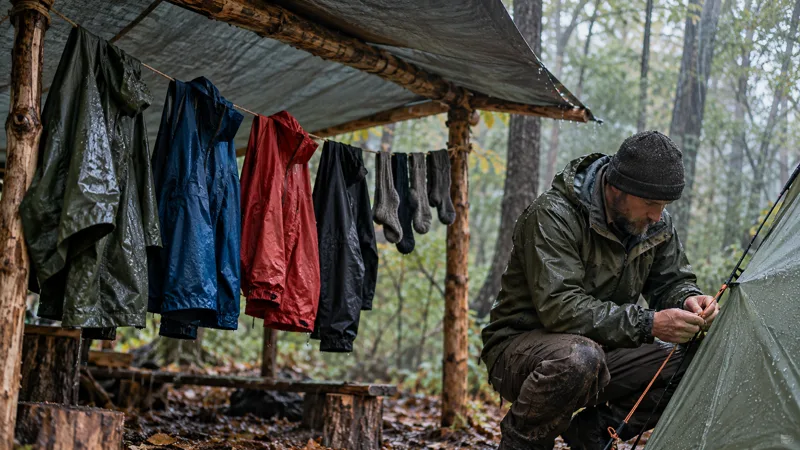
No article can forecast the exact conditions of a future Missouri course. Review the current forecast close to departure and ask about the provider's severe-weather policy. The planning issue is how you respond if conditions differ from expectations. Organize dry clothing separately from items that may get soaked. Verify that closures on protective bags work. A rain layer should fit over the clothing you actually intend to wear, rather than only over a light shirt used for a store fitting.
Think about the transition after activity. Where will wet footwear go? How will a damp outer layer avoid soaking insulation in the bag? Can you change into dry clothing without losing small items? These are ordinary camp-management questions and do not require practicing exposure. Avoid deliberately becoming cold or wet to test resolve. Controlled preparation should reduce risk; demanding field exercises, if any, belong under the supervision and safety arrangements of the confirmed provider.
Water, meals, and the uncertainty between them
Ask whether drinking water is supplied, where containers can be refilled, and whether meals are included. If food is your responsibility, clarify storage, cooking facilities, dietary restrictions, and waste arrangements. The listing does not prove that there is a shared kitchen, a fire pit, or a food procurement exercise. Bring familiar foods that fit the approved arrangements. Long instruction days are a poor time to discover that a meal is difficult to prepare or does not agree with you.
Water treatment equipment requires manufacturer instructions and knowledge of its limitations. Do not assume a source is suitable because it looks clear. Ask the provider how water safety is managed and whether participants need their own treatment method. If a water activity is included, use professional instruction rather than improvised advice from other participants. Equipment comparisons can wait until the setting is understood: speed, maintenance, weight, and compatibility with available containers all matter, but none makes every source safe.
Personal needs are operational details
Consider hearing, vision, mobility, allergies, sleep needs, and prescribed medication when assessing suitability. Discuss relevant accommodations privately with the organizer and consult a qualified clinician for medical questions. Ask how emergency assistance is summoned and how a participant can leave an activity safely. Knowing the exit process is part of responsible participation, especially when a course has an advanced label. It does not imply that you expect to use it or that the event has unusual hazards.
Store essential personal items where you can identify them promptly. Keep medication in its appropriate packaging and follow professional storage advice. A written emergency contact and a concise description of relevant needs can be useful when a phone is unavailable. Avoid treating a first-aid pouch as a substitute for training. If your current preparation has a gap, seek an appropriate recognized first-aid course separately; do not assume that this particular event provides medical instruction or certification.
Use a notebook to capture decisions
An advanced learning opportunity becomes more valuable when notes record reasons, not just steps. After an explanation, write which conditions made the demonstrated choice appropriate and which conditions would change it. For example, a shelter selection might depend on available space, ground conditions, weather, group size, and permitted materials. Those relationships are more transferable than copying a shape without understanding the constraints. Ask instructors to clarify limitations when the answer is not apparent.
Keep a small distinction between observation and interpretation. Record what was demonstrated, then separately record what you think it means for your usual outings. This prevents a single classroom example from becoming a universal rule. It also makes later follow-up more precise. Rather than asking whether a tool is good, you can ask whether it is suitable for a particular load, climate, task, or maintenance routine. Respect the provider's photography rules and other participants' privacy while documenting your learning.
Finish with a realistic transfer plan
After a multi-day event, equipment needs drying, cleaning, inspection, and replenishment. Schedule time for that work so the next outing does not begin with a damp sleeping system or depleted lighting. Review what caused repeated difficulty and identify whether the cause was knowledge, fit, organization, or an actual equipment failure. Buying something new is only one possible response. Sometimes a label, a different pocket, or a shorter packing list is the more effective change.
Select two or three skills to revisit in a safe setting after the course. Give each practice a modest purpose and clear stopping point. Keep specialized techniques within the limits of the instruction received and local rules. The useful result is a better relationship between judgment and equipment, supported by honest awareness of your limits. Before any of that can happen in Lebanon, confirm the recorded October 11–15 dates and the provider's current requirements through the event source.