
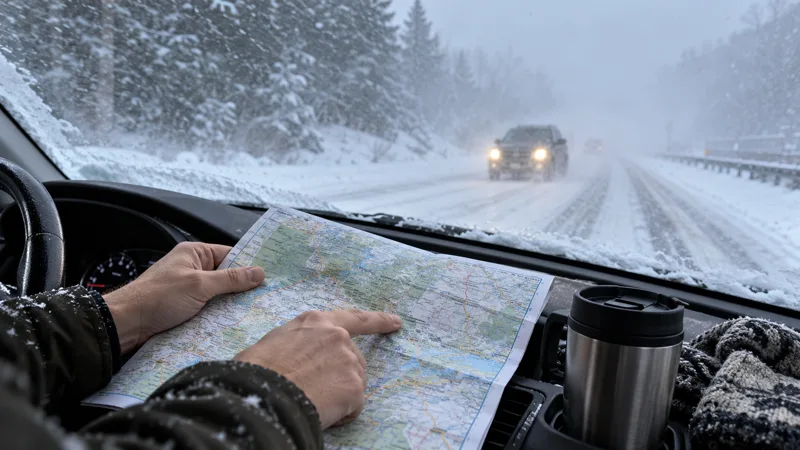
Snow Squall Awareness Week: a Pennsylvania travel planning guide
Snow Squall Awareness Week is listed for November 9–13, 2026, in Pennsylvania, USA, matching the current National Weather Service awareness calendar. The original regional winter awareness page provides related education, but a campaign listing does not establish a ticketed course or a confirmed daily program. Consult current local announcements for specific activities. The discussion below is an independent guide to preparing household travel decisions and using reliable information, rather than a substitute for live weather warnings or a description of instruction offered during the campaign.
A snow squall deserves a different kind of preparation from a long winter storm. A family can often rearrange plans for a forecast day of heavy snow. A short burst of dangerous conditions, however, can collide with a routine school pickup, delivery route, or drive home. The National Weather Service describes snow squalls as a fast developing hazard capable of producing sudden whiteout conditions and icy roads. Its central advice is to avoid or delay travel when a squall threatens. The planning problem is therefore less about enduring a lengthy expedition and more about creating permission to interrupt an ordinary journey.
Make the decision before the keys are in your hand
Write down the trips your household considers unavoidable. Work shifts, medical appointments, childcare transfers, and visiting relatives may all belong on that list. Then ask a harder question: which part truly cannot change, and which part has simply never been discussed? A workplace may accept a delayed arrival when notified early. A neighbor may be available for pickup. An appointment may have a telephone option. None of those possibilities can be relied upon without an agreement, but discovering them before a warning creates practical flexibility.
A useful household rule is to separate departure decisions from frustration. If the forecast or an official warning affects the route, pause and reassess before leaving. That rule should apply even when the sky above the driveway looks clear. A person who must make a decision while already late tends to give too much weight to the original schedule. Put the rule in a shared calendar note or near the car keys. Its purpose is to make a change of plan feel like normal preparation rather than a personal failure.
Know what information will reach each driver
Weather information is only useful when the person making the travel decision receives it. Check the phone settings of every regular driver, using the device's current instructions. Confirm that emergency alerts are enabled where supported. Save the local National Weather Service forecast page and learn which county names apply to home, work, and the usual route. A regional headline can be confusing when a commute crosses several counties. Recognition of place names makes it easier to understand whether a message concerns the road ahead.
Do not design a system that requires reading an alert while driving. Agree that the driver will review information before departure and, if necessary, at a safe stopping location. A passenger can help interpret a message without distracting the driver. Employers operating several vehicles should assign somebody who is not driving to monitor official updates and communicate decisions through their established procedures. This is a planning suggestion, not a promise that any particular alert system will detect every hazard in time.
Examine the route as a chain of commitments
A commute is not one decision. It is a sequence of junctions, ramps, bridges, and places where changing direction becomes harder. Look at the route while you are at home. Identify ordinary destinations where a trip can be postponed before joining a high speed road: your own driveway, a staffed workplace, or a legitimate public stop. This exercise is not an invitation to search for a shoulder once visibility collapses. It is about preserving choices early, while access and traffic conditions are still normal.
Consider the return journey separately. Leaving home in good conditions does not guarantee a safe drive back. If an event lasts several hours, the household should know who will check the forecast again and when. For a teenager's first winter season behind the wheel, rehearse the conversation: “I have reached the venue, but I am delaying the return because conditions changed.” That message is much more useful than an argument about whether the driver is brave enough or whether a particular tire can handle snow.
Use vehicle preparation to support a delay
A reliable vehicle remains important even when the main strategy is staying off a hazardous road. Follow the vehicle manufacturer's maintenance guidance and arrange professional attention for worn tires, poor visibility, or unreliable heating. Check that lights and windows can be kept clear before departure. Keep the car's normal supplies organized rather than scattered under seats. The driver should know where a flashlight, charging cable, warm outer layer, and contact information are stored without searching through an unfamiliar bag.
Think about a delay at the destination as well as an emergency on the road. A spare personal necessity, food you normally tolerate, and an extra layer may make waiting at work or a public building less stressful. That reduces the pressure to attempt a journey simply because being delayed is uncomfortable. Tailor supplies to the people who actually use the vehicle. A child's needs, a prescription schedule, or a mobility aid may matter more than a long list of specialized tools that nobody has practiced using.
A family rehearsal that does not involve dangerous driving
Try a tabletop scenario on a quiet evening. Choose a normal weekday and say that a snow squall warning affects the homebound route. One person is at work, another has a child at an activity, and a third is expecting a ride. Ask everyone to state the next phone call they would make. Do not turn the exercise into a competition. The useful result is discovering that two people assumed the other would contact the school, or that a relative's current number is missing.
Run the scenario again after correcting those gaps. Change one detail, such as a phone with low battery or a caregiver who cannot answer. Keep the exercise focused on communication and scheduling rather than inventing hazardous maneuvers. The rehearsal should end with a small number of decisions written in clear language. “Call this person if pickup changes” is easier to follow than a complicated flowchart. Recheck the arrangement whenever work hours, school activities, or household membership changes.
Differentiate a warning from a social media photograph
A photograph of blowing snow can be useful context, but it may show another road, another hour, or another winter. Treat official forecasts and warnings as the starting point for your decision. If a friend shares a dramatic image, ask where and when it was taken before using it to judge conditions. Equally, a calm photograph near home does not disprove a warning elsewhere along a route. The issue is the travel corridor and the relevant time, not whether one location looks reassuring.
Save screenshots only when they preserve a clear timestamp and source. A screenshot without either can circulate long after it is useful. When notifying coworkers or relatives, communicate the decision directly: the trip is delayed, the driver is staying at a particular place, and the next update will come at an agreed time. Repeating uncertain details about the storm adds noise. A short, accurate message allows the people waiting for you to revise their own plans without guessing what you intend.
Prepare organizations for interrupted arrivals
Small businesses, volunteer groups, and youth organizations can reduce risk by describing how they handle late arrivals during weather warnings. Put the policy where participants can find it. Identify who can authorize a cancellation and how families will hear about it. An activity that continues as scheduled may still need to accept that some participants cannot travel. Avoid language that makes attendance seem like a test of commitment. A clear weather policy helps individuals make conservative decisions without worrying that they are disappointing the group.
For deliveries or appointments, examine the consequences of cancellation in advance. A fee, an angry customer, or an unclear supervisor expectation can become a powerful reason to take a risk. Resolve that pressure at the administrative level, rather than asking the driver to balance it at the edge of a storm. This kind of preparedness is inexpensive but requires somebody to own the decision. The awareness week offers a useful deadline for putting the policy into writing and reviewing it with the people affected.
What a successful awareness week leaves behind
The best outcome is not a collection of dramatic winter photographs or a promise to be more careful. It is a household with working alert settings, recognizable county names, an agreed pickup alternative, and a workplace conversation about delayed travel. Choose one improvement that can be completed this week. Then choose one that needs a later appointment or another person's cooperation. Giving each task an owner makes the work more likely to happen than adding it to a vague winter checklist.
After the first warning of the season, review the plan without judging anybody's reaction. Did the information arrive? Did the driver understand the location? Did the waiting person receive a useful update? Were people pressured to keep driving because the alternative had not been arranged? These questions turn a weather event into evidence for better preparation. Keep the National Weather Service resources bookmarked and follow current official instructions when conditions develop. A short disruption handled thoughtfully is a much better result than a routine trip that becomes an avoidable emergency.
Sources and listing verification
Original Pennsylvania awareness source and National Weather Service snow squall safety provide the listing context and hazard guidance. Consult current local announcements for campaign dates and current forecasts for travel decisions. Browse events or continue reading Survival Skills.