
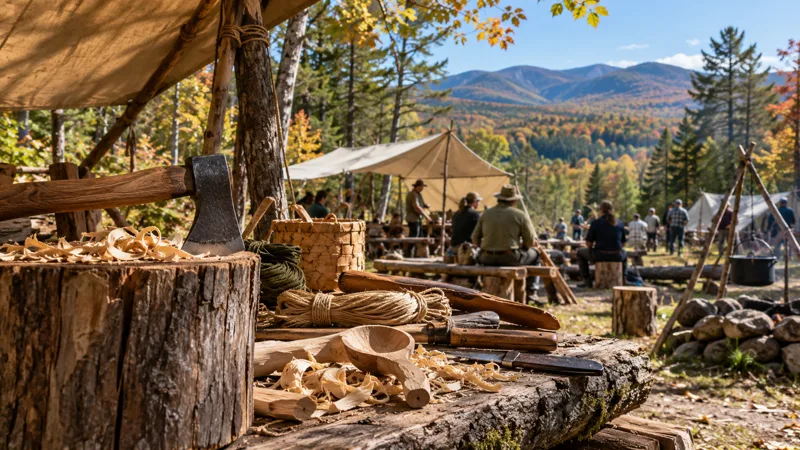
Archived event: These dates have passed as of October 7, 2026. This page retains the original listing for reference; consult the provider for later offerings.
Roots Rendezvous was listed for September 5–7, 2026 in Bradford, VT, USA.
This is an archived event listing. These dates have passed; do not use this page as confirmation of a future edition.
Event details
- Dates: September 5–7, 2026
- Location: Bradford, VT, USA
- Type: Bushcraft & Wilderness
View the event source and registration information
Using a gathering as a map of your next year of learning
Roots Rendezvous is useful to consider as a meeting point between interests rather than a test of how many skills you already possess. The archived September listing belongs to Bradford, Vermont, and should remain attached to that place and date. The planning ideas below are independent editorial guidance for readers considering a later gathering. They do not establish the sessions, instructors, or arrangements of another edition. A small community event can introduce several directions at once: making things, observing the woods, working with tools, or improving camp routines. Your job is to discover which direction you actually want to pursue when you return home.
Start by naming something you would like to make or understand, then make that goal concrete enough to discuss. “Primitive skills” is a large category. “I want to understand why the cordage I made comes apart” gives an instructor a usable question. Another participant may be interested in reading tracks or fitting a tool handle. Those goals can coexist without anyone needing to master every subject. Write three questions before leaving home and leave space for the answers. A gathering becomes easier to navigate when you recognize a relevant demonstration instead of wandering between everything that looks interesting.
Choose depth without closing the door to discovery
A schedule packed from morning to evening may appear efficient, yet it leaves little room to absorb unfamiliar material. Select one anchor activity for each portion of the day, then reserve some open time. If a demonstration catches your attention, ask what a beginner should practice afterward and what equipment would be necessary. You are assessing a learning path, not collecting an impressive list of experiences. Two hours spent understanding a simple task can provide more direction than ten demonstrations observed from the back of a crowd. The appropriate balance depends on your experience and the structure of the actual program.
When activities overlap, compare their demands rather than their titles alone. One may offer a brief overview; another may require attendance from start to finish. Ask whether an instructor expects participants to have completed an earlier session. If materials are limited, follow registration procedures instead of assuming you can join midway. A respectful observer can still learn, but should not interrupt an active group or borrow someone else's tools without permission. Keep a note of a missed subject and use it to choose later training. A missed opportunity is often a useful clue about what matters most to you.
Camp routines make the learning day easier
An overnight arrangement is part of your learning environment. Confirm the current provider's camping policy, arrival window, food arrangements, water access, and sanitation information before preparing a pack. The archived directory mentions personal camping and food planning, but those historical details do not guarantee the same arrangements in a later year. Think through the time between sessions: where will you refill a bottle, put down a wet jacket, or eat lunch? Answering ordinary questions in advance preserves attention for the work you came to do. Your campsite should support rest and organization rather than become a separate ambitious project.
Pack a familiar shelter instead of using the trip as its first test. Find out whether vehicle access ends at parking or continues to campsites. That answer changes how much equipment you can reasonably move. Put essentials for the first hour in one accessible bag: confirmation, directions, water, an outer layer, and personal necessities. Keep specialized class materials separate until requested. A tidy system also makes departure easier, because unfinished projects and damp clothing will not disappear beneath unrelated items. Leave enough room to bring home a project safely without packing a sharp or fragile object loose among your clothes.
Make observation a deliberate skill
A craft demonstration contains more than the obvious movement of the hands. Watch how the instructor positions materials, organizes the work area, checks progress, and recognizes a mistake early. These habits often explain why the task looks controlled. Ask about the signs of a good result before asking about speed. If your own attempt differs, describe what you noticed rather than labeling it a failure. That language opens a useful conversation: did the material behave differently, did you change the angle, or did you miss a preparation step? A small observation can point to a specific practice goal.
You can record those observations without turning the entire experience into a video shoot. A short sketch and a few words may be enough. Request permission before photographing instructors, participants, or their work. Some knowledge is shared in a particular teaching context and should not be posted as your own instructional content. Write down the provider's name alongside a lesson so you can give proper credit later. If you cannot explain a step accurately, mark the uncertainty. Honest notes help you seek clarification; confident notes that omit a critical qualification can mislead you months after the event.
A thoughtful approach to the trade table
The historical listing refers to an optional trade opportunity. If a later gathering includes something similar, treat it as a social exchange with clear expectations. Bring items you understand and can describe honestly. A handmade object may carry hours of work, while a purchased item has different appeal. Ask the other person what they value instead of trying to calculate a universal exchange rate. Make clear whether an item is for display, discussion, or trade. A friendly conversation should never create pressure to surrender a tool or keepsake you intended to retain.
For equipment, disclose wear, missing parts, and uncertain history. You should also ask about limitations before accepting an unfamiliar item. A tool offered at a gathering is not automatically appropriate for your intended task, and a traded object does not arrive with formal instruction. If the event has restrictions on particular items, respect them. Consider bringing a modest project that invites conversation even if you do not complete a trade. The value may be learning how someone else chose a material or solved a construction problem. That insight can outlast the novelty of taking home another possession.
Material choices deserve patient questions
Beginners often concentrate on the finished object and overlook the material selection that made it possible. Ask how an instructor evaluates a piece before beginning and which defects make it unsuitable. You do not need to harvest anything during the event to learn this distinction. A sample laid on a teaching table can reveal differences in grain, flexibility, texture, or condition. Follow the instructor's boundaries about handling it. Permission to attend a course does not grant permission to gather plants, cut branches, or remove objects from the surrounding property. Procurement is a separate question from technique.
When you return home, choose practice materials from lawful and appropriate sources. Record their origin so you can compare attempts meaningfully. Two projects made with different materials may produce different results even if your movements remain consistent. This is a useful reason to begin with one straightforward exercise and repeat it before adding complexity. If a material is unfamiliar, seek provider guidance rather than guessing from a common name. A class can show what to look for, but identification and collection decisions still belong to the place where you are working and the rules that apply there.
Learning in company without comparing yourself harshly
A gathering brings people with very different histories together. One person may demonstrate a skill learned over decades while another is holding the relevant material for the first time. Comparing finished work without considering those histories is discouraging and rarely informative. Ask what changed the experienced person's practice. They may describe a course, a repeated mistake, or a simple routine. Those answers are more useful than assuming talent explains everything. Offer your own observations respectfully and let an instructor resolve technique questions when the activity involves risk or specialized knowledge.
Families and groups should discuss expectations before arrival. Someone who loves a long craft session may need a different pace from someone who wants short demonstrations and time outdoors. Identify meeting points and check-in times using the event's actual arrangements. Let every participant choose at least one priority within the available program. That prevents the most enthusiastic person's interests from controlling the entire trip. Good companionship includes knowing when someone needs a break. A pleasant, manageable first gathering is more likely to lead to continued learning than a weekend remembered primarily for exhaustion and arguments.
Turn the trip into a realistic practice plan
Before unpacking completely, sort your notes into three groups: something you can repeat safely now, something requiring clarification, and something requiring further instruction. The first group should contain a modest exercise with materials you already have permission to use. The second group becomes a message to the provider. The third becomes a training decision, not an invitation to improvise a dangerous task. Put a date on the first practice session. Without that small commitment, even excellent notes can remain at the bottom of a bag while your enthusiasm fades.
After several attempts, evaluate progress by what you can explain and repeat. A photograph of a finished object is pleasant, but a record of how you selected the material and corrected a problem is more useful. Keep one early attempt as a comparison if practical. When considering your next event, choose a subject that addresses a real gap rather than repeating the broadest introductory offering automatically. Roots Rendezvous remains an archived reference here; the enduring value of this page is a method for turning a social learning weekend into sustained, responsible practice in your own surroundings.