
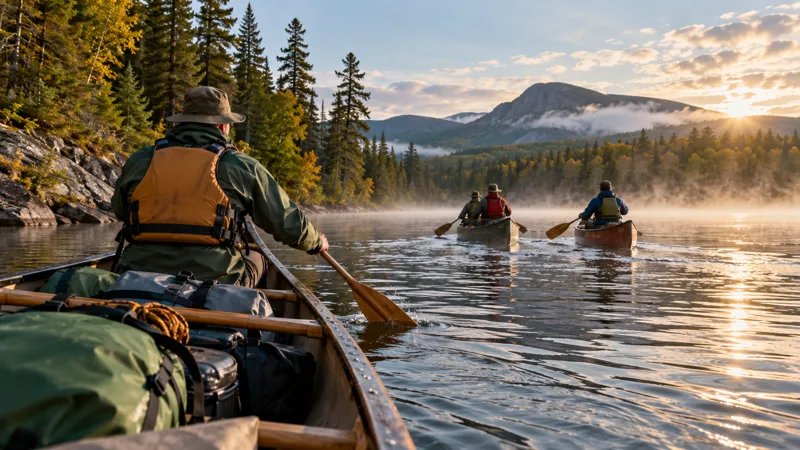
Choosing canoe guide training with honest expectations
Professional canoe guide training asks a different question from a recreational paddle. A recreational participant may mainly want to enjoy the water and develop personal ability. A prospective guide also needs to consider other people's decisions, expectations, and dependence on the group. The title of a course can suggest that direction without proving what qualification it awards. Before committing to any future program, find out exactly what is taught, how competence is evaluated, and what additional requirements apply to the work you hope to do.
The saved listing lists Professional Canoe Guide Training Course, WBS Session 3, for September 6–25, 2026, in Masardis, Maine. That session is now archived by date. This article preserves the listing and offers a framework for evaluating training and preparing questions. It does not certify the course, claim that its participants qualified for employment, or provide rescue instruction. A directory page is evidence of a listing, not proof of a person's professional readiness.
Saved event facts
- Title: Professional Canoe Guide Training Course (WBS Session 3).
- Dates in this listing: September 6–25, 2026.
- Listed place: Masardis, ME, USA.
- Recorded category: Wilderness Survival.
- Listing source: FeralSkills.
- Status of these dates: past as of October 7, 2026.
Consult the saved event source. Retrieval of this directory page was inconsistent during review, including a later unavailable response. Treat the dates and place as preserved listing information and obtain current details from the relevant school before planning another session.
Define the role you want to prepare for
Guiding can mean different kinds of responsibility. You may imagine leading short trips on familiar water, assisting an experienced leader, or eventually participating in longer journeys. Write down the role in plain language, including the people you expect to support and the setting you have in mind. Then ask a training provider whether its program addresses that role. A useful answer explains both its scope and its limits.
Ask who determines any legal or employer requirements for your intended work. Do not assume that completing a course automatically satisfies state requirements, an insurer's conditions, or an organization's hiring standards. Obtain current guidance from the relevant authority and prospective employer. Record those requirements separately from the school's promotional language. You are evaluating how the course fits a larger pathway, not asking a single weekend or session to stand in for every part of professional preparation.
Request an assessment description
Instruction and assessment are not the same thing. A program may offer valuable exposure to topics without formally assessing every student's independent ability. Ask what completion means: attendance, participation, a practical evaluation, a written evaluation, or some combination. Ask whether the assessment conditions are described beforehand and how a participant receives feedback. These questions help you interpret the outcome honestly when explaining your training later.
Also ask what happens when a learner needs more time. Is additional practice available? Can an assessment be repeated? What evidence should a participant retain? A transparent process is more useful than a promise that everyone will leave feeling confident. Confidence can increase before competence has caught up. The safest learning plan gives you a way to identify incomplete skills and arrange further supervised practice rather than hiding them behind a certificate.
Discuss the actual water environment
A place name does not describe a course's operating water, route, launch arrangement, or access conditions. Ask the organizer which information is available before the session and what may change with conditions. Clarify whether activities are on sheltered water, moving water, or other settings, without assuming that the event title provides the answer. Ask how instruction is adjusted when the planned setting becomes unsuitable.
The National Park Service's river and stream safety resource emphasizes planning for the specific waterway and matching equipment to the activity. Use that as a reason to ask detailed questions, not as a shortcut to judge unfamiliar water yourself. A canoe suitable for one setting is not automatically appropriate everywhere. Get qualified instruction for the conditions you intend to encounter, and follow the land manager's current access information and restrictions.
Wear and fit matter more than owning equipment
The United States Coast Guard's recreational boating guidance encourages wearing an approved life jacket and checking applicable state rules. Discuss fit and suitability with a qualified instructor before entering the water. Do not treat a life jacket stored nearby as equivalent to one worn appropriately. Equipment selection should account for the individual user and the activity, following manufacturer directions and current official requirements.
For a future course, ask whether equipment is supplied, whether personal equipment must be inspected, and what clothing is required. Do not buy a large specialized kit before receiving the actual list. When you do acquire something, keep the instructions and learn its intended use in the proper instructional setting. A packing photograph cannot show whether an item fits or whether a participant understands it. Those questions deserve direct attention.
Plan to learn communication, not just movement
Boat handling is only part of a group's experience. Ask how a program teaches communication between participants and between boats, if that is within its scope. Who announces changes? How is a learner's uncertainty communicated? What signals does the instructor use, and when should the group stop for clarification? Follow the system taught in the actual session rather than mixing signals learned from unrelated material.
In your notes, record the meaning and limits of each communication procedure. Avoid memorizing a gesture without understanding the circumstances in which it is used. If a partner interprets it differently, ask the instructor to settle the difference. Clear communication can be practiced in a calm classroom conversation before it is expected during a water activity. The objective is shared understanding, not an elaborate vocabulary that newcomers cannot follow.
Put the float plan into a real person's hands
An itinerary has limited value if nobody knows it exists. Ask the course organizer what information participants should leave with a trusted contact and which details the organization handles. A personal float-plan arrangement should identify who receives updates and what they should do if the expected return changes. Use official guidance for the area and avoid inventing emergency procedures based on assumptions about response availability.
Discuss how schedule changes will be communicated before departure. If the organizer adjusts the route or timing, find out whether your contact needs an update. Keep essential contact details accessible in an appropriate format, accounting for the possibility that a preferred device is unavailable. Privacy still matters: share information with the people who need it, rather than posting detailed travel and personal data publicly. Good planning is specific without being indiscriminate.
Keep medical and rescue training distinct
A prospective guide should know what first-aid and rescue education is relevant to the intended activity, but the correct pathway depends on the role and setting. Ask qualified providers and prospective employers about recognized training. Do not assume that a canoe course includes medical certification or that an introductory rescue discussion qualifies you to attempt a rescue. This article intentionally offers no improvised rescue technique or medical protocol.
Before booking, ask the organizer how emergencies are managed during instruction and how personal access or health concerns should be discussed. Provide necessary information privately through the organizer's process. If a professional recommends limits or accommodations, address those before participation. Honest disclosure supports a suitable learning arrangement. Concealing a concern to appear ready can leave instructors and partners working from incorrect assumptions about what you can safely do.
Use an observation log during training
A learning log can help distinguish a lesson you understand from an action you can perform reliably. Record the task, the setting in which you practiced, the feedback received, and the next practice need. Add whether you performed it independently under supervision or only observed it. This distinction prevents your memory from turning an impressive demonstration into a personal capability that was never actually tested.
Keep descriptions factual. “Needed a reminder to communicate before changing position” tells you what to improve. “Bad at guiding” offers little direction. After a session, look for recurring issues involving attention, organization, or explanation. Ask the instructor which practice is most appropriate next. A short, honest log can support future training discussions and help you choose a more suitable course level than a broad claim about experience.
Consider the learner experience from both sides
Notice what makes instruction understandable. Does an explanation define its terms? Is the demonstration visible? Can a participant ask a question without delaying the whole group? These observations do not qualify you to teach, but they can help you recognize how much thoughtful preparation effective instruction requires. A future guide's role includes helping other people understand what is happening rather than assuming they share the leader's experience.
Practice describing an ordinary, nonhazardous planning task to a partner on land. Ask them to repeat what they understood. If the explanation was unclear, revise it. Avoid turning that exercise into unsupervised water coaching. The point is to learn the limits of your communication and seek appropriate teaching experience. Clear explanations, humility about unfamiliar conditions, and willingness to request assistance are professional habits worth developing alongside technical skills.
Choose a next step supported by evidence
After any future training, compare the documented outcomes with the role you originally described. Identify which requirements remain unmet and who can assess the remaining skills. Arrange practice under qualified supervision appropriate to that setting. Do not immediately increase difficulty simply because a course has ended. A sensible progression respects what was actually learned and what has not yet been demonstrated.
Primary references for general planning are National Park Service river and stream safety and United States Coast Guard life-jacket guidance. Consult those sources and current local authorities for official advice. The archived Masardis listing remains a record of supplied dates, while your next training decision should rest on current, specific information.