
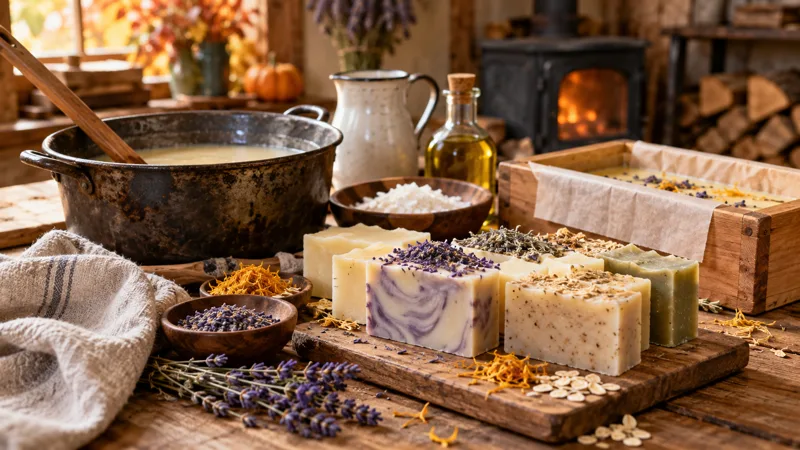
Old Fashion Soap Making: make the workshop useful before buying supplies
Old Fashion Soap Making – Fall Class is listed for November 21, 2026 at MNSI, 1721 E. Sprague Road, Seven Hills, Ohio. The Midwest Native Skills Institute home-skills workshop page includes soap making within its November program. Confirm the particular class option, hours, remaining availability, equipment and take-home arrangements directly with the provider. A page covering several workshops can contain information that applies to a different activity. The discussion below is an independent planning guide for learning the craft responsibly. It is not a formula, chemical-handling procedure or promise about what this particular class will teach.
Choose a reason to learn beyond nostalgia
Making a familiar household product can be satisfying, but an appealing historical image is not a complete plan. Decide whether you want a creative hobby, a better understanding of ingredients or a practical household skill. Those goals influence the questions you bring. A hobbyist may care most about repeatability and storage; someone considering regular household use may need to understand cost, consistent quality and whether other family members tolerate the product. There is no requirement to turn the first workshop into a business or an entirely homemade household.
Keep the first project small. Learning how to follow an instructor's complete method, document a batch and understand its limitations is substantial progress. An ambitious collection of oils, fragrances, molds and colors can make the work more confusing before you understand the basics. Ask what the provider supplies and what participants should leave at home. Arriving with a large bag of unrelated materials may interrupt a demonstration designed around a specific formula. A focused notebook can be more valuable than a new collection of specialty tools.
Ask which kind of soap-making activity is involved
Soap workshops can involve different materials and processes. The title alone does not tell you which one you will use, whether participants handle caustic substances or whether a prepared base is involved. Ask the provider to describe the process and safety requirements clearly. Find out what protective equipment is provided, what you must bring and how the work space is arranged. If the explanation is unclear, resolve it before registering. A hands-on class should make responsibilities understandable rather than assuming every participant already recognizes the hazards.
Sodium hydroxide, commonly called lye, is a hazardous caustic chemical. The CDC NIOSH Pocket Guide entry for sodium hydroxide identifies important exposure hazards and protective considerations. Consult the instructor and the specific product's safety information; do not treat the pleasant appearance of a finished bar as evidence that all stages of its production are harmless. This article deliberately leaves chemical measurements and procedures to qualified instruction. If an exposure occurs, obtain appropriate emergency or poison-control assistance rather than improvising treatment from hobby advice.
Evaluate whether home practice is realistic
The classroom may have a dedicated work area that your home lacks. Before planning a follow-up batch, think about interruptions, storage, ventilation, access to water and the ability to keep children and pets away from materials. Discuss your actual space with the instructor. A shared kitchen can create conflicts between food preparation and craft work, so ask how equipment should be separated and identified. A good plan describes where materials will be kept before, during and after use. “I will be careful” does not answer those practical questions.
Consider what happens if the project must stop unexpectedly. A child needs attention, someone arrives at the door or you realize that an essential item is missing. Ask the instructor how the process should be organized to prevent avoidable interruption and what to do when something does go wrong. Do not start home practice until you have a complete, suitable method and understand its safety arrangements. Some households may reasonably decide that supervised workshops are a better setting than independent production. That is still a useful outcome from the class.
Learn to read a complete formula
A formula is more than a list of ingredients. It should have an identified source, clear units, the intended process and the conditions under which it is used. During instruction, ask how the provider checks a formula and how participants avoid transcription errors. Copying a number without its unit or changing an ingredient casually can create a different project. Keep the original approved instructions with your notes. Do not assume that a recipe found in a social-media comment has the same basis as the method demonstrated by the instructor.
Ask how substitutions are evaluated. You may already own an oil or fragrance and wonder whether it can replace something in the demonstration. Bring that question, but do not make the substitution on your own. Ingredients can differ in ways that matter to the process and finished product. A beginner's useful skill is recognizing when the available knowledge is insufficient. If the instructor advises keeping the formula unchanged while learning, follow that boundary. Creativity becomes more meaningful when it rests on a method you understand rather than on accidental variation.
Record one batch clearly enough to revisit it
A batch notebook should identify the approved formula, ingredient names, dates and observations the instructor recommends recording. Include any uncertainty, rather than writing a success story after the fact. If you misread a label or cannot account for a measurement, say so and ask for guidance. The record is a way to diagnose and prevent mistakes, not a document that makes an uncertain product acceptable. Label training samples exactly as directed and keep them separate from ordinary household products until their intended status is clear.
Photographs can support notes, but an attractive picture of a finished bar tells little about how it was produced. With permission, photograph labels or demonstrated equipment so you can identify them later. Add context while you still remember it. Write down the questions answered in class and the questions left open. If the method involves waiting, curing or testing before use, obtain the provider's specific instructions rather than making a calendar assumption. Do not give away a sample simply because you are excited to show someone what you made.
Inspect equipment against a defined task
Ask which tools are essential, which are convenient and which the instructor uses because they already own them. An experienced maker's collection may be much larger than a beginner needs. Compare readability, durability, cleaning requirements and compatibility with the demonstrated materials. If a scale or other measuring device is required, ask how to select and check it for the task. Do not substitute equipment merely because its appearance is similar. The point of the class is to understand why a tool is appropriate, not only what brand appears on the table.
Keep craft equipment identifiable. Household members should not have to guess whether a container is used for cooking or for a chemical process. Discuss storage and cleaning requirements with the provider and consult product instructions. Consider the full life of an item: where it is bought, where it is kept, how it is used, how it is maintained and how it is retired. Those questions are less glamorous than choosing a mold, but they determine whether a hobby remains manageable. Buying fewer suitable items can reduce clutter and uncertainty.
Think about the people who will use the product
A product you enjoy may not suit everyone in your household. Ask about ingredients and labeling, especially when considering fragrance or additives. Do not infer that handmade, natural or old-fashioned automatically means gentler or suitable for sensitive skin. Avoid medical claims about treating a condition unless they are supported by appropriate professional guidance. If someone has a skin disorder or a known allergy, discuss product use with the relevant health professional. The workshop can improve ingredient awareness without giving you authority to diagnose or treat another person.
For gifts, provide clear information rather than a vague assurance that the product is pure. Follow the instructor's guidance on readiness, storage and identification. Someone receiving a bar should know what it is and what ingredients it contains. Keep samples out of reach of people who may confuse them with food or another product. Attractive packaging is a later task, after quality and suitability have been considered. A thoughtful gift respects the recipient's preferences and limitations instead of expecting them to use something simply because it took effort to make.
Calculate the hobby's practical cost
Write down the cost of the class, equipment, ingredients and storage supplies before buying a large inventory. Compare those costs with the amount you expect to make and use. A first batch is partly education, so it need not be the cheapest way to obtain soap. However, describing the project as a money-saving strategy requires a realistic estimate. Include materials that expire, unused ingredients and the time required to keep records and clean up. Buying bulk quantities too early can create waste rather than independence.
Business plans require another layer of research. If you eventually want to sell a product, obtain current guidance about labeling, product classification, insurance and applicable local requirements from authoritative sources and qualified advisers. This article does not establish those rules. A workshop attendance record is not a business license or a guarantee that a product is ready for sale. First establish a reliable learning process and understand the difference between making a sample for yourself and accepting responsibility for products supplied to others.
Use the workshop to build judgment
Before class ends, ask the instructor to review your understanding of the next appropriate step. You might be ready to follow the approved method at home, need another supervised session or decide to keep the activity occasional. Any of those can be reasonable. Identify one question about materials, one about equipment and one about safety that you can now answer more clearly. That review helps separate useful learning from the temporary enthusiasm of a successful demonstration. Keep the contact information or recommended references supplied by the provider.
The November 21 listing is a chance to investigate a traditional household craft with modern care. Confirm the event arrangements, learn the process actually being taught and make honest decisions about your home environment. Independence is not measured by refusing purchased products or by producing the largest batch. It is the ability to understand a task, choose appropriate instruction, recognize hazards and keep a method repeatable. A modest, well-documented project can teach more than a shelf of elaborate bars whose ingredients and production history you cannot explain.