
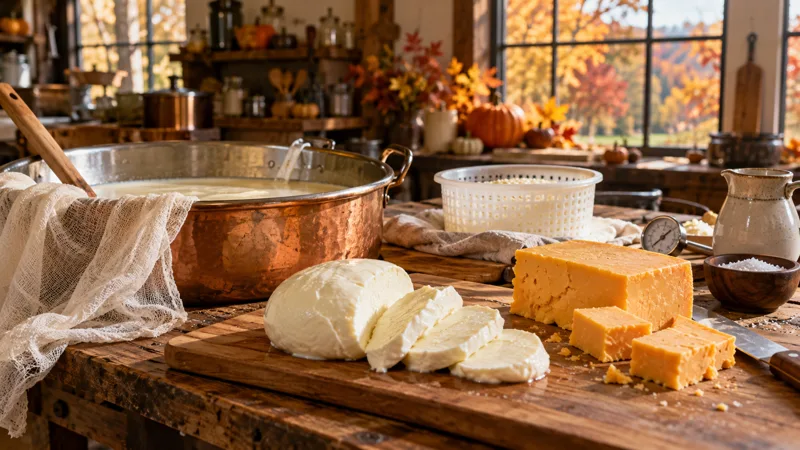
Fall – Cheese Making Class is listed for November 15, 2026 in MNSI 1721 E. Sprague Rd., Seven Hills, OH, United States.
Event details
- Dates: November 15, 2026
- Location: MNSI 1721 E. Sprague Rd., Seven Hills, OH, United States
- Type: Survival & Self-Reliance
View the event source and registration information
What the November cheese class actually establishes
Fall – Cheese Making Class is listed for November 15, 2026, at MNSI, 1721 E. Sprague Road, Seven Hills, Ohio. The provider's product page describes an afternoon offering that introduces mozzarella and cheddar. Obtain current registration details from the school; this planning guide does not guarantee availability or reproduce its recipes. The distinction between fresh cheese and an aging project is important when deciding what you want to learn. A satisfying classroom result and the ability to manage a repeatable food process at home are different goals. Ask the instructor how the session supports each one.
The editorial sections below focus on preparation, documentation, and questions for qualified instruction. They are not a cheese-making procedure, an aging protocol, or a substitute for food-safety guidance. Food projects should use reliable instructions and appropriate ingredients, storage, and sanitation. The Centers for Disease Control and Prevention recommends pasteurized milk and dairy products to reduce risks associated with raw milk. Do not interpret a craft class as evidence that raw milk is safe or that a traditional process removes every hazard. Clarify the school's ingredient choices and consult authoritative guidance for your own home project.
Decide whether you want a fresh result or a longer project
A beginner may be attracted to making something that can be enjoyed soon, while another reader wants to understand a project that continues after class. Those interests can lead to different questions. For a fresh product, you need clear information about safe handling, transport, and storage. For an aging project, you need to know what approved conditions, equipment, monitoring, and guidance are required beyond the event. Do not assume that a short session supplies everything necessary for the longer path. Ask the provider exactly what students are expected to manage afterward.
Write down the space, time, and equipment you realistically have at home. A project can sound appealing until you consider where it will be kept and how its instructions will be followed. If your available arrangement does not match the requirements, choose a more suitable learning goal instead of improvising. It is reasonable to attend primarily to understand the craft before attempting it independently. A class can help you decide that one style fits your circumstances better than another. That decision is useful even if you do not immediately begin producing cheese in your kitchen.
Clarify participation and food concerns before booking
Ask about the actual format, duration, ingredients, accessibility, and the items participants should bring. Discuss allergies or other dietary concerns directly with the provider before registration. Do not infer suitability from a broad description or assume that substitutions can be introduced during a food activity. If a medical condition affects what you can consume, obtain guidance from your clinician. Participation and tasting are separate questions. You may want to observe a subject that is not appropriate for you to eat, but the provider must confirm whether that arrangement fits its session.
Confirm what is included and what leaves with you. The product page describes materials and take-home items, but those arrangements should be verified for the session you book. Ask for the exact packaging, transport, and storage instructions in advance so you can prepare appropriately. A drive home is part of the food-handling plan, not an afterthought. Do not assume that an ordinary shopping bag or an unplanned stop along the way will be suitable. Clear logistics let the teaching time focus on understanding the process rather than resolving a preventable question at departure.
Record the exact instructions instead of a remembered version
Food work depends on details that can disappear in casual notes. Ask whether the provider supplies written guidance and how to clarify it afterward. Record ingredient identities, equipment specifications, and any important qualifications in the form the instructor recommends. Keep those notes linked to the particular project. Avoid merging steps from separate demonstrations into a recipe no one actually taught. An attractive final product can make a process seem forgiving, but your own understanding should come from complete reliable instructions rather than a memory of how the classroom result looked.
If you miss an explanation, ask before proceeding under supervision. Mark unresolved questions clearly in the written record. Do not fill them with a guess or an unrelated online shortcut. The purpose of the notebook is repeatability and accountability. It should show which information came from the instructor, which came from an authoritative food-safety source, and which remains uncertain. A neat page with hidden gaps is less useful than an honest page that tells you exactly what to clarify. This distinction becomes especially important when a project continues at home after the class has ended.
Equipment questions should concern function and measurement
A cheese class may introduce thermometers, containers, molds, or other tools. Ask what each item does and what characteristics matter for the project described. Do not assume that an ordinary-looking household substitute performs identically. Consult the relevant instructions for any equipment you already own and ask the instructor about compatibility. A measurement tool is useful when the user understands its operation, limitations, and maintenance. Familiarity with the display alone is insufficient. Keep the model information with your notes so that a later question can be answered precisely rather than through a vague description.
Wait before buying optional equipment. A demonstrated item may serve several projects, or it may belong to a more advanced process than you intend to undertake. Write down the function and the reason it was selected. After reviewing the course guidance, decide whether you need the same capability at home. Ask whether loan, shared, or simpler appropriate options exist. This approach can save money while keeping the learning focused. The goal is not a kitchen full of specialized objects. It is a manageable project with suitable tools and instructions you can follow accurately.
Treat sanitation as part of the craft
Food safety should not appear only as a warning attached to an otherwise casual activity. Ask how the provider integrates it into the work area, handling routines, and project instructions. The Food and Drug Administration's safe-food-handling guidance organizes general household practice around cleaning, separation, appropriate cooking, and prompt chilling. That resource is useful context, but a specific cheese project still needs suitable complete instructions. Avoid assuming that a tidy appearance establishes sanitary conditions or that a pleasant smell proves a product safe. The relevant process and professional guidance matter more than confidence in a visual impression.
At home, choose a time when you can follow the complete approved process without repeated interruptions. Prepare the space according to reliable guidance before beginning, and keep the project distinct from unrelated kitchen activity. If a condition differs from the instructions or you are unsure how an interruption affects the result, obtain qualified advice rather than improvising a recovery method. A beginner's aim should be a controlled, understandable exercise. Scaling up or adding variations before you understand the original process can make it difficult to identify why a result differed and whether it remains suitable to use.
Ingredients carry information worth keeping
Record the labels and source information for the ingredients used in a supervised project. This is a learning and traceability habit, not an invitation to experiment with unfamiliar ingredients. Ask the instructor which details matter and how replacements should be evaluated. A product with a similar everyday name may have different properties or instructions. Keep unopened or remaining ingredients according to their labels and appropriate food-safety guidance. If the teacher discusses several options, record the distinction rather than treating them as freely interchangeable. Clear ingredient notes support better questions and more consistent learning later.
Resist the urge to attach broad health claims to a handmade product. The appeal of learning a craft does not establish that the result is healthier for every person or appropriate for every diet. Food choices can involve individual medical needs and should be discussed with qualified professionals when necessary. Likewise, a traditional method is not automatically safer because it has a long history. You can appreciate the craft's cultural and practical interest while using current authoritative guidance. That combination makes the experience more responsible without reducing the pleasure of understanding how a familiar food is made.
Plan the first home attempt as a learning record
If the provider identifies a suitable beginner project, follow its complete reliable instructions and keep the scope modest. Record the project date, the guidance used, ingredient information, and the relevant observations requested by the instructor. Do not measure success solely by whether the result resembles a photograph. Ask how the process should be evaluated and when a result should not be used. Food-safety uncertainty calls for qualified guidance, not tasting as a test. A cautious decision about an unclear result is part of responsible learning rather than evidence that the entire class was wasted.
After the attempt, review one change you would make in preparation or documentation. Perhaps you need clearer equipment labels, a more suitable work period, or clarification of an instruction. Resolve the question before another attempt. Avoid increasing quantity or complexity simply because the first project was enjoyable. A repeatable basic process is a better foundation than several improvised variations whose differences are difficult to explain. The notebook should help you understand the relationship between the instructions and your own work, while keeping uncertainty visible enough to seek appropriate advice before relying on the result.
Keep the class and preparedness claims in proportion
Cheese making can be an interesting food craft and part of a broader interest in self-reliance. It should not automatically be described as an emergency food strategy. A project may depend on suitable ingredients, equipment, storage, and controlled conditions that are not available during an outage or disruption. Ask what the actual requirements are rather than assuming that handmade food is shelf-stable. Broader household food planning is a separate subject. A useful class can increase your understanding without replacing other preparations or establishing a method for every situation in which access to food becomes uncertain.
Use the school's current product page for the November 15 session's enrollment and arrival details. Use CDC and FDA guidance for general safety context, and qualified instruction for the complete project. This page's independent contribution is a way to prepare and learn: define the goal, resolve food concerns, obtain accurate instructions, understand tools, document ingredients, and evaluate a modest follow-up responsibly. The strongest outcome is a craft you understand within its requirements. It does not need exaggerated claims about health, independence, or emergency readiness to be a worthwhile addition to your practical knowledge.