
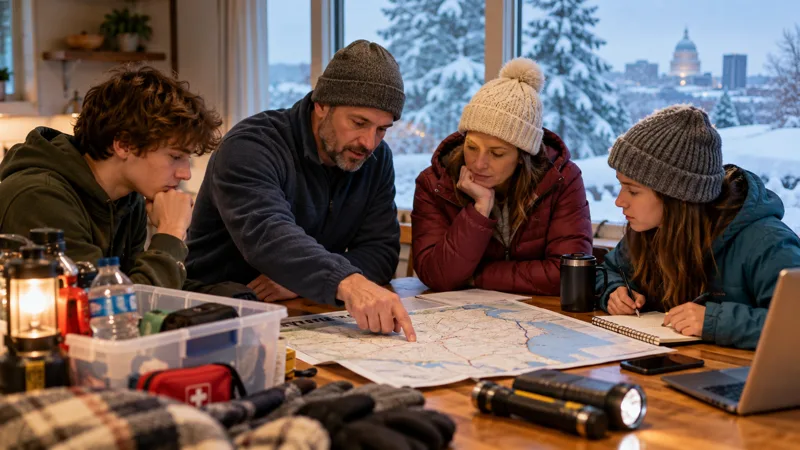
Wisconsin winter awareness: make the next shift's plan usable
Winter Weather Awareness Week is listed for November 16–20, 2026, in Wisconsin, USA. The National Weather Service's current awareness calendar lists those dates. This is a statewide reminder to prepare, rather than a booking for a particular classroom or venue. Consult the calendar and current local weather information for updates. The independent guide below focuses on households where work schedules change, people return home at different times, or one adult regularly leaves before everyone else wakes. These ordinary arrangements can make a winter disruption harder to coordinate than a family expects.
Event details
- Dates: November 16–20, 2026
- Location: Wisconsin, USA
- Type: Weather Safety & Preparedness
A plan written for a Saturday afternoon may be difficult to use at two in the morning. The person who normally handles a school announcement could be at work. The person who knows where a household item is stored might be asleep after a night shift. Preparation should account for those realities without expecting everyone to remain constantly available. The useful result is a handoff that gives the next person enough information to make an appropriate decision. That handoff can be short, familiar, and part of a routine you already use.
Begin with the week that actually happens
Draw a simple outline of a normal workweek. Include departure times, expected returns, school commitments, care visits, and the periods when someone must sleep without interruptions. Then identify decisions that depend on one particular person. Perhaps a parent checks closure notices, a roommate manages the vehicle, or a family member receives building announcements. Describe the responsibility itself rather than treating the person as permanently on duty. Once the task is visible, the household can discuss who takes it over when that person is unavailable.
Schedules do not have to match perfectly to support a workable plan. What matters is agreeing on a small number of transitions. Someone arriving home can report whether an appointment has changed, whether a delivery is delayed, and which message still needs an answer. Someone leaving can confirm that the next responsible adult has the relevant information. Keep the conversation about current decisions. A long discussion of every possible winter hazard can bury the one change that affects the next school pickup or work departure.
Give the handoff a dependable home
Choose a place where the next person will actually look. A shared note near the usual keys may work better than a document hidden in an unfamiliar application. A household that already checks a group message can use that channel, while keeping a paper version of important contacts accessible. Agree on the location together. Placing information somewhere you personally find obvious does not establish that other residents will see it, understand it, or know whether it is current.
The note should identify its author and when it was written. It should distinguish a confirmed change from a question still awaiting an answer. For example, a school closure announcement is different from a parent wondering whether school might close. An employer's confirmed schedule adjustment is different from a weather forecast that may influence commuting. Label those differences in ordinary language. This helps the next person avoid repeating an assumption as a fact when speaking to a caregiver, teacher, supervisor, or another member of the household.
Set an information check that fits the shift
Follow current National Weather Service information and official local instructions when conditions affect travel or daily activities. For household planning, decide when those sources will be checked before a departure and who is responsible. The exact timing depends on the schedule. Someone who drives early in the morning may need a different routine from someone whose shift starts in the afternoon. A check made for yesterday's departure should not quietly become the basis for every later journey.
Write down what information remains necessary after reading a forecast. You may still need the employer's attendance procedure, a school's announcement, or a facility's opening status. Those sources answer different questions. Avoid asking a weather page to confirm a workplace decision it cannot make. If a response is pending, give the next person a clear contact and a reasonable time to check again. This is more useful than a note that simply says to keep watching the weather throughout the day.
Agree on responsibilities before somebody is tired
A household can mistake availability for responsibility. The adult who happens to be awake is not necessarily the person who can leave work, transport a child, or assist another resident. Discuss those limits before a disruption. Ask each person which tasks they can realistically cover and which require another arrangement. A dependable agreement respects work rules, transportation limits, health needs, and sleep. It does not require someone to promise that they will solve every problem because they have the most flexible schedule.
Imagine that one parent is finishing an overnight shift while another has already left for work. A delayed school opening changes the morning routine. Trace the decisions in order: who receives the announcement, who confirms the child's care arrangement, who contacts the school if necessary, and who informs the other parent. The purpose of this example is to expose a missing agreement while everyone is comfortable. It is not a reason to improvise additional driving or leave care responsibilities unclear during actual difficult conditions.
Protect access to the items that support the plan
Review where the household keeps its ordinary lighting, communication equipment, essential documents, and personal supplies. The next person should be able to find the things they are expected to use without waking somebody who knows the storage system. Try a calm demonstration: ask another resident to locate an agreed item and explain its ordinary use. If they search several cupboards or need a password that only one person remembers, improve the arrangement. Treat that difficulty as a problem with the system, not a failure of the individual.
Store information with appropriate privacy. A handoff for a caregiver may need a contact number and a schedule adjustment, while a public note near a shared entrance should contain less personal detail. Decide what belongs in a visible household note and what belongs in a protected document. Make sure authorized people know how to obtain the protected information. An arrangement can support practical access without displaying an entire medical history, financial record, or collection of account credentials to everyone who enters the home.
Separate transportation decisions from pressure to arrive
The National Weather Service's winter resources explain that snow, ice, and blowing snow can make roads hazardous. Use current official travel information, the relevant authority's directions, and your actual capabilities when deciding whether a journey should happen. A work handoff should record the communication procedure if travel is affected. Knowing whom to call is valuable even when the eventual decision depends on changing conditions. Preparation should reduce confusion rather than create an expectation that a particular vehicle or collection of equipment makes every trip possible.
If a household shares a vehicle, discuss what happens when one journey changes. The next driver may depend on a return time, a key location, or an agreed pickup. Avoid arrangements that require a second person to solve a difficult journey with another equally difficult journey. Contact the relevant workplace, school, or provider about its procedures before an incident. Keep those procedures accessible. A plan that acknowledges when a commitment must change can be more dependable than one built around an untested promise that everyone will always arrive on time.
Keep the handoff brief enough to repeat
A useful handoff might contain four entries: what changed, who has confirmed it, what action remains, and who owns that action. Those entries can be expressed in a few sentences. Add detail only when it helps the next person act. If the note becomes a diary of every forecast update and every conversation, important information becomes harder to find. Keep a separate record if a complex issue needs one. The everyday handoff should remain a practical bridge between people whose schedules do not fully overlap.
Test the format on an ordinary day. Ask the next resident to read it and describe what they would do. Listen for misunderstandings rather than grading their answer. Perhaps an abbreviation means something different to them, an arrival time lacks a date, or the contact person is identified only by a first name. Correct those small problems. A format that works during normal routines is more likely to remain useful when people are tired, distracted, or dealing with an unexpected cancellation.
Review the plan after a changed day
After a real schedule disruption, compare the agreed process with what happened. Identify the point where information arrived late or ownership became unclear. Correct that specific issue rather than rewriting everything immediately. If a backup caregiver was unavailable, the next step may be discussing an alternative. If a message went unseen, the household may need another channel. If the plan worked, keep the parts that helped. A modest improvement that everyone remembers can be more valuable than a complex replacement nobody has practiced.
Use Wisconsin's November awareness week as a deadline for one concrete improvement: a working handoff location, an agreed closure contact, or a shared understanding of vehicle access. Continue reviewing those arrangements when jobs, schools, or care needs change. The calendar supplies a prompt; the household supplies the actual schedule and responsibilities. A winter plan becomes dependable when the next person can use it without guessing what the previous person meant. That is a practical preparedness skill that carries beyond a single campaign week.
Official campaign and safety resources
National Weather Service awareness calendar · Official winter weather safety resources. Check current local information when making an actual weather decision.