
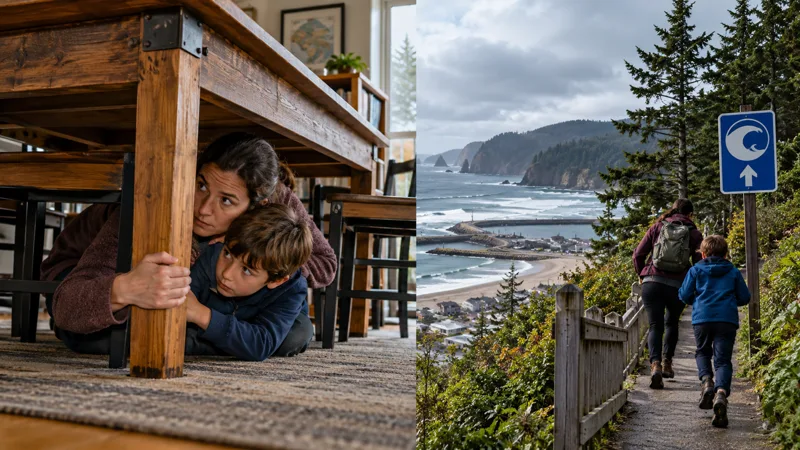
The Great Washington ShakeOut: turn one drill into a household conversation
The Great Washington ShakeOut & Tsunami Exercise is listed for October 15, 2026, in Washington, USA. The supplied record names National Weather Service / ShakeOut as its source and categorizes the listing as Preparedness. The official Washington campaign and state emergency management resources describe earthquake readiness and encourage participation in a drill. This article is an independent household planning guide. It does not imply a ticketed wilderness course, an instructor appointment, or a special survival equipment requirement.
ShakeOut's central practice is Drop, Cover, and Hold On. Use the official campaign instructions, including guidance appropriate to your mobility and setting. Washington emergency management also encourages people on the coast to practice their tsunami evacuation route after their earthquake drill. Those are two related but different activities. Do not improvise an evacuation route from a general article: obtain the current official route information for your location. The household work described below helps people understand their own plans without pretending to replace official earthquake or tsunami instructions.
Choose the room where the conversation begins
Instead of imagining a dramatic distant scenario, begin in a room your family uses every day. Ask where each person normally spends time and what would be difficult if they had to respond without searching for information. A child's answer may differ from an adult's. A person using a mobility aid may need an arrangement the rest of the household has never considered. Look at the actual setting and review the relevant official instructions together. Do not ask someone to perform an unsafe movement merely to make the drill look realistic.
Let the conversation reveal assumptions. Perhaps one adult expects the other to collect the child after a disruption, while the second expects the child to remain at school. Perhaps visitors do not know which household member can help them understand the plan. Record those questions rather than rushing to answer everything at once. The drill provides a starting point. A successful household session can be short if it leaves everybody with one clear improvement and a reliable source for the next question.
Use clear roles rather than heroic expectations
Describe what each adult can realistically do after the immediate protective action, according to current official guidance and the circumstances. Avoid assigning a role that depends on somebody traveling through disrupted conditions to reach you. A person at work and a person at home may be unable to reunite quickly. Discuss that possibility before it becomes emotionally difficult. The household should understand that delayed contact or changed transportation does not mean anyone has forgotten their responsibilities.
Keep roles appropriate to age and ability. A child can learn who the trusted adults are and where agreed contact information is kept. They should not be made responsible for managing the family's emergency response. An older relative may prefer a simple check in arrangement rather than an extensive document. Ask what works for them. Preparedness should reduce confusion and support dignity, not create a performance where the most confident person gives everybody else instructions they cannot use.
Check the contact information that already exists
Review the numbers and names the household would need if ordinary communication is disrupted. Include the school or care provider's current process rather than guessing how reunification works. Ask the organization directly about its current policy. A household plan should fit those established arrangements. Do not assume a family member can simply arrive at a building and collect someone without following the required process. Understanding the real procedure is more useful than inventing a shortcut in a private checklist.
Keep essential nonprivate contact information available in a form that does not depend on a single phone. Use a readable copy and update it when details change. Protect medical and access information appropriately. If an out of area contact is part of your arrangement, confirm that the person has agreed and knows what information the household expects to share. A name on a page is not an agreement. Discuss how messages will be passed on and avoid promising immediate communication under every circumstance.
Distinguish a coastal route review from an inland household drill
The tsunami part of the listing does not mean every participant has the same route or needs the same activity. People living, working, or visiting an affected coastal area should consult current local emergency management route information. Someone elsewhere in Washington may focus this household session on earthquake readiness and communications. Avoid copying another town's route map because it looks clear or because a friend used it. The route needs to fit your actual location and the responsible authority's current guidance.
If you do review a local route, ask practical questions about the people involved: who needs an accessible option, which caregiver requires the information, and how a visitor would identify the starting point. Practice only in a safe, appropriate way and follow local directions. The goal is familiarity rather than speed or competition. A family outing to understand official signage can expose a confusing detail that is easy to resolve before an emergency. Document the question and ask the responsible local office rather than filling the gap with a guess.
Look for ordinary household obstacles
Walk through storage and access arrangements with another responsible adult. Can they find a light and their personal necessities? Is essential information understandable? Are frequently used pathways cluttered? These are ordinary observations that can improve day to day living as well as readiness. For structural, electrical, or equipment safety questions, seek qualified advice rather than improvising changes from a general preparedness article. The fact that a concern is discovered during ShakeOut does not make the household qualified to repair every hazard itself.
Create a short project list with owners. A simple task might be labeling the normal location of a light. A more involved task might be arranging professional assessment of something the household cannot safely evaluate. Keep those categories separate. Finishing a small organizational task is useful progress; it should not be mistaken for resolving an unrelated building issue. The list is most effective when each person knows the next action and when the household will review whether it was completed.
Rehearse a day when everyone is in a different place
Choose a normal weekday and describe where each person would be. One is at work, another is at school, and a relative is attending an appointment. Ask how they would learn the relevant organization's instructions and whom they would try to contact when safely possible. Keep the discussion on communication and expectations. You do not need to invent a spectacular disaster narrative. Ordinary separation is enough to reveal whether the plan depends too heavily on everyone being together at home.
Then change one detail, such as an unavailable phone. Does each person still know who the trusted contact is? Can the person at home locate the relevant number? Does the family understand that immediate reunification may not be possible? Revisit the plan after the exercise. A misunderstanding discovered during a calm conversation is a good outcome. The purpose is to make the actual arrangements clearer, not to declare that everyone has passed a test after reciting a few slogans.
Make equipment support the decisions you have made
List the tasks that remain difficult and consider whether supplies, instruction, or a changed arrangement would help. Do not begin with a large shopping list unrelated to your household. A device is useful only if the intended user understands it and can find it. Review manufacturer instructions and test ordinary equipment under normal safe conditions. Personal needs should take priority over impressive gadgets. Routine medications, accessible communication, or a familiar light may matter more than another tool whose purpose nobody can explain.
Recognize which needs require professional planning. Essential powered medical equipment, installation of backup systems, and building repairs should be discussed with appropriate providers or qualified professionals. A product advertisement cannot establish that a device fits your specific requirement. Record the professional contact and the next action. The family can prepare useful information for that conversation without guessing a technical answer. This approach directs spending and effort toward problems that actually affect the household.
Review the drill without blaming the participant
After the session, ask what was unclear. Did an instruction assume a movement someone could not make? Did the contact list contain an obsolete number? Did the household use two different names for the same meeting arrangement? Fix the system rather than treating confusion as an individual failure. A person who raises a concern has provided information that improves the plan. Keep the review short and record the decisions in language everyone involved can understand.
Choose a follow up date to revisit unfinished tasks. ShakeOut can prompt a useful conversation, but the value depends on what changes afterward. October 15 is a practical deadline for beginning, not the only day earthquake readiness can be considered. Maintain current official information and revisit the household plan when school, work, mobility, or caregiving arrangements change. A well prepared household knows the limits of its plan and is willing to update it, rather than treating one annual drill as proof that every emergency has been solved.
Official participation resources
Use the original Great Washington ShakeOut campaign and Washington State Military Department ShakeOut resource for current instructions and participation details. Consult local emergency management for location specific tsunami routes. Continue with Survival Skills or the event listings.