
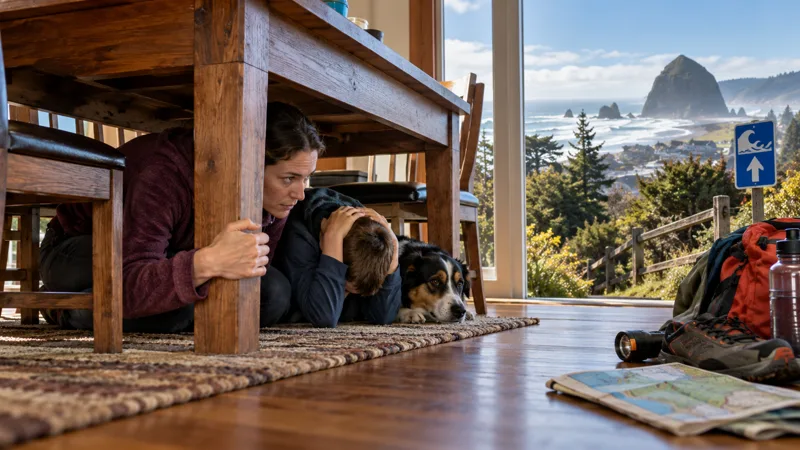
Oregon earthquake practice begins with the room you are in
The Great Oregon ShakeOut & Tsunami Exercise appears in the supplied listing for October 16, 2026, in Oregon, USA, under National Weather Service / ShakeOut. That date has not been independently confirmed; check the Oregon ShakeOut website for the current campaign schedule and local arrangements. A statewide awareness listing does not establish an in-person class, reserved place, ticket price, or instructor. The practical discussion below is a household planning guide, not a description of an announced event curriculum. Participation can mean working through decisions with the people who share your home, workplace, school, or travel plans.
For an Oregon household, the most useful starting question is surprisingly ordinary: where will each person probably be when shaking begins? A plan developed exclusively around the living room misses the commuter in a parking structure, the child in a classroom, and the visitor in a coastal rental. Walk through those settings separately. The objective is to recognize an appropriate protective action in the actual environment, then understand what should happen after the shaking. Practice should follow current earthquake guidance from emergency managers and the facility responsible for each location. Do not turn a drill into a physical endurance exercise or deliberately place someone near falling objects.
Keep earthquake and tsunami decisions separate
Earthquake protection and coastal evacuation belong in the same conversation, but they solve different problems. During shaking, immediate protection matters. Afterwards, someone in a tsunami evacuation zone may need to move toward the locally designated safe area. Someone elsewhere may instead need to assess building damage and follow emergency instructions. A single instruction such as meet at the car cannot safely cover every situation. Identify which locations involve coastal inundation hazards, which involve ordinary earthquake disruption, and which involve both. Mark those distinctions on the family plan instead of relying on memory under stress.
The National Weather Service explains that tsunamis can affect any ocean coast and do not have a season. Its tsunami safety resources provide the official background for this separate coastal risk. Use local evacuation maps and posted routes to understand the location you occupy; a statewide campaign page cannot tell you whether a particular hotel, beach access, or neighborhood is inside a mapped zone. Before a coastal visit, ask the lodging operator where guests are directed and which route is intended for pedestrian evacuation. Confirm current guidance rather than assuming that a familiar highway is the correct destination.
A room survey with a purpose
Choose one frequently used room and inspect it from the positions where people actually sit, sleep, and work. Notice shelves, suspended items, windows, and furniture that might move. Write down the questions that require qualified help: how a tall cabinet should be secured, whether an appliance needs an appropriate restraint, and what a landlord permits. Use professional guidance for structural or utility work. The value of the survey is not a dramatic list of dangers. It is identifying a few manageable improvements that can be completed before the drill and checked again afterwards.
Include the routes between rooms. A hallway may become difficult to use if stored boxes spill into it. A flashlight kept in a drawer across the building may be inaccessible when needed. Think through the difference between owning an item and being able to reach it. Place essential supplies in sensible, consistent locations and let the people who use the building know where they are. Keep exits usable in everyday life. Do not obstruct required egress with an emergency kit, and do not modify doors or fire protection systems based on an informal internet suggestion.
Practice without surprise or competition
A well-run household exercise should have an agreed beginning, a limited purpose, and a clear end. Tell participants what will be practiced, including anyone who could be frightened by an unexplained alarm. Ask how mobility, hearing, vision, or sensory needs change the exercise. An accessible version may involve discussing a protective position with a caregiver, identifying a reachable communication device, or rehearsing instructions slowly. The person who needs an adaptation should help choose it. Getting through the activity quickly is less important than making sure everyone understands their own workable response.
After the protective-action portion, pause before introducing another scenario. Ask each person what they expected and what felt confusing. Perhaps one participant understood the instruction but could not hear it from another room. Perhaps a pet hid where the household had not anticipated. Record those observations without blaming anyone. They show where the plan needs adjustment. A drill that uncovers uncertainty has done useful work. Repeating an unrealistic performance until it looks tidy can hide the very problems the campaign should help you notice.
Coastal route homework
If your home, job, or usual recreation takes you into a coastal evacuation area, route preparation deserves its own session. Locate the official map for that specific community. Read its legend, identify the area of concern, and confirm where local authorities direct people to go. Map symbols should be understood before an emergency. Ask whether a person using a wheelchair, pushing a stroller, or assisting someone with limited stamina can use the suggested route. Contact local emergency management when the accessible options are unclear. Do not improvise a shortcut across private property or unstable terrain.
A normal walk can reveal practical problems without simulating a disaster. You may discover an intersection that is confusing, an uphill section that takes longer than expected, or a route sign that is difficult to see at dusk. Treat the walk as familiarity practice, following traffic rules and current access restrictions. Note alternatives identified by local officials. Keep enough information available offline that losing cellular service does not erase the entire plan. A route should be connected to an actual safe destination rather than merely pointing away from the water.
Reunification when the usual meeting point is unavailable
Families often choose a meeting place and stop there. Extend that discussion: what if the place is damaged, closed, or inside the evacuation area? Choose an alternative with the same care as the first location. For children, learn the school's established reunification procedures instead of inventing a competing plan. For workplaces, find out who communicates closure or relocation decisions. A household contact sheet should respect those institutional responsibilities. Parents and caregivers need to understand who may collect a child and what identification the school requires.
Arrange a communication fallback that does not depend on everyone making a voice call at once. Write down an out-of-area contact and agree on the essential message: who is safe, where they are, and what they intend to do next. Keep private information protected, especially when copies travel in bags or vehicles. During practice, send a clearly labeled exercise message if everyone agrees. Afterwards, verify that it reached the intended person. Discovering an outdated phone number during a quiet drill is far better than discovering it after the household has scattered.
Supplies through the lens of access
Start with items your household already knows how to use. Consider lighting, water, food, necessary personal supplies, communication charging, and the equipment required by individual needs. A useful inventory identifies where each item is stored, who maintains it, and when it was checked. Avoid treating quantity as the only measure of readiness. Supplies that are difficult to open, incompatible with a medical device, or inaccessible to the person who needs them may not serve their intended purpose. Discuss medically necessary continuity planning with the relevant clinician or supplier.
For coastal evacuation, distinguish portable essentials from everything stored at home. A very heavy bag can interfere with movement. Choose the contents with the route and the person carrying them in mind, and follow local guidance on priorities. Keep documents and contact information protected from moisture. If an essential item cannot travel easily, work on a realistic contingency with qualified assistance. The campaign is an opportunity to ask those questions early, not to pretend that an ordinary backpack can solve every personal or household problem.
Guests, pets, and people outside the household
A visitor does not know the building or the neighborhood as well as a resident. Give guests a brief orientation that includes exits, current hazard information, and any coastal evacuation instructions relevant to the location. Keep that information readable and easy to find. For a rental property, verify it with the property manager. Do not assume that a decorative map or an old printed notice remains current. If a guest speaks another language, use official translated resources where available and check understanding without making them feel embarrassed.
Pet planning should include ordinary practicalities: a suitable carrier or leash, current identification, and knowledge of where animals are permitted during temporary relocation. Rehearse handling calmly rather than frightening the animal with a staged emergency. Keep important animal-care details accessible to someone who may assist you. Discuss neighbors who may need support, but avoid promising help that conflicts with urgent protective action or official evacuation instructions. Mutual assistance works best when people understand limits and responsibilities before a crisis forces them to improvise.
Turn the exercise into completed improvements
End with a short list of actions, each assigned to a person and a realistic date. Examples include contacting the landlord about furniture restraint, updating the emergency contact sheet, locating the current coastal map, or arranging an accessible route discussion. Separate tasks that require professional help from simple organizational work. Revisit the list in a week. The drill matters because it changes something tangible, not because the household checked a box on a calendar. A second short practice can test the improvements without repeating every part of the first exercise.
The Oregon listing is a useful reminder, but household circumstances continue changing after October. A new job, school, caregiver, vehicle, or holiday rental can alter the plan. Review those changes as they happen. Keep the official Oregon ShakeOut page and National Weather Service tsunami resources available as starting points, and consult local emergency managers for the location-specific instructions that this article cannot provide. The strongest outcome is a group of people who understand their own circumstances, know where trustworthy information comes from, and can explain the next decision clearly to each other.