
Foundations are useful when you can explain what they support
Level 1 Survival Foundations Course is recorded here for September 19–20, 2026, with Houston, AR, USA as the original general location. The event dates are past as of October 7, 2026, and the directory now marks the listing as concluded. It also notes that an exact class location is not published, so the general location should not be used as a meeting address. Consult Arkansas Survival School directly for future dates, venue details, and enrollment. This archived guide explores how a beginning student can make introductory learning practical without claiming that every subject below was taught during the recorded session.
The word foundations describes a useful goal: developing abilities that support later learning. A foundation should help you recognize a problem, understand the function of an item, and make a responsible next decision. It is different from trying every technique that looks dramatic in a video. For a first course, choose a few clear goals you can discuss with the provider. Perhaps you want to organize essential equipment, understand outdoor decision-making, or become more comfortable asking for help before a situation deteriorates. Those are concrete aims even before you can perform a complex field task.
Arrive with a problem statement
Write down why you are considering survival training in the first place. A family camper who worries about an unexpected delay has a different immediate need from someone considering a professional outdoor role. Describe the trips you take, the people you travel with, and what you find difficult. Avoid giving the instructor a vague request to make you ready for anything. No introductory weekend can do that. A specific problem statement helps the provider explain whether the course is an appropriate starting point and what additional instruction may be needed afterwards.
Ask the school what the Level 1 label means within its own progression. Numbered levels are not universal standards shared by every outdoor program. Clarify prerequisites, learning objectives, assessment, and recommendations for continued practice. Arkansas Survival School's current website presents a progression of courses, so its own information is the appropriate place to understand the sequence. Do not compare two providers solely by the number in the course title. The meaningful comparison concerns the documented skills, teaching conditions, and level of supervision involved.
Translate a gear list into functions
Once the provider gives you the current equipment requirements, group items by their purpose. Clothing supports comfort and protection under the expected conditions. Lighting supports seeing and being seen when appropriate. Containers and storage help keep essentials accessible and organized. Navigation equipment belongs to a learning system rather than a pocket of unrelated objects. Ask about any item whose role is unclear. Understanding the function helps you bring a suitable item and avoids a purchase based only on appearance, brand reputation, or an enthusiast's preferred setup.
Inspect what you already own before shopping. Try closures, locate instructions, check condition, and identify missing accessories. Ask the instructor before substituting an alternative for a required item. A superficially similar object may not serve the intended teaching task. Avoid arriving with a complicated product you have never handled and expecting the course to become an individual setup session. At the same time, do not be embarrassed by plain equipment that meets the requirement. Reliable, understandable items often leave more attention available for learning the underlying decision.
A shelter lesson begins with site judgment
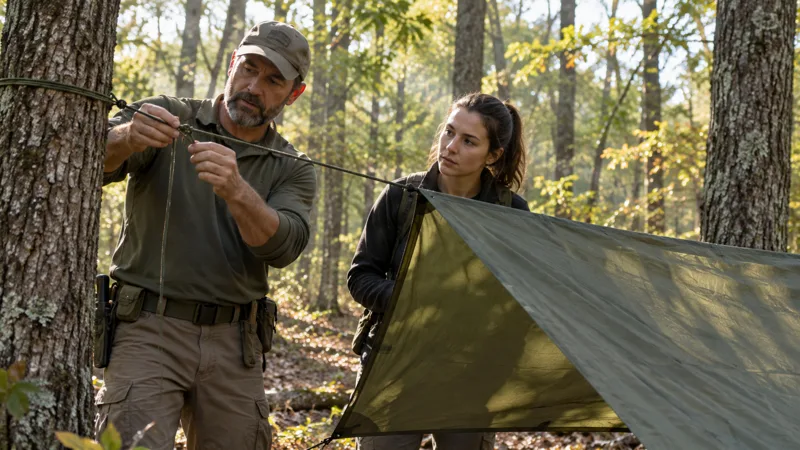
Introductory shelter discussion should address why a location and setup are appropriate, not merely how quickly something can be assembled. Ask instructors what information they consider before choosing a site and what hazards would rule it out. Follow land-use permissions and the course's supervised arrangements. Do not cut vegetation, move natural materials, or construct something independently because the title includes survival. An instructional site may have specific permissions and boundaries that are not obvious to a visitor.
When permitted to practice, pay attention to how equipment is inspected, arranged, and packed afterwards. A shelter system is not only the finished shape. It includes knowing where components are stored, whether they are intact, and how the setup changes within the instructor's guidance. Record the decisions you did not understand. If something worked poorly, describe the observation rather than immediately blaming the product. Suitable feedback can reveal whether the difficulty involved configuration, site selection, unfamiliarity, or an item that did not fit the task.
Fire learning includes the decision not to light one
Fire demonstrations require current permissions, appropriate conditions, and responsible supervision. Ask how the course decides whether an activity can proceed and what arrangements are used for safe practice. Do not treat a general course description as permission to light fires on other land. Consult the responsible land manager and follow applicable restrictions. A useful introductory lesson explains the circumstances in which fire is inappropriate as clearly as the circumstances in which a controlled demonstration can occur.
Observe organization around the activity: where participants stand, how tools are handled, how materials are controlled, and who supervises completion. Avoid crowding a demonstration to get a photograph. Ask for clarification when you cannot see rather than moving into a work area uninvited. Keep technical notes accurate, but recognize that a written sequence cannot establish competence under different conditions. The appropriate next step may be more supervised practice. A student's goal is to learn sound judgment, not to prove the ability to repeat a hazardous activity alone immediately after watching it.
Water questions need more than a product name
Ask how instruction distinguishes water sources, treatment objectives, and the limitations of equipment. Follow the complete guidance from the instructor, product manufacturer, and relevant public-health authority. Do not assume that clear-looking water is suitable for drinking or that one device solves every possible problem. This guide does not supply a treatment protocol because the appropriate response depends on the water and the intended method. A beginning student can still learn something important by asking what the method addresses and what it does not.
At home, understand the instructions for any equipment the provider expects you to bring. Check compatibility, maintenance, and storage requirements. Locate spare parts or consumables required by the manufacturer, but do not improvise modifications. During training, keep treated and untreated supplies clearly organized according to the instructor's system. If an explanation is uncertain, stop and ask. A small organizational mistake can undermine the task even when the equipment itself works as intended. Attention to sequence and labeling is a practical learning outcome rather than an uninteresting detail.
Navigation is an explanation before it is a journey
A map and compass can be unfamiliar to a new student even if phone navigation feels routine. Tell the instructor your starting level honestly. Ask how the course introduces symbols, orientation, position, and route decisions. Work within the supervised practice area and instructions. Do not wander away to test yourself without agreement. An introductory exercise should make uncertainty visible while assistance is available. The aim is to understand the reasoning, not to hide confusion until the group assumes everyone has followed the demonstration.
Try explaining a simple decision back to the instructor: what information you used, what you believed it meant, and what would make you reconsider. This provides better feedback than saying you think you understand. Keep notes about mistakes, particularly mistakes that seemed plausible at first. They can reveal assumptions you need to change. After the course, ask which navigation practice is appropriate for your level and location. A successful supervised task does not automatically justify traveling independently into unfamiliar terrain with only a new tool and confidence.
Small skills become useful through organization
Introductory programs may discuss knots, packing, or other apparently simple tasks. Evaluate them through use rather than memorizing a collection of names. Ask what load, equipment, and circumstances the instructor intends, and what applications require a different standard or qualified training. Do not use a casual practice knot for life-support, climbing, rescue, or another critical purpose. The same physical-looking technique can have very different requirements when consequences change. Learning the boundary is part of understanding the skill.
Keep the ordinary workflow visible. How do you store cordage so it is ready when needed? Where does the light go after use? Which pocket contains the item you reach for frequently? These questions can improve daily outings without adding another specialized product. A beginning student often benefits from reducing friction in simple tasks. When routine items are organized, attention is available for the unfamiliar subject being taught. Reliability grows from small habits practiced consistently, not only from the rare moment when a dramatic problem appears.
Ask about safety and assistance plainly
Before field activity, learn how to report discomfort, confusion, or a safety concern. Ask which staff member handles a problem and how participants are expected to communicate. Relevant personal medical questions should be discussed with a qualified clinician and the provider in advance. Do not let embarrassment prevent you from identifying an unsuitable activity or needed accommodation. A well-matched course should let a student learn without pretending to have abilities or conditions they do not have. Honesty helps instructors make responsible arrangements.
Treat other students respectfully. Avoid giving unsolicited technical directions that conflict with the instructor, especially in hazardous activities. If you notice a concern, bring it to the responsible person clearly. Shared learning can include comparing observations and helping with agreed ordinary tasks, but it should not become an informal competition over toughness. People arrive with different backgrounds and goals. A useful weekend produces better questions and more dependable habits, not a hierarchy based on who carried the largest tool or appeared least affected by discomfort.
Leave with a short continuation plan
After introductory training, choose a few items to review and identify the appropriate setting for each. Separate safe organizational work from techniques that need continued supervision. Record feedback, maintain equipment according to instructions, and ask the provider what further learning fits your actual goals. Do not interpret a course completion as readiness for every outdoor situation. The stronger result is being able to recognize what you know, explain why a decision makes sense, and identify when professional guidance or additional training is needed.
For the archived September foundations course, retain the original record while checking Arkansas Survival School's current pages for later opportunities. Confirm an exact venue directly; Houston is a general location, not a complete arrival instruction. The most useful foundation is a practical learning method: define the problem, understand the function, follow responsible supervision, ask about limitations, and review the result. That method can continue supporting ordinary hikes and camping trips long after the dates on an event listing have passed.