
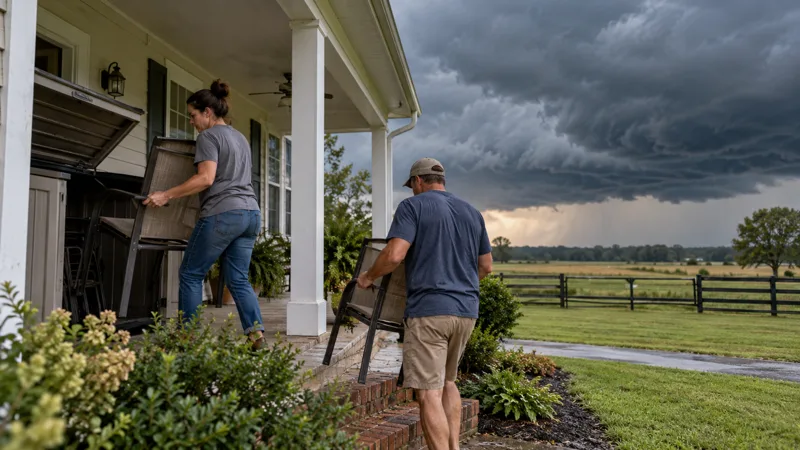
Mississippi Fall Severe Weather Awareness Week is October 12–17, 2026. The National Weather Service awareness calendar lists that date range for Mississippi. As of October 7, the week is upcoming. This statewide awareness period is a prompt for preparation, not a single venue or a promise of ticketed classes. Local offices, emergency managers, schools, and employers may publish their own activities; consult the specific organization for any program you intend to join.
The original source for this listing is the NWS severe-weather safety hub. It provides subject guidance rather than attendance instructions. The independent household review below concentrates on the difficult gap between receiving information and taking action. It does not assign a daily theme to the campaign or claim that an official drill, seminar, or warning test is scheduled.
Start with the moment an alert arrives
Imagine a realistic household scene: someone is asleep, someone is at work, and another person has their phone on silent. A weather alert reaches one device. What happens next? Preparedness begins with that sequence, because an excellent shelter or stocked cupboard does little good if the household never recognizes the need to act. Write down who can receive alerts, which places people commonly occupy, and how the message reaches someone who needs assistance.
Use the exercise to expose assumptions. Perhaps everyone believes someone else checks the forecast. Perhaps a weather application has location permission disabled. Perhaps the home radio has not been tested since the last power interruption. These are solvable problems, but they are easy to miss when the plan consists only of a supply list. The awareness week gives a useful deadline for resolving them without waiting for threatening weather to turn a small inconvenience into urgency.
Different messages require different decisions
Use official explanations to learn the distinction between a watch and a warning for the relevant hazard. Broadly, a watch calls for readiness when conditions favor a threat, while a warning calls for the protective action specified for a threat that is occurring or imminent. Do not use that summary to flatten all alert types into one rule. Read the actual message, including its location, timing, and recommended response, and follow local officials' instructions.
A household discussion should attach a decision to each message. During a period of heightened risk, the decision might be to keep devices charged, reconsider an outdoor plan, or ensure that the shelter space is accessible. When a tornado warning applies to your location, the decision is immediate protective sheltering. Avoid making recognition depend on seeing a tornado. Darkness, rain, buildings, and terrain can prevent a useful view, and looking outside can waste time needed to reach safety.
Map the places where people really are
Draw a simple inventory of home, school, workplace, regular childcare, and common travel routes. Ask each institution about its protective procedures. A school may have a supervised process that differs from the family's home plan. An employer may designate a shelter location and a staff member responsible for alerts. Learn those arrangements before trying to coordinate relatives during an emergency. A plan becomes more credible when it respects the real authority and responsibilities at each location.
For the home, identify the best available protective location and keep the route clear. The NWS tornado response page directs people toward a basement, safe room, or interior room away from windows and warns that tents, sheds, and mobile homes do not provide suitable tornado protection. If your housing does not offer a safe option, investigate a dependable nearby alternative and how to reach it before threatening conditions arrive. Ask local emergency management for location-specific advice.
Rehearse shelter access without creating a hazard
A calm walkthrough can answer practical questions without simulating danger. Can a person using a mobility aid reach the space? Is the door easy to open? Is stored furniture blocking entry? Can children find the location when an adult gives a clear instruction? Put a light where it can be retrieved and consider how necessary personal supplies reach the space. Keep the practice manageable; the purpose is to reveal friction, not frighten participants.
Review the plan with a person who has hearing, vision, cognitive, or mobility needs rather than writing instructions on their behalf. Ask what notification method actually works and which assistance is appropriate. The person may have a more effective solution than the one others assume. For pets, plan safe handling and readily available supplies in advance. During a real warning, human safety and official instructions determine what is possible; the rehearsal should reduce last-minute searching.
Choose alert tools by the job they must do
A smartphone is portable and familiar, but its usefulness depends on settings, battery condition, reception, and the user's attention. A weather radio can provide another route for official information, but it must be correctly configured and maintained. A household that relies on several identical phones may still share a weakness during an outage. Examine independence rather than merely counting devices. Two tools that fail for the same reason do not provide much practical redundancy.
Test notification volume and placement under normal circumstances, following the manufacturer's instructions. Check that the location used by each service corresponds to where the person is, particularly while traveling. Decide which device stays near a sleeping area and who checks it. A compact power bank is convenient, while a larger unit may support more charging but be less portable. Compare usable capacity, charging connections, and maintenance effort against an actual need, rather than treating a bigger specification as automatically better.
Make the driving decision before reaching water
Weather preparation extends beyond tornadoes. A route that is routine in dry conditions can become unsuitable during flooding. The NWS Turn Around Don't Drown guidance emphasizes avoiding flooded roads and paths. For household planning, the useful decision is to turn back or find a safe alternative rather than trying to estimate what a vehicle can manage. Road barriers and official closures apply even when the destination is close.
Discuss how work, school, and childcare arrangements change if the usual route is unavailable. Who can postpone a trip? Is there an approved pickup alternative? Can someone remain safely at their present location? A map app may propose another road without understanding current flood conditions. Use official road and local emergency information, and avoid improvising a shortcut through unfamiliar low ground. The object of this planning is to reduce pressure to continue because a person feels they have no other option.
Outdoor plans need a shelter deadline
For sports, yard work, fishing, or a gathering, ask who monitors conditions and who can stop the activity. Identify the actual safe shelter and the time needed for the slowest participant to reach it. A pavilion or convenient overhang is not a substitute for an appropriate protective building. Consult official guidance for lightning and the specific hazards in the forecast. Moving a start time does not necessarily solve the problem if the same group remains exposed later.
Give the decision maker permission to cancel before the weather becomes visibly dramatic. Social pressure often delays action: people have traveled, paid, or prepared food, and nobody wants to disappoint them. An agreed decision process changes that conversation. If the available shelter is inadequate or the route to it is too slow, modify or cancel the plan. That is a practical planning choice, not a prediction that the worst outcome will occur.
Supplies should support a temporary interruption
A household review can begin with basic needs during a power or service interruption: drinking water, familiar food, lighting, communication, sanitation, and personal necessities. Inventory what is already available before buying more. Keep supplies in places that household members can reach safely. A flashlight on a known shelf often provides more immediate value than a specialized item stored in an unlabeled container. Check batteries and rotate ordinary consumables as part of existing routines.
Food and medication requirements vary, especially where refrigeration or powered medical equipment is involved. Seek qualified advice for those needs and make a specific continuity plan with providers. Do not improvise storage changes or substitute an internet checklist for medical guidance. If backup power is being considered, have appropriate professionals assess the equipment and installation. Fuel-burning generators require safe outdoor placement and adherence to official and manufacturer instructions; they are not indoor comfort devices.
A communication plan with fewer promises
Choose an out-of-area contact if that fits your household, and write the details on paper as well as in phones. Decide what a short check-in should contain: identity, location, safety status, and immediate needs. Avoid promising that everyone will call at an exact moment regardless of circumstances. A workable plan allows for delayed communication and gives recipients a clear way to understand an incomplete picture. Limit nonessential communication when networks are strained.
Set a backup meeting arrangement that is appropriate to local hazards and institutional procedures. A tornado shelter plan should not send family members out to gather each other during an active threat. School reunification processes should not be bypassed because a household has chosen its own meeting point. Talk through those conflicts now. The best communication plan often consists of fewer decisions, clearly understood, rather than a complicated tree of messages that nobody can remember.
Give the week a small, measurable outcome
A useful review ends with evidence of improvement. Record that the radio was tested, a blocked doorway was cleared, a shelter alternative was confirmed, or a transport arrangement was agreed. Assign unfinished tasks to particular people and set a date to revisit them. Avoid making the whole plan dependent on one enthusiastic household member. Shared knowledge matters because that person may be elsewhere when an alert arrives.
Mississippi's October 12–17 awareness week is an occasion to connect official information with ordinary routines. Participation does not require buying a special kit or traveling to a statewide venue. It can mean discussing one difficult decision and removing the obstacle that would delay it. Keep monitoring the appropriate NWS office and local emergency authorities for any actual campaign activities, and use their current guidance when real conditions require action.