
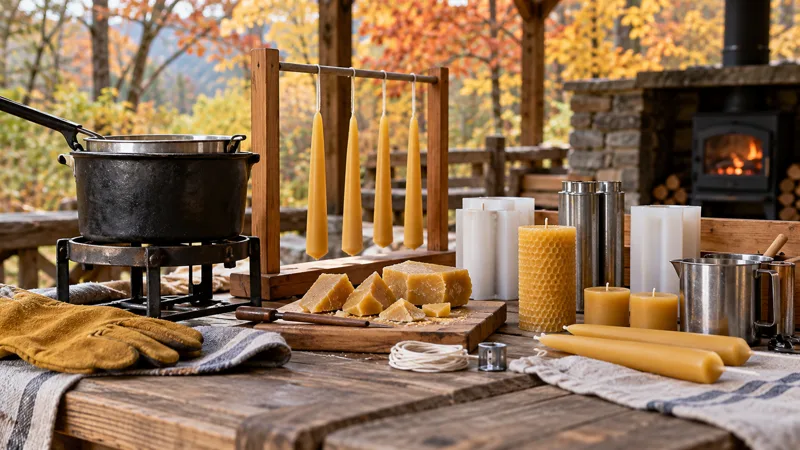
Candle making as a craft with responsibilities
Fall – Candle Making is listed for November 14, 2026, at MNSI, 1721 East Sprague Road, Seven Hills, Ohio 44131. The Midwest Native Skills Institute event page confirms that date, address, and a 9:00 a.m.–noon session. It describes beeswax taper candles and work with metal and silicone molds, with the class available on its own or within the Homesteading Skills Series. As of October 7, the session is upcoming. Confirm current registration, availability, and participation requirements directly with the school.
The verified description establishes a craft topic, not a certification or an emergency-lighting qualification. This independent guide focuses on how to approach the lesson thoughtfully: understand materials, organize a workspace, ask useful questions, and separate decorative candle making from household outage planning. The event's source page should control what is supplied and what students bring. Do not arrive with your own heating apparatus, additives, containers, or tools unless the organizer explicitly requests them.
Choose a learning goal that extends beyond appearance
A finished candle can look pleasing while leaving important questions unanswered. What makes the chosen material appropriate for the project? How does the form affect handling? What does the instructor want students to observe as the work develops? Before class, decide whether you most want to understand the craft process, evaluate materials, improve consistency, or learn how to maintain a safe workspace. That focus gives your notes a purpose.
Do not expect one session to settle every question about candle design. Different materials and forms may require different manufacturer instructions and testing. An explanation that applies to the demonstrated project should remain attached to that project. Ask what must be reconsidered before changing a material, adding a scent, or using another mold. Visual similarity alone is not enough to establish safe substitution.
For a homesteading learner, the broader value may be understanding production discipline. A repeatable craft requires organized materials, clear labels, appropriate equipment, and attention to the result. Those habits transfer to other household projects without assuming that the same technical process applies. Treat the class as an opportunity to improve how you learn a practical skill, not just how you produce a decorative object.
Understand why a supplied workspace matters
A classroom work area can include controls that are easy to overlook: suitable surfaces, stable equipment, defined movement routes, a way to manage spills, and an instructor monitoring participants. Ask where personal belongings belong and what areas must remain clear. Keep bags, coats, and drinks out of the active workspace. Follow the organizer's clothing requirements, including any guidance about loose sleeves, jewelry, footwear, or protective equipment.
Hot materials and heated tools create a need for deliberate movement. Listen before reaching for equipment, and wait for the instructor to explain how an item is transferred or handled. Do not assume a container is cool because it is no longer on a heating surface. Tell the instructor promptly about a spill, damaged object, or uncertainty. Trying to correct a problem quietly can create additional hazards for the next participant.
Ask about accommodations before arriving if mobility, vision, hearing, or hand function may affect participation. A clear explanation of your practical needs helps the school plan. You do not need to disclose more personal information than necessary, but the organizer should know if an arrangement affects safe use of the station. Consult your clinician about any relevant health restrictions. An event guide cannot determine whether a particular person should handle heated materials.
Materials questions should precede substitutions
The source page's mention of beeswax and molds gives you a useful starting point for questions, without establishing a complete recipe. Ask which materials are approved for the demonstrated project and how they are identified. Ask what documentation accompanies purchased supplies and how storage conditions affect later use. Keep the material name and manufacturer information with your notes. An unlabeled remainder is difficult to evaluate later.
Discuss the distinction between a material's attractive appearance and its intended use. A decorative container, unknown pigment, or pleasant fragrance is not automatically appropriate around heat or flame. If you want to experiment with a variation after class, seek qualified instruction and manufacturer guidance first. Do not rely on a social-media photograph or an improvised recipe to fill gaps in the lesson.
One practical household habit is to maintain a small project record. Record the date, material identity, form, instructor's resource, and any unresolved question. That information makes it easier to ask for help and prevents confusing one project with another. Avoid attaching a confident performance claim to an item merely because it looks similar to something previously made. Consistency depends on more than shape and color.
Evaluate equipment with maintenance in mind
Before buying supplies after the class, identify exactly what task each item supports and whether it is suitable for the chosen material. Ask the instructor about the required features, not just a favored brand. A tool that is easy to clean and store may be more useful for occasional household work than an elaborate system designed for higher production. Conversely, a very cheap improvised object can become unsuitable if it lacks the required heat compatibility or stability.
Consider the complete cost of ownership: compatible supplies, replacement parts, cleanup, storage space, and the time required to inspect equipment. Keep dedicated craft equipment separate where appropriate rather than assuming every item can return to food preparation. Follow the relevant product and instructor guidance for cleaning and use. Do not improvise a cleaning process with unfamiliar chemicals or dispose of leftovers in a way that can damage plumbing or violate local requirements.
Start with the taught project rather than purchasing a large collection of molds and additives. A modest set of understood equipment supports repetition and feedback. Too many variables can make it difficult to identify why results differ. If you change something, record what changed and seek guidance about the implications. The objective is controlled learning, not a rapid expansion into unfamiliar processes.
Separate a finished object from a safe burning arrangement
The U.S. Fire Administration candle-safety guidance recommends considering flameless alternatives and emphasizes stable holders, separation from combustible objects, and extinguishing candles before leaving or sleeping. It specifically recommends flashlights rather than candles during power outages. A craft lesson does not remove the hazard of an open flame. Appropriate placement and supervision remain necessary even for a candle made carefully.
Think through the intended display location before making or giving an item. A shelf may be surrounded by curtains, paper, plants, or other materials that make burning inappropriate. Children and animals can change how stable a location really is. A pleasant decoration can remain unlit; there is no requirement that every handmade candle be burned. Choose a battery-operated alternative when it better fits the room or occasion.
A candle is also unsuitable as a substitute for a household heating plan. Do not use it to improvise warmth in a vehicle, sleeping area, or enclosed shelter. During an outage, use appropriate lighting and follow current official guidance about heating and relocation. The homesteading value of this craft lies in learning and making responsibly, not in treating a small flame as a universal preparedness tool.
Gifts require clear communication
If you intend to give a candle away, ask the instructor what information should accompany the demonstrated type. Explain its material and intended use accurately, and do not promise an unverified burn time, health benefit, or special emergency performance. A recipient should not have to infer whether an object is decorative or intended for burning. Keep any recommended safety information readable and connected to the item.
Think about the recipient's setting. Someone with curious pets, limited vision, or a crowded living space may prefer a nonburning decoration or a flameless light. Do not assume that handmade automatically means suitable. Packaging should protect the object without creating confusion about how it is used. If a recipient has questions beyond your experience, direct them to an appropriate source instead of improvising instructions.
Commercial sale involves responsibilities beyond a beginner class, including product evaluation and requirements that depend on location and business activity. Seek qualified professional advice before selling or making broad safety claims. This article does not establish legal compliance, insurance needs, or a product standard. A useful first step is to keep learning and avoid presenting a classroom result as a tested commercial product.
Bring the questions back to the instructor
Take notes in a way that keeps observation separate from instruction. Write “I noticed this change” when recording an observation, and identify a specific instruction as such. Ask whether photography is permitted and avoid recording other students without permission. If you miss a detail while participating, ask for the school's recommended resource rather than reconstructing a procedure from fragments.
Afterward, review the notes before acquiring materials. List any ambiguity about approved equipment, handling, cleanup, storage, or intended use. Resolve those questions before attempting the project at home. A calm follow-up inquiry is more useful than pressing ahead with an uncertain setup. If the craft interests you, further instruction may be the sensible next purchase.
Make the November visit manageable
Confirm the arrival time, parking, accessible entrance, and any requirements for transporting finished work. Ask whether the item will be ready to take home and what protection it needs; do not assume that a newly made object can be placed loose in a bag. Plan the return trip and keep personal essentials separate from craft materials. If you hope to attend other weekend workshops, register and verify their arrangements individually.
The November 14, 2026 class provides a verified opportunity to explore a specific homesteading craft in Seven Hills. Approach it with a manageable learning goal and respect for the school's workspace. Ask about materials before changing them, retain accurate notes, and keep candle-use decisions aligned with fire-safety guidance. A well-made object is only one outcome; better habits around practical work can be the more lasting benefit.