
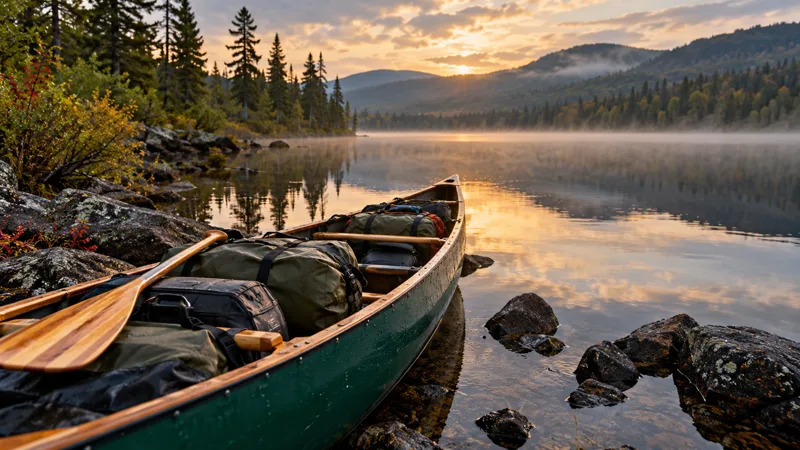
An archived canoe week, and the planning skills worth carrying forward
Expedition Canoe Skills (WBS Session 3 week 3) was listed for September 6–11, 2026, in Masardis, ME, USA. Those dates are past as of October 7, 2026. This page is an archived event guide, not an invitation to register for a session that is still upcoming. The original FeralSkills listing links to Jack Mountain Bushcraft; consult the school's own calendar and course information for later opportunities. The following discussion explains how to think about preparation for expedition canoe learning. It does not claim that a particular exercise, route, instructor, or assessment occurred during the archived week.
An expedition canoe carries more than people across water. It carries the decisions that allow a group to eat, rest, navigate, remain organized, and respond when the original schedule no longer fits conditions. That makes preparation different from casually renting a canoe for an afternoon. A prospective student should understand how the school defines prerequisites, how equipment responsibilities are divided, and what support exists when a participant is struggling. Jack Mountain's own site identifies expedition canoe skills among its program options. Read the current course description before interpreting an old directory entry as a complete statement of expectations.
Ask what the course title leaves unsaid
The phrase session three, week three suggests a place within a larger program, but it does not tell a new student whether the week can be taken independently. Ask the school directly. Confirm whether earlier instruction is expected, whether equipment is provided, and whether participants live at a base site or travel elsewhere. A date range alone does not establish camping arrangements, daily mileage, or the level of moving-water exposure. Keep those questions separate so an answer about accommodation is not mistaken for an answer about paddling difficulty.
Describe your experience honestly when seeking advice. Explain the boats you have used, the conditions you have encountered, whether your experience was guided, and how recently you practiced. Broad labels such as experienced outdoorsperson can obscure an important gap: someone comfortable camping may still be unfamiliar with canoe handling or group water procedures. A precise conversation helps the school recommend an appropriate starting point. It also gives you permission to arrive as a learner rather than spend the first day trying to preserve an image of competence.
Flotation is personal equipment, not communal cargo
The U.S. Coast Guard's life jacket guidance emphasizes using a serviceable device appropriate to the wearer and activity. Follow current instructions, product labels, applicable rules, and the course provider's requirements. Fit should be checked with knowledgeable assistance when needed. Do not select a device merely because its color matches the boat or it was comfortable in a shop for thirty seconds. Clothing, movement, and the intended activity all matter. Keep the safety discussion with qualified instructors; an article cannot verify that your chosen equipment is suitable from a product name.
A useful preparatory task is inspecting the equipment you already own according to its instructions. Look for damage, missing information, and maintenance needs before departure. Ask whether the school wants students to bring personal equipment or use supplied items. Avoid assuming an inflatable design is acceptable for every participant or water activity. If an item requires maintenance you do not understand, seek help rather than promising yourself to solve it at the launch. The first learning session should not be delayed because an essential piece of personal equipment arrived unusable.
Pack by function and access
Expedition packing starts with a division of responsibilities. Which items must remain with an individual, and which belong to a group system? Which need quick access, and which can remain stored until camp? Ask the instructor how the group organizes those categories. The right answer depends on the actual course and boats. Do not copy an online load plan and assume it applies to every expedition. Incorrect placement, loose equipment, and unsuitable attachment arrangements can create hazards, so follow the school's directions for loading and securing gear.
Practice organizing belongings on land before the course. Label bags so their owner and contents are identifiable without unpacking everything. Keep clothing, sleeping equipment, food, and electronics protected according to their requirements. Check closures and learn how your storage systems work. A bag advertised as water resistant should not automatically be treated as submersible. Record which items you can reach easily and which require disrupting the whole load. Those observations create useful questions for the instructor without encouraging unsafe experiments on the water.
The camp routine is part of the expedition
A multi-day journey involves repeated transitions between travel and camp. Each transition creates opportunities to lose equipment, overlook a task, or leave someone waiting without clear instructions. Before a course, think about how you normally manage a camp: keeping sleeping equipment dry, locating personal items, preparing meals, and returning borrowed tools. These habits may matter as much as a single impressive paddling maneuver. Ask how the school assigns shared chores and how students are expected to communicate when a task is incomplete.
Bring a willingness to help with ordinary work. Group travel becomes difficult when everyone waits for someone else to handle water, meals, or cleanup. At the same time, do not independently change a planned system because your home camping routine seems better. Ask why the instructor organizes it that way. The reasoning may involve timing, land-use rules, hygiene, weather, or the needs of other participants. Understanding the system gives you something transferable: a way to organize responsibilities rather than merely a memory of a pleasant campsite.
Navigation discussions belong before departure
Ask what maps, route information, and navigation instruction are used. Find out whether personal electronic devices are encouraged, restricted, or unnecessary. Learn what current permissions and local rules apply through the organizer and relevant land or water managers. An archived page should never be treated as authorization to repeat a course route independently. Access, closures, water conditions, and group needs can change. Even a correctly remembered place name is not a complete itinerary, and a photograph of a landmark is not a substitute for a route plan.
One useful land-based exercise is explaining a hypothetical itinerary to a trusted contact. What would that person need to know to recognize a missed check-in and respond appropriately? Include timing, planned locations, contact arrangements, and the appropriate way to seek help. Use the school's actual communication plan when attending a course. Do not impose a personal schedule that conflicts with the expedition's procedures. The goal is to make information understandable, especially to someone who is not a paddler and may not recognize shorthand that seems obvious to you.
Weather is a decision input, not scenery
A course participant should be prepared to hear that conditions change the day's plan. Ask how the school monitors weather, communicates a pause, and chooses alternate activities. Do not request a promise that every advertised skill will be practiced regardless of conditions. Qualified instruction includes judging when an activity is inappropriate. A student can learn a great deal from the reasoning behind a changed plan. Observe what information the instructor uses and how that information is communicated to the group without trying to turn those observations into independent permission to attempt hazardous water.
Think about clothing as a usable system. Follow the current equipment list and ask about requirements you do not understand. Pack items you can manage with the rest of your equipment, including spare clothing as directed. Discuss individual health concerns with relevant professionals and the course provider. Avoid treating physical toughness as a substitute for suitable preparation. Fatigue and discomfort can interfere with attention, but this guide does not prescribe a medical threshold or exposure limit. Those questions deserve qualified instruction and advice appropriate to the conditions and person.
Learn how the group communicates
Water-based groups need clear communication, particularly when distance, wind, or noise makes conversation difficult. Ask which signals and instructions the course uses and practice them under supervision. Do not invent an alternate gesture because it feels intuitive. A signal only works when the sender and receiver share its meaning. Confirm how questions are raised, how a participant reports a problem, and what the group expects when someone needs to stop. These are practical foundations for learning and do not require pretending to be an expedition leader.
During demonstrations, notice the difference between understanding an explanation and being able to perform reliably. Ask for feedback on the exact task rather than a broad judgment about whether you are doing well. Keep a short record of what the instructor asked you to change. If a technique involves rescue or difficult conditions, continue learning through supervised training; do not recreate it alone because a written note seems complete. A classroom or field explanation is part of a learning process, not a universal authorization to perform under every circumstance.
Evaluate progress after the week
An archived event can still inspire a useful review for someone who attended or is considering similar training. Separate lessons into personal organization, group communication, boat skills, and judgment. Note where you improved and where you need more supervised practice. Avoid awarding yourself mastery because one attempt succeeded. Reliable performance involves repetition in appropriate conditions and honest feedback. Ask the provider what further training would fit your goals, whether those goals involve recreational trips, extended travel, or a professional pathway.
Keep equipment purchases tied to a specific observation. If a bag was inconvenient, determine whether the problem was size, placement, closure design, or unfamiliarity before replacing it. If the group system worked well, consider which parts apply to your own outings and which depend on trained leadership. Consult the original listing for historical context and Jack Mountain's current pages for present options. The lasting value of an expedition canoe week is the ability to explain why a decision was made, organize ordinary work reliably, and recognize when more instruction is needed before the next journey.