Complete Desert Survivor was recorded for October 1–6, 2026, associated with Roosevelt, Arizona, USA. Those dates have passed as of October 7, 2026, so this is an archived listing. It does not establish that another session is scheduled or that places remain available.
The recorded desert course
- Dates: October 1–6, 2026.
- Recorded location: Roosevelt, Arizona, USA.
- Category: bushcraft and wilderness.
- Source: FeralSkills event listing.
The linked listing also marks the event concluded and associates it with Reevis Mountain School. Its dedicated location field does not publish an exact class site. Roosevelt is therefore useful regional context, not an independently verified arrival address. The source describes a multi-day immersion in wilderness living, but this article does not reproduce its syllabus or guarantee the details of a later edition.
The independent guide below considers the planning questions that make desert learning more useful. It is not a report of attendance, an assessment of the instructors, or a set of instructions for attempting an unsupported desert stay.
Read the landscape before reading your equipment list
A desert itinerary begins with relationships: distance between reliable support points, the effort of travel, the exposure along a route, and the time available before returning. Someone who can make an impressive shelter in a demonstration area may still make a poor journey decision. Learning to notice those relationships is a more transferable goal than collecting isolated tricks. A familiar day walk with a clear turnaround can teach more about judgment than an ambitious route whose uncertainties have been ignored.
For example, imagine two possible practice locations. One is close to a maintained access road but has little shade. Another has appealing rock formations and sheltered spaces but requires a longer approach over uneven ground. Neither is automatically the better classroom. Ask how instruction, water access, supervision, and evacuation arrangements interact with the terrain. The attractive location may demand more attention to transport and fatigue, while the accessible location may allow more focused repetitions of a skill.
Do not turn the word desert into a single forecast. Conditions depend on season, elevation, time of day, and the exact site. Before any future course, use the forecast for the actual training area and ask the organizer how weather changes affect activities. A broad city forecast or a photograph of a sunny landscape cannot answer whether an exposed exercise will be comfortable or appropriate for your group.
A water plan is an agreement, not a hopeful guess
Ask where drinking water is supplied, what participants must carry, when containers can be refilled, and what happens if a planned source is unavailable. These questions are appropriate even when a course discusses finding or treating water. An educational demonstration should not be mistaken for a dependable personal supply. Your participation plan should work without requiring you to discover a new source or test a technique under urgent conditions.
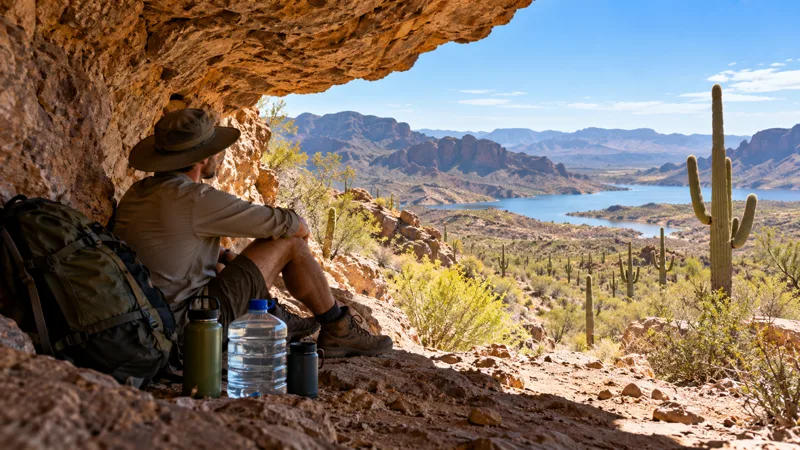
Container choices illustrate a useful tradeoff. A rigid bottle is easy to inspect and can make remaining volume visible. A soft container packs compactly when empty but may require more care around sharp objects. A hydration reservoir can encourage convenient sipping during movement, yet its hose and fittings create additional parts to check. The right combination is the one you can fill, protect, monitor, and use reliably in the activity the organizer actually plans.
Water treatment equipment also has limits that must be understood through its instructions and qualified teaching. A product description saying it is suitable for outdoor use does not mean it resolves every possible contaminant. Do not experiment with unidentified water merely to give new equipment a trial. Ask what water is provided for practice, what treatment methods are discussed, and which health precautions apply. Safe learning separates equipment familiarity from unnecessary exposure.
Shade, clothing, and rest belong in the same conversation
People sometimes evaluate clothing by asking whether it feels light. A more useful evaluation asks how it handles the whole day: sun exposure, movement, wind, contact with brush, and a cooler rest period. Before buying anything, review what you already own against the organizer's clothing advice. Comfortable fit and consistent use matter more than a collection of technically impressive items that you remove whenever they become inconvenient.
A broad sun-protection strategy may involve shade, suitable coverage, eye protection, and sunscreen used according to its label. None is a reason to extend an outing beyond a sensible plan. Treat comfort changes as information to share with staff rather than proof that you should endure silently. If you have health conditions or medicines that affect your response to heat or exertion, discuss participation with an appropriate clinician and the organizer before enrolling.
Rest is another practical skill. In a course setting, notice where people stop, how they keep equipment organized during a break, and whether they resume with a clear understanding of the next task. A break that leaves essential items scattered can create a later problem. A pause used to check the group, review the route, and tidy the immediate area improves both learning and readiness without requiring any dramatic survival exercise.
Use demonstrations to discover limits
A fire demonstration can be fascinating, but its value should include the conditions under which it must not be attempted. Ask about land permissions, fire restrictions, supervision, and the site's rules. A learner should be able to explain why a demonstration was controlled and why copying it elsewhere may be inappropriate. If conditions do not support live fire, a discussion of decision making or equipment handling can still be a productive lesson.
The same principle applies to tools. Before an activity involving a cutting edge, establish the working area, spacing, protective requirements, and how a participant can stop safely. Learn with direct instruction and the equipment approved for the exercise. This guide does not provide a substitute cutting or toolmaking procedure. Being willing to ask for a slower explanation is evidence of useful judgment, especially when several people are concentrating on objects close to their hands.
Wild plants deserve an even firmer boundary. Identification, legal access, and safe use require local expertise; photographs and general descriptions are insufficient grounds for eating or applying an unfamiliar plant. A course may discuss traditional uses without making those uses appropriate for a particular participant. Observe, take notes, and ask what identification process and professional guidance are needed. Do not interpret historical interest as a medical recommendation.
Build a kit around recoverable mistakes
Consider the small failures that would interrupt learning: a lamp switched on inside a bag, a blister developing during an approach, a loose item left at the previous work station, or a phone that cannot obtain service. Preparing for those ordinary problems is more useful than choosing gear for an imagined movie scenario. The National Park Service's Ten Essentials overview offers a framework for thinking about outdoor support needs; adapt it with the actual course requirements rather than treating it as a complete packing list.
Place frequently used items where you can retrieve them without emptying the pack. Keep instructions and important contact information available independently of a working phone. Test closures, light controls, and container access before the trip. These checks do not require a remote setting. A short walk near home often reveals whether straps rub, pockets are confusing, or an apparently convenient attachment repeatedly catches on things.
Weight still matters, particularly when a training day includes movement. Redundancy should solve a specific failure rather than become an excuse to carry every item you own. Two ways to access important navigation information may be sensible; several large cutting tools may simply complicate handling. Ask which supplies the course provides and which personal items are mandatory before deciding that an additional purchase is necessary.
Plan arrival as carefully as the field day
For a future edition, request a precise meeting point, usable directions, expected access conditions, and an explanation of any transfer from the meeting location to the training site. An address associated with a school is not necessarily the location of every class. If a route may take you beyond reliable communications, obtain instructions before leaving the last dependable connection and share the plan with a trusted contact.
Accommodation arrangements should be explicit. Ask whether you need to bring sleeping equipment, how sanitation is handled, which meals are provided, and whether personal dietary requirements can be accommodated. Avoid inferring that the arrangements shown for this archived session will recur. An apparently minor difference, such as whether a sleep space has power or whether arrival includes a meal, can change what you need to organize in advance.
Allow room for the journey home. Learning outdoors can be mentally demanding even when the physical tasks feel manageable. A return drive scheduled immediately after a long final day may deserve reconsideration. Arrange a realistic departure, an opportunity to rest, and a contact who understands that completion of the class does not instantly place you back within normal travel conditions.
What to keep after the session
A useful notebook separates what you observed, what you personally practiced, and what remains uncertain. If you saw a shelter demonstration but did not build one, record that distinction. If a technique worked with prepared materials in a supervised area, include those conditions. This makes later practice honest and helps you ask better questions rather than converting a memorable demonstration into an overconfident claim of competence.
Select one modest follow-up activity that can be done legally and safely close to support. It might involve organizing a pack, reviewing a map with an instructor, or checking how a sun hat and layers work on an ordinary walk. Do not choose a solitary desert challenge simply because the course title sounds comprehensive. Progress is the ability to make better supported decisions, including deciding that a plan needs more information.
This archived October listing remains useful as a starting point for comparing future instruction. Ask a provider how it teaches limits, supervises practice, and responds when participants need help. Those answers reveal more about the learning environment than a promise of total self-reliance. Explore other event listings and survival skills articles with the same emphasis on clear evidence and realistic planning.