
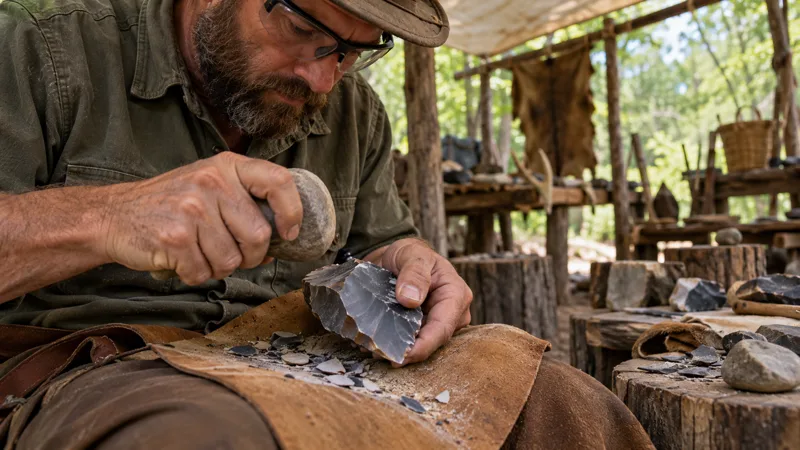
Archived event: These dates have passed as of October 7, 2026. This page retains the original listing for reference; consult the provider for later offerings.
Bois d'Arc Primitive Skills Camp & Knap-In was listed for September 23–26, 2026 in Greenfield, MO, USA.
This is an archived event listing. These dates have passed; do not use this page as confirmation of a future edition.
Event details
- Dates: September 23–26, 2026
- Location: Greenfield, MO, USA
- Type: Bushcraft & Wilderness
View the event source and registration information
Understand what the archived camp entry can tell you
Bois d'Arc Primitive Skills Camp & Knap-In was listed for September 23–26, 2026, near Greenfield, Missouri. Those dates are past. Keep the entry as a historical reference rather than assuming a registration link leads to an available 2026 place. The directory connects the gathering with Hulston Mill Historic Park and points toward its event website. Readers should obtain any later edition's directions and rules directly from the provider. The planning guide below is independent editorial material for attending a craft-oriented skills camp. It does not claim that a particular future workshop, instructor, or package is confirmed.
A camp that brings crafts and primitive skills together can appeal to many kinds of learners. Some want to understand an unfamiliar material, others want feedback on a project, and some simply want to observe a skilled maker. You do not need to turn every visit into a test of self-sufficiency. Decide what form of participation makes sense for your experience. If a subject involves sharp tools, fragments, heat, or another hazard, the relevant instruction and protective arrangements come before independent practice. A social event setting does not make an unfamiliar process safe to improvise.
Observe the work area before the object
When watching a demonstration, look first at the way the working space is arranged. Where do tools wait when not in use? How are participants positioned? What keeps spectators from drifting into the active area? These details may be less eye-catching than the object being made, but they are part of the craft. Follow posted boundaries and the instructor's directions. Ask before approaching, touching materials, or setting down your own equipment. A respectful observer gives the maker room to work and allows the people enrolled in the demonstration to concentrate.
If you join a supervised activity, ask how the area will be reset afterward. Offcuts, fragments, and unfinished materials may require specific handling. Do not assume a piece on the ground is a souvenir that anyone can take. The maker may still need it, or the event may have a disposal procedure. Learning how work begins and ends gives a more complete understanding than remembering only the most dramatic movement. Your notes should describe organization and inspection alongside technique. Those habits remain useful even if you later choose a different craft or decide that observation is enough.
Separate craft appreciation from archaeological collecting
A newly made demonstration object and an archaeological artifact are different things. A skills event does not establish permission to collect from surrounding land or disturb a historic site. Ask the event staff and relevant land manager about rules. If something appears historic, leave it undisturbed and follow appropriate reporting guidance. Do not try to prove your interest by searching beyond the designated activity area. Respecting the place is part of responsible participation, especially when a gathering is associated with a park or another location that has its own cultural and historical significance.
This distinction also matters in conversation. A maker can describe a reconstruction, a personal design, or an interpretation without claiming that it reproduces every historical practice. Ask what is known, what is inferred, and what is the maker's own choice. That question encourages a richer discussion than asking whether an object is “authentic” in a vague sense. Give credit for the explanation when you share it. Avoid turning a brief event conversation into a sweeping account of a culture or period. An honest description of a modern demonstration can be interesting without overstating what it establishes.
Choose a workshop by the learning conditions
A workshop title tells you the subject; it may say little about what a beginner actually does. Ask about prerequisites, age policies, materials, physical demands, and supervision. The archived directory contains age-related cautions for some activities, so families should obtain explicit guidance for a later event rather than treating the camp as uniformly suitable for everyone. Explain what the participant has done before. A provider can help distinguish a hands-on session from a demonstration that is better observed first. You are seeking the right conditions for learning, not the most impressive title on the program.
Consider whether the workshop requires continuous attendance. If you leave midway for another activity, you may miss the explanation that makes a later step understandable. Reserve enough time for questions and clean-up. If your interest is broad, select a demonstration to sample the subject before committing to an intensive session. If your interest is specific, prepare a question about a problem you encountered in your own permitted practice. Both approaches can be worthwhile. The wrong choice is to schedule yourself so tightly that every activity becomes a rushed glimpse and none gives you enough context to continue responsibly.
Keep project notes that identify the material
Write down the name and source of the material used in a supervised lesson, along with any condition or selection criteria the instructor explains. Do not assume two similar-looking samples behave alike. A useful notebook distinguishes the material from the tool and the process. If your project turns out differently from the demonstration, you can then ask a precise question. Perhaps the preparation differed or a feature was overlooked. Without that record, students may blame their skill for every problem or conclude that a method never works, when the comparison was incomplete.
Ask permission before photographing another person's project. Include intermediate stages in your own record when allowed, because the finished piece may hide the decisions that mattered. Label an image as your attempt, an instructor's demonstration, or another maker's work. This avoids confusion when you review several photographs later. If a step remains unclear, record the gap instead of writing an invented explanation. A craft notebook should be a trustworthy learning aid. It becomes less useful when attractive pictures and confident captions conceal how little you actually observed about the process.
Buying and trading require their own questions
If an event allows sales or trades, slow down before choosing an unfamiliar tool or material. Ask what the item is intended for, what condition it is in, and what instruction would be needed to use it properly. A seller's enthusiasm may be sincere without answering your particular needs. Do not make a purchase simply because everyone nearby appears interested. Compare it with the project you intend to attempt and your available learning support. It may be better to write down the maker's contact information and decide after you have reviewed your notes at home.
A handmade object can be valuable for reasons beyond function: workmanship, a conversation with its maker, or the experience it represents. Those reasons are legitimate, but they should remain distinct from a claim that the object is necessary emergency equipment. If you trade, make expectations clear and describe your own item's condition honestly. Respect someone who declines. A camp gathering should be a place for fair exchange and learning rather than a competition to obtain the most unusual possessions. Consider setting a spending limit in advance so enthusiasm does not determine every decision.
Plan camping separately from the workshop
Verify the later edition's camping options, water access, sanitation, arrival procedures, and vehicle arrangements. Historical rates and packages are not current promises. Ask what a registration includes and which choices require separate arrangements. Keep confirmations together so that an evening arrival does not become a search through several messages. If you are new to overnight events, choose familiar camping equipment and a manageable plan. A craft weekend is not the ideal time to discover that your shelter is missing a part or that you do not understand the campsite rules.
Pack workshop necessities according to the provider's list and keep them distinct from general camping gear. An organized bag lets you move between activities without carrying everything you own. Make room for the safe transport of an unfinished or fragile project. Ask how the instructor recommends moving it if necessary. Avoid packing a sharp object loose among clothing. Plan meals and personal needs from confirmed facilities rather than assuming a gathering will supply them. A simple, well-rested camp routine leaves you with more attention for the instruction and conversations that brought you there.
Learn socially without claiming someone else's expertise
A conversation around a project can offer useful perspective, but recognize the difference between informal advice and the direction of the responsible instructor. If suggestions conflict during a supervised session, ask the instructor to clarify before proceeding. Do not combine several people's partial explanations into a technique no one actually taught. Give others room to describe their own experience without turning every discussion into a contest. A person who has practiced for many years may be happy to explain a small detail if the question is thoughtful and the timing is appropriate.
When sharing the experience afterward, describe what you learned accurately. “I watched a demonstration” is different from “I completed a supervised project,” and both differ from expertise. Credit the event and maker where appropriate, and respect requests not to post certain material. A good account can invite other readers into responsible learning without claiming you mastered a craft over a weekend. It can also highlight the parts you intend to study next. That honesty makes your progress more credible and keeps a friendly event conversation from becoming unsupported instruction for someone who was not there.
Measure progress through a smaller repeatable exercise
After the gathering, select one task that the instructor identified as appropriate for your level and setting. Confirm permitted materials and safe conditions before starting. Keep the exercise small enough to complete and inspect. If a technique requires specialist supervision or protective arrangements you do not have, choose another learning task or book instruction. Reading and reviewing notes can still be productive. The purpose of follow-up is to consolidate a lesson, not to recreate the most dramatic activity from the weekend without the circumstances that made the demonstration appropriate.
Compare your observations across attempts. Can you explain the preparation more clearly? Do you recognize a material difference you previously missed? Can you identify when a result needs qualified feedback? Those are meaningful signs of progress. The archived Bois d'Arc entry remains attached to its original Missouri dates, while this guide provides a way to approach a later craft gathering thoughtfully. Choose the learning environment carefully, respect the site and the makers, organize camp logistics, and give a small lesson enough attention to become a reliable part of your understanding.