
Basic Wilderness Survival Weekend is recorded for October 16–18, 2026, in Paris, Tennessee, USA. The dates are still ahead as of October 7. The source attached to this listing is a FeralSkills event entry. Its specific details could not be independently retrieved during review, so the date range and city should be treated as recorded planning information pending confirmation from the provider.
A basic course title does not guarantee suitability for every beginner. It does not establish overnight camping, supplied equipment, particular subjects, age eligibility, or a certification. Ask the provider for the current program and requirements. The following guide is independent beginner preparation, built around the ordinary habits that make outdoor instruction easier to absorb. It is not a claim about what will be taught at the Paris event.
Begin with a question you actually want answered
New learners often arrive with a broad ambition to become ready for anything. That can be motivating, but it is hard to evaluate after one weekend. Choose a smaller learning question. Perhaps you want to understand how to organize a day pack, how to recognize when to turn around, or which navigation instruction would suit your next outing. A specific question gives you a reason to pay attention without demanding mastery of every outdoor skill at once.
Write the question in ordinary language and add the situation in which it matters. For example, knowing how to keep a spare layer dry matters when a short walk becomes a wet afternoon. Knowing what information to leave with a contact matters when a planned return is delayed. These situations are more useful than vague labels such as self-reliance. They help an instructor understand your goals and help you judge which lesson to practice again after the weekend.
Confirm whether this weekend fits your starting point
Contact the organizer about prerequisites, physical demands, accessibility, and the amount of time spent outdoors. Ask whether lodging and meals are included and whether participants must bring a complete overnight system. A three-day date range may include evening check-in and two days of activity, or it may have a different arrangement entirely. The listing does not decide that question. Confirm the start and finish times before choosing transport or booking accommodation.
Describe your experience without embarrassment. A person who has never camped may need different preparation from someone who camps regularly but has never used a map. Ask how the provider supports unfamiliarity with required equipment and whether any items can be borrowed. If the course includes tools or fire, ask about supervision and equipment restrictions rather than assuming every participant must buy a knife or ignition kit. A clear answer can prevent unnecessary purchases and help you choose appropriate instruction.
Prepare your pack at a table first
Use the provider's list as the primary guide, then review whether it covers your personal needs. Lay equipment where you can see it all. Group items by their immediate purpose: weather protection, drinking water, lighting, personal necessities, and whatever the class specifically requests. The National Park Service Ten Essentials offers a broad outdoor planning framework, but it is not a course-specific packing list and does not imply that every item will be used in this event.
Look for practical mismatches. Does the power cable fit the device? Does the rain jacket allow comfortable movement? Can the water container be opened without setting down everything else? Does the bag close when fully packed? These checks are simple enough to perform at home. Beginners sometimes focus on dramatic equipment while overlooking how closures, straps, and pockets affect ordinary tasks. A well-organized familiar bag can support learning more effectively than a new collection of specialized gear.
Learn the controls, not a survival routine
Before departure, turn on the light, adjust the pack, unfold the rain layer, and locate small personal items. Read the instructions for anything supplied with a manufacturer manual. You do not need to invent a challenging scenario to establish familiarity. Practicing controls in a well-lit room avoids the frustration of discovering unfamiliar switches while trying to follow an instructor. Charge electronics and check batteries using the recommended method rather than guessing from how recently an item was purchased.
If navigation equipment is required, ask what preparation the provider expects. Looking at a map of a familiar area can help you understand symbols and scale, but it is not a substitute for navigation instruction. Do not head into unfamiliar terrain alone to prove you are ready. Safe preparation should make participation easier and reveal questions to ask. The course, if confirmed and suitable, can then provide the supervised context needed to build beyond those first steps.
Comfort is a tool for attention
Discomfort can consume the attention you hoped to spend learning. Wear footwear you have already used and clothing that matches the forecast and provider advice. Plan for changes in temperature and rain without treating a future October date as a precise forecast. Layers allow adjustments, but only if they fit together and can be reached. Keep an appropriate spare layer protected from moisture. Ask about indoor shelter, outdoor exposure, and weather changes before choosing what to pack.
Try the full clothing combination before travel. Bend, sit, reach, and walk a little to notice pinching or restriction. A boot that is comfortable for a short shopping trip may rub when worn longer. Deal with those ordinary issues ahead of time rather than hoping enthusiasm will overcome them. If you have health concerns about exertion, temperature, or sleep, consult an appropriate professional and discuss accommodations with the organizer. Avoid deliberate hardship as a substitute for sensible preparation.
Water planning starts with the refill arrangement
Ask whether safe drinking water is available, how far it is from the activity area, and what container the provider recommends. Carrying water is a practical responsibility even on a beginner weekend. Container choice involves tradeoffs: a bottle is easy to inspect and clean, while a reservoir can make drinking convenient but may require more attention to hoses and packing. Select what fits the confirmed activity and what you can operate without confusion.
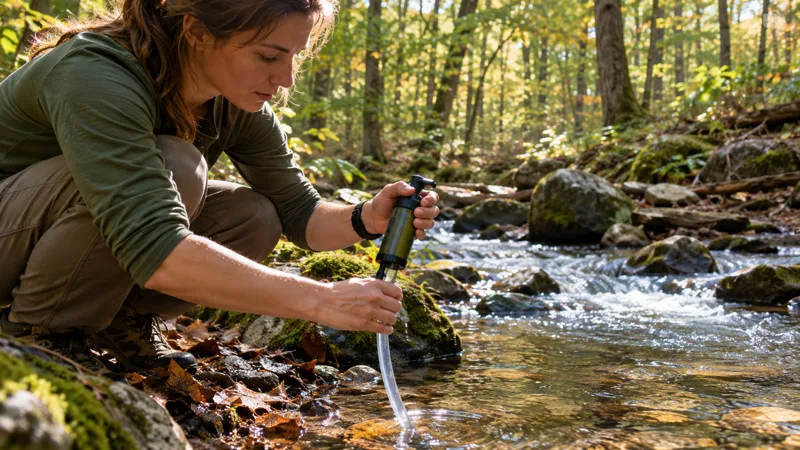
If treatment equipment appears on the required list, ask the organizer which types are suitable and how instruction will be handled. Filters and other methods have limits; clear water is not proof of safety. Follow the product instructions and official local advice. Do not make water testing into an improvised experiment with untreated sources. A beginner's useful learning objective is to understand the questions that determine a safe method, not to assume one device makes every source drinkable.
Food arrangements affect more than the menu
Confirm meals, refrigeration, cooking access, and food storage rules. If you supply your own food, bring familiar choices that work within those arrangements. An event listing is not evidence of a camp kitchen, an open-fire cooking activity, or a shared meal plan. Allergy and dietary needs should be discussed directly. Avoid relying on food procurement or foraging unless the confirmed program includes professional instruction and the provider has explicitly explained safe arrangements.
Convenient snacks can help bridge travel delays or gaps between meals, but they do not replace knowing the schedule. Consider preparation time, cleanup, rubbish, and how food is protected in the setting. A complicated menu can become an unnecessary project when you are already learning unfamiliar skills. The useful question is whether your food supports the weekend reliably. Review official food safety advice or a qualified professional when storage conditions or personal requirements are uncertain.
Ask for explanations that connect choices to conditions
During instruction, a beginner can learn much by asking why a particular choice fits the situation. A demonstration may depend on the weather, available materials, group size, permitted tools, or the time available. Write those constraints beside your notes. That prevents one demonstration from becoming a universal rule. It also helps you recognize when a method should not be used during an independent outing.
Ask one question at a time and make it concrete. If you did not understand a step, say where you lost the sequence. If you cannot safely perform a movement, say so before attempting it. Good learning requires honest feedback, not pretending competence. Respect tool boundaries and the instructor's supervision requirements. If a task feels unsafe or your circumstances have changed, stop and seek clarification. A weekend should increase your ability to make responsible decisions, including the decision to decline a task.
Navigation begins before the trail
Even getting to the class deserves a basic route plan. Obtain the precise meeting point, arrival window, parking information, and a contact for delays. Paris is the recorded city, not necessarily the exact training property. Save directions and essential contact details in a format that does not depend on a live signal. Tell a trusted person where you expect to be and when you expect to return, using the confirmed arrangements rather than only the event title.
For later outdoor trips, the same habit develops into a broader itinerary. Decide which route is appropriate, where you can leave safely, and when to reconsider continuing. Learning to pause before uncertainty grows is more valuable than treating every outing as a test of endurance. The course may or may not address these topics; they remain useful questions for any beginner seeking further instruction. Keep future practice modest and supported until you understand your skill limits.
Record one success and one difficulty
At the end of each learning day, make a short note about something that worked and something that needs attention. Perhaps the pack organization made rain protection easy to reach, but the light was awkward to operate. Perhaps you understood an explanation but need more supervised practice before repeating it. Naming the difficulty is progress because it turns a vague feeling of being unprepared into a specific next step.
After the weekend, dry and inspect equipment, replace consumables, and organize notes while the experience is fresh. Select one safe practice and one further learning question. Do not treat attendance as proof that every wilderness challenge is now manageable. A basic course can be the beginning of a thoughtful learning process. For this listing, that process starts by confirming October 16–18 in Paris and obtaining the provider's current requirements through the recorded source.