
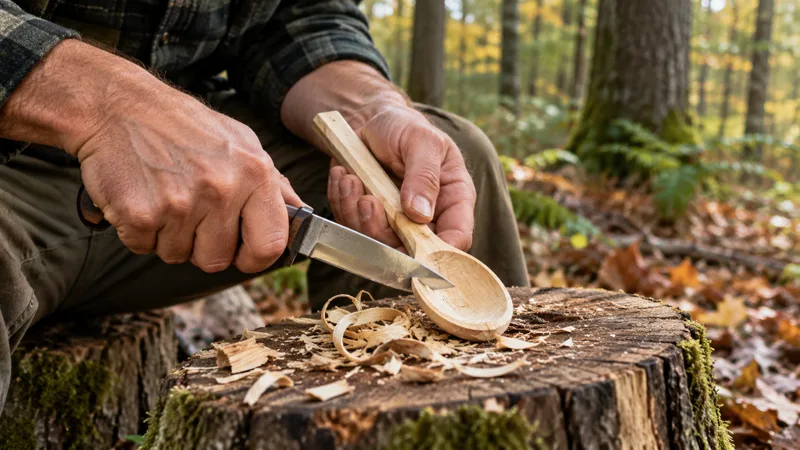
Basic Bushcraft is listed for October 23–25, 2026, in Pennsylvania. The FeralSkills event page identifies Coalcracker Bushcraft, while the school's course page describes its Basic Bushcraft course in Ringtown, Pennsylvania. As of October 7, this recorded session is upcoming. Confirm the selected date, remaining places, exact arrival instructions, and current equipment requirements with the school before booking travel. A general product page describes the course, but its presence alone is not a guarantee that the October session has available admission.
The listed three-day session
- Dates: October 23–25, 2026.
- Recorded location: Pennsylvania, USA; school course information names Ringtown.
- Provider identified by the listing: Coalcracker Bushcraft.
- Directory source: Basic Bushcraft on FeralSkills.
- School source: Coalcracker Basic Bushcraft course.
The school's description presents a three-day, two-night experience involving field skills, equipment use, and making or maintaining woodland gear. It publishes a specific required kit rather than a generic backpacking checklist. Use that complete current list and ask about any substitutions. The discussion below is an independent guide to learning resourcefulness and care for equipment; it does not add activities to the school's curriculum, assess its teaching quality, or promise a particular outcome from attendance.
Resourcefulness starts with understanding ordinary gear
Bushcraft can be approached as an attempt to carry fewer manufactured items, but beginners often benefit more from learning why their existing items work. What keeps a shelter tensioned? Why does a container fit one cooking arrangement and not another? What causes a strap to fail? Those questions connect craft skills to useful judgment. If you understand the function of an object, you can evaluate a repair or alternative without relying entirely on resemblance to something shown in a video.
Choose one piece of familiar outdoor equipment to examine before class. Look at its working parts, the points that receive stress, and the instructions supplied by its manufacturer. Write down what you do not understand. This is not an invitation to dismantle safety equipment or alter a protective item. It is an observation exercise: notice how a buckle connects, where fabric is reinforced, or how a lid is retained. A concrete question gives an instructor something specific to discuss.
A useful goal is to become better at deciding when to repair, when to replace, and when to stop using an item. Those are different decisions. A small cosmetic defect may be acceptable, while a failure in a load-bearing or safety-critical component may require professional assessment or replacement. Avoid assuming that every improvised fix is suitable because it holds for a moment. Ask what a repair is intended to withstand, what warning signs matter, and what an honest backup plan would be.
Read the required kit as part of the course design
The Coalcracker course page lists tools, cordage, shelter and sleeping materials, cooking equipment, and other items. Do not turn this article's suggestions into a replacement list. Ask the school how its requirements apply to your booking, especially if you already own a similar item. A substitution that works for personal camping may not fit a particular teaching exercise. Getting that answer in advance avoids arriving with equipment that prevents you from participating comfortably or requires a last-minute purchase.
Separate questions of size, condition, and familiarity. An item can match the specified size yet be damaged, or be in good condition yet unfamiliar to its user. Inspect what you will bring, learn ordinary controls and storage arrangements, and ask about tool preparation the school expects. Avoid making unfamiliar modifications based on internet advice. If sharpening, repair, or adjustment requires instruction, say so. A beginner who states that limitation helps the instructor establish a suitable starting point.
Borrowing can reduce expense, but borrowed tools should come with clear ownership and condition checks. Photograph or record identifying marks if several people are sharing equipment, and agree on what happens if something is damaged. Do not borrow a sharp tool merely because it looks appropriate; ask whether it is suitable and how it should be transported. For unfamiliar items, clarify the school's loaner policy before assuming somebody will have a spare. Good equipment planning prevents social pressure from substituting for safety.
Tool lessons need room for slow feedback
Any activity involving cutting tools should be learned through direct, competent supervision and the instructor's rules for the work area. This article does not provide axe or knife techniques. Before participating, ask how students signal for assistance, where others should stand, and how tools are stored between tasks. If fatigue, distraction, or a problem with the equipment arises, stop and obtain guidance. The meaningful beginner skill is recognizing when to pause before an error becomes an injury.
Observe the organization around a demonstration, not only the movement of the tool. Where are finished pieces placed? How is the work area kept clear? What happens when someone approaches? Which checks occur before the task begins? These details can reveal how an instructor manages a shared environment. Record the principle in plain language and ask for clarification if you cannot explain its purpose. A habit understood as a reason is easier to remember than a rule memorized without context.
Do not confuse speed with progress. A slow attempt that receives corrective feedback may teach more than repeating an incorrect motion several times. Ask the instructor what one aspect deserves your attention next. Limit yourself to that change until you understand it. If a task becomes frustrating, a pause is a useful choice. Craft learning involves patience with materials and with your own limitations; both are relevant to outdoor travel, where hurrying can create avoidable problems.
Evaluate shelter through comfort and consequences
The school describes overnight outdoor participation and a shelter-oriented equipment requirement. Ask what arrangements apply to the booked session, how weather affects them, and what backup options are available. Do not replace a dependable sleep system with an unfamiliar approach merely to appear committed. Explain relevant health, mobility, or temperature-related concerns through the school's appropriate contact process. Understanding the boundaries of an exercise is part of preparation, especially when it includes sleeping outside.
Before travel, organize sleep clothing separately from daytime clothing and protect it from moisture. Check whether your ground insulation and bedding suit the organizer's guidance and forecast. A household trial in an appropriate, safe setting can reveal a missing item without becoming an endurance test. If you are uncertain about the required materials, ask the school rather than extrapolating from an unrelated camping trip. The right setup is the one that meets the course's requirements and your legitimate needs.
During a shelter lesson, ask how the instructor evaluates the result. A visually neat shelter may still be poorly suited to its intended conditions. Rather than guessing structural or weather limits, ask what signs the teacher looks for and what should trigger adjustment. Keep your observations tied to the supervised setting. A class-built example does not automatically authorize the same arrangement on unfamiliar land, in a different climate, or under weather conditions beyond the student's experience.
Food and fire should support learning
Confirm the course's meal arrangements, food requirements, dietary accommodations, and cooking rules. A weekend that includes cooking instruction still needs a dependable food plan. Pack ordinary snacks if permitted and think through how food will be stored according to the site's directions. Avoid assuming you can supplement meals with wild plants or mushrooms. Learning about natural resources should remain separate from relying on uncertain ingredients to meet immediate needs.
Fire instruction belongs within the school's supervised practice and current restrictions. Ask where demonstrations occur, which fuels or ignition materials students should bring, and how weather-related decisions are made. Do not treat a course title as permission for independent fires at camp. Outdoor skills also include accepting that conditions may make a technique inappropriate. A stove or other cooking alternative may be part of a personal backup plan only if the organizer permits it and you know its proper use.
The National Park Service's Leave No Trace overview offers useful questions about campsite impact, waste, vegetation, and other people. For this course, follow the school's site rules first and ask how natural materials are obtained for teaching. Permission to use school-provided material is different from permission to cut or collect elsewhere. Make that distinction explicit in your notes so that an instructional example does not become a habit of taking materials from any convenient woodland.
Practice repairs as decisions, not performances
When a class discusses making or repairing kit, record the original problem and the intended use of the finished item. A repair that keeps a pocket closed has different stakes from a repair that supports a person or secures a heavy load. Ask which examples are appropriate for beginner practice and which should not be improvised. This helps resist the temptation to generalize from one successful demonstration. The interesting part is the reasoning that narrows the repair's purpose and limits.
Create a personal equipment note with four headings: problem, possible cause, supervised response, and follow-up question. Use it for one item rather than trying to document everything. If the cause is not established, say that. If the instructor recommends replacement, record why. A record that admits uncertainty is more useful than a triumphant claim of permanent success. Later, it can guide a conversation with a manufacturer, repair professional, or teacher who needs an accurate description of what happened.
Manage energy over the whole weekend
Three days of learning can be tiring even when the walking is modest. Plan travel so you arrive rested, and allow time after the final session rather than treating the return drive as an afterthought. Ask about the actual finish time and whether cleanup or equipment packing extends it. Consider a travel companion or an additional overnight stop when appropriate. The course's recorded dates establish the range; they do not tell you how alert you will feel at its end.
Keep notes brief enough to maintain without sacrificing participation. A few clear sketches and questions can be better than a dense transcript. At the end of each day, select one idea that changed how you think about an object or task. The next morning, ask a targeted follow-up if the program allows it. This approach builds continuity across the weekend while leaving room to rest, eat, and organize equipment. It also produces a useful record when several new topics compete for attention.
After the course, choose a low-risk practice project with a defined purpose and any needed permissions. Repeating the supervised lesson in an appropriate setting is different from trying to recreate the entire weekend alone. Keep safety-critical tasks and sharp-tool skills within the level of instruction you actually received. If you cannot explain a technique's limits, obtain more guidance before expanding it. Additional learning is a sensible next step, not evidence that the first course failed.
For October 23–25, verify the Ringtown logistics, selected session, and full required kit directly with Coalcracker Bushcraft. Arrive with reliable equipment and questions about how materials and repairs are judged. Leave with a small practice plan and a clearer understanding of the limits of improvisation. Further opportunities are available through event listings and Survival Skills, where each course should be considered according to its own verified requirements.