
Event details
- Dates: September 12, 2026
- Location: See event listing
- Type: Foraging & Wild Edibles
Acorns as a lesson in process, not a shortcut to food
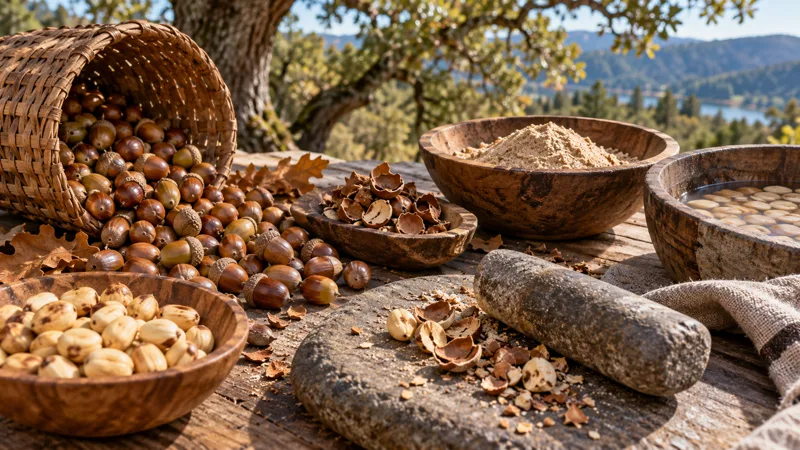
Wild Foods: Traditional Acorn Processing Workshop was listed for September 12, 2026. That date is now past, and the saved event listing does not identify a venue beyond directing readers to the listing. This is an archived notice. Consult the FeralSkills source for the original provider and any future workshop rather than treating the old date as current registration information. The discussion below concerns responsible learning and questions to ask about food processing; it is not a recipe or a report that a particular method was taught at that event.
An acorn workshop is interesting because it shifts attention from simply finding an ingredient to understanding the work between gathering and eating. A natural material can require correct identification, careful selection, suitable preparation, and appropriate storage. Knowing that an ingredient has a history of use does not remove those requirements. The educational value is in seeing the whole process, including the points where an instructor rejects material or changes a plan. A beginner should come away with better questions, not with the belief that every nut found under a tree is ready for the kitchen.
Ask what kind of workshop is offered
Before attending another edition, ask whether it includes identification, a processing demonstration, supervised student work, tasting, or discussion of historical use. Those activities involve different levels of participation. Find out whether the material is supplied, whether students are expected to collect anything, and whether participants take prepared food home. Ask about the teacher's relevant experience and the sources behind the process. A class title alone cannot establish either the preparation method or the food safety controls used in the room.
Clarify the time required outside the session. Food processing can include stages that are not visible in a short demonstration, and a prepared sample may have been started earlier. Ask which parts you will observe from beginning to end and which will be represented by examples. Understanding that distinction prevents a student from assuming that a quick classroom sequence is the full elapsed process. A clear explanation of timing is more useful than a performance that looks easy because the less interesting stages occurred before the audience arrived.
Identify the source material carefully
Start with identification and collection context. Ask how the instructor identifies the relevant tree and what features distinguish it from alternatives in the region. Record the scientific name where available and the source of the identification. If a class uses preselected acorns, ask whether students will learn how those were chosen. Handling a basket of supplied material is not equivalent to learning to identify a tree independently. Keep those two achievements separate when deciding what you are prepared to do afterward.
Collection permission is another independent decision. An abundant crop does not make every location open to gathering. Landowner rules, public land restrictions, and the purpose of a teaching site may limit collection. Ask for permission through the appropriate authority and avoid disturbing areas merely because an old event happened there. Do not assume that the organizer's access extends to students outside class hours. It is possible to study the process using authorized, supplied material without becoming an unsupervised collector.
Learn why material is accepted or rejected
Watch the sorting stage closely. Ask what condition the instructor considers suitable and what would lead to rejection. Request explanations that connect the decision to observable features rather than a vague assurance that something looks fine. Do not use tasting as a way to determine whether an unknown ingredient is safe. A workshop should provide a controlled learning context, and the teacher should be able to explain its limits. If uncertainty remains about a specimen or batch, leaving it out is a reasonable result.
Keep records of the material's origin and handling. A notebook can include the collection date, location with permission, identification, selection criteria, and where the material went next. These records are useful when comparing demonstrations or asking a follow up question. They also reveal how little a detached photograph may establish. Food knowledge is not just recognition of an object; it includes information about the process and the conditions under which that object was collected, stored, and prepared.
Processing is a controlled sequence
Use the class to understand the purpose of each stage, not merely its order. Ask what changes the instructor is trying to achieve, which variables matter, and how they decide that a stage is complete. If a method has a limit, write it down. Avoid combining fragments from several demonstrations into an improvised new process. A sequence that is safe and effective in one controlled setting may depend on details that a beginner has not noticed or recorded correctly.
This article deliberately does not provide processing times, consumption tests, or instructions for turning unidentified acorns into a meal. Those details belong in reliable instruction specific to the material and method. General enthusiasm about wild foods cannot replace that instruction. If the class explanation seems incomplete, ask for a documented resource and another opportunity for supervised practice. The ability to recognize that your notes are insufficient is part of responsible learning, especially when the outcome is something people will eat.
Separate cultural history from present instructions
Traditional foods can carry knowledge about place, community, labor, and season. Ask whose tradition is being discussed and how the instructor learned it. A historical account may describe a practice without recommending that a modern beginner reproduce it. Avoid treating a short class as ownership of a broad cultural story. Credit the people and sources that explain the method, and be careful not to present someone else's knowledge as a personal discovery simply because you watched it once.
A useful question is which parts of the lesson are historical interpretation and which are current food preparation advice. Those categories can overlap, but they should not be confused. Equipment, storage conditions, and ingredients may differ from the original setting. The instructor should be able to identify those differences or acknowledge uncertainty. Respect for traditional knowledge includes taking its details seriously rather than reducing it to an attractive claim that old fashioned food is automatically simple or suitable for everyone.
Prepare for the practical classroom work
Confirm the provider's equipment list before bringing knives, grinders, containers, or other tools. An observation workshop may supply everything, while a hands on class may specify personal items. Ask whether surfaces and tools are shared and how cleaning is managed. Choose clothing appropriate to the tasks and comfortable for the duration, and identify any mobility or grip requirements in advance. These questions make the learning more accessible without presuming that the archived event had a particular setup.
Discuss food allergies and dietary restrictions before samples are served. Ask what other ingredients are present and whether cross contact is possible. It is acceptable to observe without tasting. Bring ordinary drinking water and a suitable meal or snack if the provider does not supply them. Do not rely on workshop samples as your day's nutrition. When a student is comfortable and prepared, attention can stay on the explanation rather than on whether an unfamiliar ingredient is the only available thing to eat.
Evaluate the process as a household activity
After a demonstration, consider the actual labor and equipment involved. A wild ingredient may be interesting without being an efficient replacement for a household staple. Estimate the time, workspace, cleaning, and storage requirements before planning a large batch. The goal is not to dismiss traditional foods but to understand the commitment accurately. An ingredient becomes useful when the household can prepare and handle it reliably, not when a small sample looks appealing at the end of a class.
Make a modest next step that matches your level of certainty. You might review the tree identification lesson, discuss the process with the instructor, or compare documented methods without preparing food yet. If supervised practice is available, ask which part would most improve your understanding. Avoid scaling up because gathering material was easy. Larger quantities can magnify confusion and make handling more difficult. It is better to understand one complete, appropriately controlled process than to accumulate a large pile of raw material with no dependable plan.
Keep food safety distinct from self reliance
Self reliance should mean better judgment about what you know and what you need to verify. It should not mean refusing qualified help or replacing food safety guidance with a survival story. The National Center for Home Food Preservation is a useful primary resource for established preservation topics; its existence does not imply that it endorses any particular acorn method. Ask an appropriate specialist about storage or preservation questions and do not invent a shelf stable process from an unrelated recipe.
If you later share the lesson, describe it honestly as an observation or supervised activity. Do not publish a simplified procedure that omits the instructor's conditions, testing, or rejection criteria. A responsible article can explain the questions a beginner should ask and the reasons to seek a verified method. That kind of writing can be valuable without inviting readers to consume uncertain food. Accuracy matters more than turning every class into a universal recipe for people in entirely different locations.
What remains useful after the event
The September 12 workshop belongs to the archive, but the idea behind it remains relevant: ingredients have histories and preparation requirements that deserve patient attention. Seek the source for a new date, confirm what participation involves, and approach the subject as a process to understand. A good learning outcome is the ability to explain identification, permissions, selection, and handling as separate decisions. That is a durable form of preparedness, whether or not acorns become part of your household's future meals.