Fall plant learning in Seven Hills: build identification habits before making claims
Fall – Edible & Medicinal Plant Class was listed for September 19, 2026, at MNSI, 1721 E. Sprague Rd., Seven Hills, OH 44131. That date has passed, so this page is an archived event reference and a continuing learning guide. The organizer's event page confirms a September 19 class and describes fall plants, late season plants, cordage, drying, and tree identification. Consult Midwest Native Skills Institute directly for future offerings and current directions. This independent article discusses how to organize plant study; it is not an identification key, a recipe, or a treatment guide.
A plant class can spark enthusiasm quickly. You recognize a leaf, learn a name, and suddenly notice similar shapes along a familiar walk. That attention is valuable, but resemblance does not establish identity or safety. The National Capital Poison Center emphasizes that plants may cause harm through ingestion or skin contact and that accurate identification matters. Treat observation as a learning activity in its own right. You do not need to eat, apply, or harvest a plant to make progress in understanding it.
Start with the question you actually want to answer
Separate several different questions: what is the plant, what evidence supports the identification, what activity is allowed at the location, and what claims are supported about its use? These questions require different kinds of information. A field guide may help with identification but cannot grant permission to collect from a property. An organizer's description can explain a class topic but cannot establish that a preparation is appropriate for your medical needs. Keeping the questions distinct prevents a familiar name from carrying more authority than it deserves.
Write your initial learning goal narrowly. “Become confident with plants” is appealing but difficult to measure. “Learn how an instructor distinguishes one locally common plant from its confusing relatives” creates a specific task. Ask the instructor what evidence should be recorded and what uncertainty would stop the identification. The useful habit is learning to explain the conclusion, not memorizing an isolated name. If you cannot describe the evidence, keep the observation unresolved and seek competent local help.
Make a record that preserves uncertainty
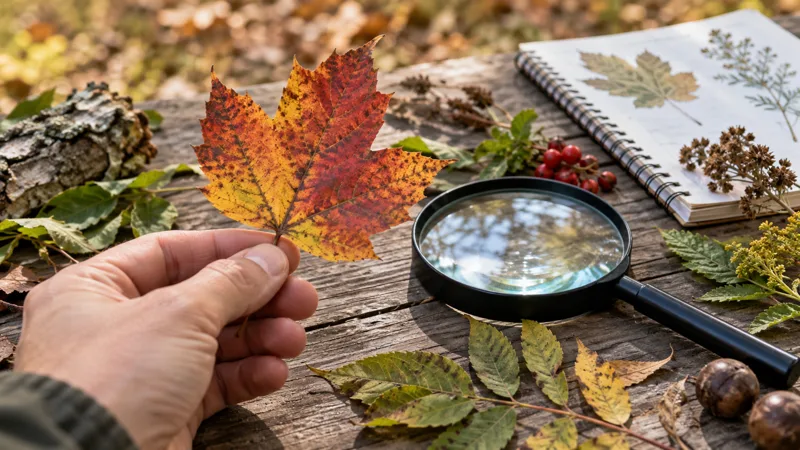
Use a notebook entry that includes the date, location description, observed features, and the source of any suggested name. Distinguish your own observation from the instructor's interpretation. If a photograph is permitted, record what it shows and what it fails to show. A close image of one leaf may omit the rest of the plant or its setting. Do not label the photograph as certain merely because an app proposes a name. A learning record can remain valuable while clearly marked as a tentative identification.
Avoid editing uncertain notes later so that they appear more confident than the original observation. Instead, add a dated correction and explain why the conclusion changed. This creates a useful account of your reasoning. It also helps prevent a photograph from becoming a misleading reference when you revisit it months later. The plant you see in another season or location needs its own evaluation. An earlier identification belongs to the earlier observation, not automatically to every similar specimen.
Ask about lookalikes before asking about uses
During a future plant learning session, invite the instructor to explain common sources of confusion and the limits of the comparison. Ask what features would make them decline an identification. Those questions are often more useful than asking for a long list of edible possibilities. The aim is to understand how uncertainty is handled. Avoid trying to extract a one sentence rule that lets you bypass a careful identification. A short description can be memorable while still omitting the evidence that matters most.
Do not use tasting as an identification method or assume that a small amount makes an unknown plant safe. Keep children and pets away from unfamiliar collected material. If an exposure occurs, seek appropriate poison guidance promptly rather than trying to solve the identification privately. In the United States, Poison Control provides assistance at 1-800-222-1222 and through its official online service; emergencies requiring immediate response should use emergency services. These resources complement prevention, not permission to experiment.
Medicinal language needs a different standard of evidence
The word medicinal in an event title describes a topic; it does not demonstrate that a plant treats a condition or is safe for a particular person. The National Center for Complementary and Integrative Health advises discussing supplements with health care providers and considering risks such as interactions. A traditional description, personal story, or classroom demonstration should not be converted into an instruction to change prescribed treatment. Keep cultural or historical information clearly labeled and seek qualified medical guidance for health decisions.
When taking notes, distinguish a reported tradition from a studied effect and from a personal recommendation. Ask where a claim can be checked. If the instructor discusses a preparation, that does not establish dosage, suitability, or safety for you. This article provides none of those instructions. A careful learner can appreciate plant knowledge while refusing to treat enthusiasm as clinical evidence. That distinction protects the value of the educational experience by preventing it from being stretched into claims the available information does not support.
Collection permission is a separate learning task
Before collecting any material, ask the responsible landowner or land manager about current rules. A public looking space is not automatically open to harvesting, and an instructor's permission at a class venue does not apply to another property. Learn the relevant restrictions for the particular location and species through authoritative sources. Do not rely on a social media comment from a different area. If permission or identity remains unclear, observe without removing material. Observation can still support a useful notebook entry and question.
Consider why you want to collect. A photograph and note may meet the learning objective with less impact. If a supervised class requires material, follow its current instructions and the site's rules. Avoid gathering more merely because an example appears abundant. An individual learner may not know the wider context of a population or the interests of others using the land. Respecting those limits is part of becoming competent, not an obstacle to authentic plant study.
Craft topics can be explored without confusing them with food safety
The organizer's archived description includes cordage and seasonal plant material. That creates an opportunity to think about craft as a separate learning goal. Ask which materials are suitable, how they were identified, and what precautions the instructor uses while handling them. A plant's usefulness for a fiber project does not mean it is edible, and an edible reputation does not establish that every part is appropriate for every use. Maintain the same careful labels when moving between these topics.
For a home craft project, use responsibly sourced, known materials and appropriate supervised instruction. Record what you changed and what result you observed without claiming a traditional technique worked perfectly on the first attempt. A failed sample can teach you about preparation, storage, or the limits of your notes. Keep tools and materials organized, especially around children or pets. The practical objective is a repeatable, appropriately bounded craft skill, not proof that all products from the natural world are harmless.
Return to the same learning area over time
Choose an accessible location where observation is allowed and revisit it during different parts of the year. Record the changes without assuming you are seeing the same individual plant unless you can support that conclusion. Seasonal observation helps reveal the limitations of a photograph taken once. It also gives you more questions for a competent local instructor. The activity can be brief: a few careful observations may be more valuable than a hurried walk that produces dozens of uncertain names.
Compare notes by asking what you can now describe more clearly. Perhaps you have learned to document the whole setting or to distinguish an observed feature from a suggested interpretation. That is meaningful progress even when the entry remains unidentified. Resist turning the notebook into a list of guaranteed food sources. The discipline of leaving a question open is especially useful in plant study, where a confident but unsupported conclusion can have consequences far beyond an ordinary mistaken label.
What to retain from an archived class listing
Keep the organizer's source link as a reference for the original class, but do not assume the past date represents a current booking. Ask about new schedules, registration conditions, location, and material requirements directly. The class description establishes a broad educational focus, not every detail of what an individual participant experienced. This page makes no claim that anyone attended or mastered the subject. It offers a way to turn interest in that event into a thoughtful plan for future learning.
The most useful result is a learner who records evidence, recognizes uncertainty, respects collection rules, and separates botanical knowledge from health claims. Those habits remain valuable long after September 19. They make future instruction more productive because your questions are specific and your notes are honest. You can become more attentive to the plants around you without treating the landscape as an unverified pantry or pharmacy. Careful observation is a substantial skill in its own right.
Primary sources and archived event
Read the original Fall – Edible & Medicinal Plant Class page, National Capital Poison Center plant guidance, and NCCIH supplement guidance. Browse current events for future learning opportunities.