
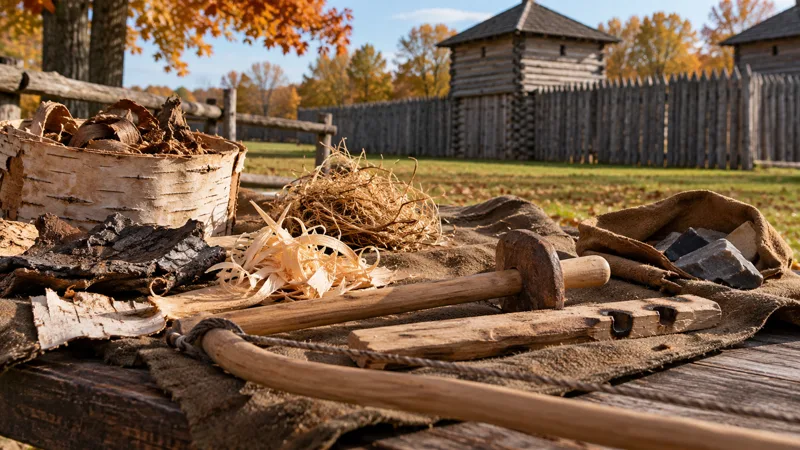
A private class requires a different attendance assumption
Private Fire Making Class @ Ft. Laurens (Bolivar, Ohio) is listed for November 7, 2026, at Fort Laurens Historic Site, 11067 Fort Laurens Road NW, Bolivar, Ohio 44612. The Midwest Native Skills Institute calendar currently shows this November session with an 11:00 a.m.–1:00 p.m. time range. It remains upcoming as of October 7. The word “private” is significant: a public calendar entry does not establish that members of the public can register or walk into the session.
The original class source link should be retained when making an inquiry. Direct access to that specific page was unavailable during verification, so contact the school or the authorized booking contact for participation instructions. Confirm who is eligible, whether registration is possible, where attendees meet, and what equipment is permitted. Neither the historic-site address nor a general survival-school calendar guarantees admission to a private group. This article does not establish a fee, instructor, certification, or detailed curriculum.
Fire knowledge begins with deciding whether fire belongs
It is tempting to approach a fire-making lesson as a contest between ignition methods. A more valuable starting point is the decision to use fire at all. What job is needed: warmth, cooking, light, or a supervised educational demonstration? Can another arrangement perform that job with fewer hazards? What conditions make ignition inappropriate? Those questions give techniques a context and prevent a useful skill from becoming an automatic response in every setting.
A historic property adds a clear reminder that training sites have responsibilities beyond the lesson. Structures, grounds, visitors, collections, and cultural resources may all need protection. Follow the site and instructor's designated work area. Do not collect materials, leave a teaching group, or start an independent fire because you assume the property is available for practice. Permission is specific to an activity and location; it does not extend automatically to nearby land.
The National Park Service fire-safety resource connects campfire, structural, and wildland concerns. Its broader lesson for a visitor is that an outdoor flame is part of a managed environment. Before participation, ask who controls ignition, who monitors the surrounding area, and what the stop instruction will be. An instructor's ability to cancel an exercise is as relevant as their ability to demonstrate it.
Prepare questions that reveal the principles
A short session can easily fill with demonstrations, so choose a few questions before arriving. Ask how the instructor distinguishes a suitable teaching material from an unsuitable one, how moisture changes the decision, and what information a beginner should record. Ask what a participant should recognize before attempting a technique independently. These questions focus on judgment and observation without requiring the class to teach a particular method.
One useful distinction is between a demonstration prepared by an instructor and a real outdoor situation. A teaching station may have controlled materials, sheltered space, assistance, and a known extinguishment system. An inexperienced person can overlook those supports and attribute the result entirely to the ignition tool. Ask the instructor to identify the conditions that made the demonstration possible. Learning those conditions is more transferable than memorizing only the visible movements.
Another useful question concerns failure. If an attempt does not work, what does the instructor inspect first? How do they decide whether to adjust the materials, change the setup, or stop? A thoughtful answer can show that repeated attempts are not always productive. Fatigue, frustration, and loss of attention can create hazards. Being willing to step back is part of competence, especially around heat and cutting tools.
Dress for observation and controlled participation
Ask the school for its clothing and equipment requirements. Avoid bringing an assortment of ignition devices, fuel, or sharp tools unless requested. Equipment introduced without the instructor's approval can complicate a controlled activity. Footwear should suit the stated surface and allow stable movement. Clothing needs to support the weather and the teaching arrangement; the forecast and organizer's advice should determine the final choice rather than the season alone.
Discuss relevant mobility, vision, hearing, or dexterity needs before the class. A participant may need to stand at a different position, receive an instruction in writing, or use an alternative grip arrangement. That conversation gives the instructor time to plan rather than improvise during an active demonstration. If a health condition could affect participation, ask your clinician about appropriate restrictions. Do not treat an event guide as a medical assessment.
Keep personal belongings out of the work zone. A dangling strap, loose bag, or crowded bench can interfere with movements even when the participant is trying to be careful. Know where to place a notebook, coat, and water bottle. If the class provides protective equipment, ask how it should fit and when it must remain in use. Bring your questions, but do not interrupt a critical instruction because you want to capture an answer immediately.
Understand the tool before comparing the tool
Fire-related products are often marketed with claims about reliability in challenging conditions. Translate those claims into practical questions. Can the intended user operate the device with the gloves and hand strength they have? How is it protected during storage? Does it depend on consumables or an accessory? What does the manufacturer instruct users to inspect? A device that works smoothly for an experienced demonstrator may still be poorly suited to another person.
Ask the instructor whether an equipment comparison is appropriate for this private session. The class may not be organized as a product evaluation, and you should respect its purpose. If products are discussed, distinguish ignition capability from a complete safe fire arrangement. A spark-producing item does not provide permission, a suitable site, appropriate materials, supervision, or a means to manage the fire. Packaging that emphasizes emergency utility can conceal how much planning remains necessary.
A modest kit can be easier to maintain than a complicated collection. The issue is not the number of methods carried but whether each has a understood role and safe storage arrangement. Keep manufacturer instructions, inspect equipment according to those instructions, and replace damaged components appropriately. Do not modify fuel-containing devices or experiment with unapproved materials to imitate something seen online. Professional instruction should establish the boundaries of practice.
Separate camp warmth from shelter design
People often imagine a fire as the center of a survival camp, but warmth planning cannot depend on a flame being available. A suitable shelter, dry clothing, ground insulation, food, and the ability to leave an unsuitable site may all matter. Even a person skilled at ignition can encounter restrictions or conditions that make fire inappropriate. Ask how the instructor plans when the safe decision is to avoid using it.
Never assume that a flame or combustion device can be moved into an enclosed shelter because outdoor conditions are uncomfortable. Fire and combustion gases introduce hazards that a brief skills lesson cannot solve. Follow manufacturer guidance and current public-safety advice. The National Weather Service's winter-preparedness page discusses unsafe heating and carbon monoxide during cold-weather disruptions. That guidance reinforces the need for a separate, appropriate warmth plan.
For an ordinary outing, think through an example with no ignition. You have rain protection, an appropriate insulation system, lighting, water, food, and a planned return. What would make you leave sooner? Where is an accessible sheltered destination? Who knows your plan? This exercise gives fire skills an honest place among other preparations instead of allowing them to hide weaknesses elsewhere.
Take notes that do not become an incomplete recipe
Record the instructor's safety conditions alongside any technical observations. A note such as “worked with this material” is insufficient if the lesson depended on specific preparation, supervision, or an approved fire area. Ask permission before taking photographs or video, especially during a private class. Do not place a recording device where it distracts participants or blocks movement. Respect other attendees' privacy and the site's rules.
Organize notes around decisions: prerequisites, site restrictions, equipment inspection, stop conditions, and questions needing follow-up. Avoid turning a few remembered movements into an unsupervised procedure. If the school recommends a reading resource or another class, record the exact title or link. A missing detail is a reason to seek clarification, not to fill the gap with guesswork. This approach is especially important when ignition, fuel, heat, or sharp tools are involved.
Build a responsible practice plan after the session
Post-class practice should follow the instructor's stated boundaries and local requirements. Identify an authorized location and obtain appropriate supervision for any task beyond your experience. Do not use the historic site as a later practice area without separate permission. Check the current restrictions that apply where you intend to work. An approved class on one day does not establish conditions for another place or date.
Some useful follow-up tasks do not involve ignition at all. You can organize equipment, review manufacturer instructions, rehearse retrieving lighting in darkness, or discuss a no-fire camp plan with companions. You can also inspect how your pack keeps equipment dry and whether necessary items are accessible. These quiet exercises improve the surrounding system while leaving hazardous techniques for a properly managed setting.
The Fort Laurens listing is therefore most useful as a prompt for an eligibility inquiry and a thoughtful learning plan. Its recorded November 7 date, site address, and current calendar time are distinct from the unconfirmed participation arrangements. Confirm your authorization to attend, follow the school and property's instructions, and judge the experience by the decisions you understand afterward. A responsible fire-making student learns when to stop as well as when a technique succeeds.