
Event details
- Dates: September 20, 2026
- Location: Hanna City, IL, USA
- Type: Herbal Medicine & Remedies
Study wild medicinals without turning a class into treatment
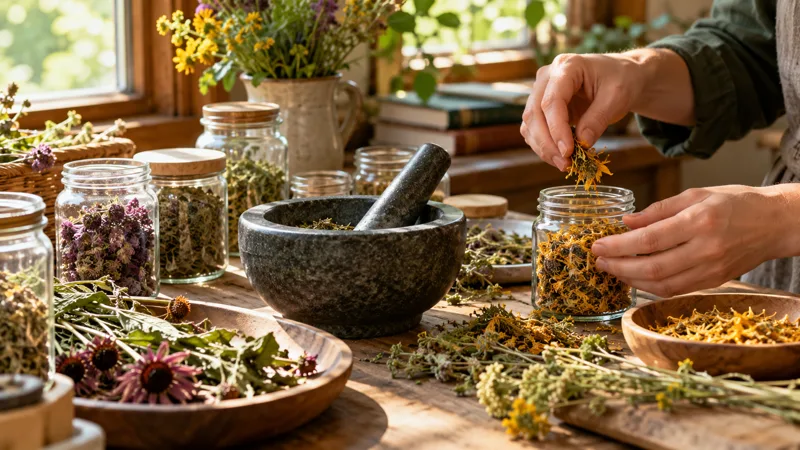
Preparing Wild Medicinals was listed for September 20, 2026, in Hanna City, Illinois. The date has passed. This page preserves an archived event record and should not be used to confirm a new session, available registration, or permission to collect plants at a teaching site. Follow the FeralSkills source to identify the original provider and ask about future instruction. The event title does not establish which plants were discussed, what preparations were demonstrated, or whether any participant used a product. Those details are not supplied by the record.
The subject deserves a careful boundary. Learning about a plant's history, identification, or preparation is different from deciding that it can treat a health problem. An educational session is not a substitute for qualified medical care. The National Center for Complementary and Integrative Health notes that herbal products can have safety concerns, including interactions with medicines. These notes use that principle as a starting point while offering original questions about how to evaluate a class, organize records, and distinguish cultural information from evidence about a health claim.
Decide what kind of learning you want
A person might attend because of an interest in local plants, traditional practices, gardening, or the history of household remedies. Those interests do not require self treatment. Before booking another session, describe your goal in plain terms. Do you want better identification skills, an understanding of how a demonstration is documented, or help finding reliable references? That specific goal gives the organizer a fair chance to explain whether the program matches your needs. It also makes it easier to decline activities that go beyond the learning you intended.
Ask whether the session is observational or hands on and whether tasting, skin contact, or taking a preparation home is involved. Find out how ingredients are identified and what sources support the explanations. A responsible organizer should be able to tell you what the class does and does not claim. You should not need to guess whether a story about historical use is being offered as health advice. Resolve that ambiguity before participation, especially if you have allergies, take medicines, or have a health condition requiring professional guidance.
Keep identity, preparation, and evidence separate
A correct botanical identification is essential to understanding a specimen, but it is only one part of the subject. It does not prove that the plant is safe for a particular person, that a preparation has a consistent strength, or that a proposed use has reliable evidence. Ask the instructor to explain these decisions separately. A common name may be convenient in conversation, but scientific names and relevant plant parts are important when checking a reference. Keep unresolved identification questions visible rather than smoothing them over in your notes.
The preparation method is another separate subject. Ask what the demonstration is meant to show and whether students are being taught a historical process or a currently supported use. Differences in plant part, source material, handling, and concentration can matter. This article gives no dosing, extraction procedure, treatment recipe, or method for deciding that a wild plant is safe to ingest. Such details should not be reconstructed from a brief event listing or a beginner's memory of an interesting demonstration.
Ask for evidence in a useful form
When a health claim is mentioned, ask what kind of support is available. A historical account, a laboratory finding, a personal story, and a clinical study answer different questions. One cannot simply replace another. Request references you can examine after class and note whether the teacher acknowledges uncertainty. A confident tone is not evidence, and a long tradition does not by itself establish the benefits or risks for an individual. A good educational discussion makes those distinctions understandable instead of asking students to accept every claim on trust.
Avoid trying to resolve complicated health questions through internet comments. Use primary public health resources and qualified clinicians for decisions involving medicines and treatment. NCCIH's herbal resources can help you identify topics to discuss with a health professional. Their purpose here is to support informed questions, not to endorse the archived event or any particular preparation. If a source says that evidence is limited, preserve that limit in your own account. Do not turn uncertainty into a positive claim merely because the topic fits a self reliance theme.
Bring health questions to the right professional
Before using an herbal product, discuss it with a qualified health professional who can consider your medicines and circumstances. Bring the actual product information or an accurate ingredient record if you have one. The class instructor may have expertise in botany or history without being qualified to review your medical care. Ask about credentials rather than assuming that a teaching role includes every relevant qualification. An honest referral to another professional can be a sign of appropriate boundaries, not a weakness in the educational program.
Do not stop prescribed treatment or delay care because a class introduces an appealing alternative. Emergency preparation should make appropriate help easier to obtain. It should not become a reason to experiment with an uncertain remedy when someone is seriously unwell. If an unknown plant or preparation has been consumed and there is concern about exposure, seek appropriate medical or poison control advice promptly. Provide the available information rather than trying to settle the identity through guesswork. The priority is qualified assessment, not proving that the original idea was sound.
Make a notebook that preserves context
Organize notes into clearly labeled categories: identification, historical information, demonstration observations, sources, and unanswered questions. That structure stops a remembered story from becoming a personal recommendation. Record the exact name used, the part of the plant discussed, and what the teacher said was uncertain. When you later review the notes, you should be able to distinguish what you observed directly from what someone asserted. A notebook with visible gaps is more useful than a polished summary that hides the limits of the lesson.
If photographing specimens is allowed, include context and distinguishing features, not only an attractive close up. Do not collect material just to improve a photograph or to take a reminder home. Permission to attend the event does not automatically authorize harvesting. Store photographs with the associated notes and avoid attaching a confident identification later if the original lesson did not establish one. Technology makes it easy to share a label, but easy distribution does not make that label more accurate or suitable for someone else's health decision.
Treat collection as a separate responsibility
If a future class includes gathering, ask about landowner permission, site rules, and how the provider avoids unnecessary disturbance. A plant may be common in one location and scarce in another. A teaching example does not establish an unlimited harvest right. Ask whether supplied material can be used instead of collecting from the landscape. The educational purpose may be achieved with observation and documented specimens, especially for a beginner who is still learning to distinguish important features.
Also ask how material is tracked from collection to demonstration. Origin, handling, labeling, and separation of specimens are practical questions even when nobody plans to consume anything. Confusion between containers can undermine an otherwise careful lesson. You do not need an elaborate personal laboratory to appreciate the value of clear records. Understanding why an instructor labels and separates material helps students recognize that preparation is a controlled process rather than an intuitive activity based on appearance and enthusiasm.
Prepare for an educational session
Confirm the actual supplies needed. A notebook and comfortable clothing may be enough for an observational class; a practical demonstration may have additional requirements. Do not bring tools or ingredients unless requested. Ask about seating, outdoor walking, breaks, and access to facilities if those details affect your participation. Hanna City identifies a locality, not the exact classroom or parking arrangement. Obtain precise directions from the provider and keep an ordinary meal and drinking water available if refreshments are not part of the confirmed program.
It is reasonable to decline tasting or application while continuing to learn. Explain relevant needs to staff through their normal registration process, and ask whether observation is possible. A participant should not need to consume something to demonstrate interest in the subject. The central value can be understanding the questions, seeing how material is documented, and learning where reliable information ends. That approach allows curiosity without making the educational visit a personal experiment in treatment or exposure.
Share what you learned responsibly
When discussing the session with friends or writing about it online, identify the subject as education. Avoid presenting a remembered demonstration as a recipe for treating someone else's symptoms. A useful summary can describe the distinction between identification and evidence, explain which questions remain open, and link to qualified resources. Do not claim outcomes for other participants or suggest that a natural ingredient is inherently harmless. Readers may have circumstances you know nothing about, including medicines and conditions that change the risk.
The archived Hanna City event can remain useful as a prompt to study plants carefully and evaluate claims honestly. Check the original source for new programming, keep historical knowledge distinct from medical advice, and seek professional guidance for decisions about use. A strong self reliance habit is knowing when outside expertise is necessary. The worthwhile result of a wild medicinals class is better understanding and better questions; it does not require a bottle of homemade treatment or a promise that a single workshop can replace established care.
Further reading
https://www.nccih.nih.gov/health/safety
https://www.nccih.nih.gov/health/tips/tips-how-herbs-can-interact-with-medicines