
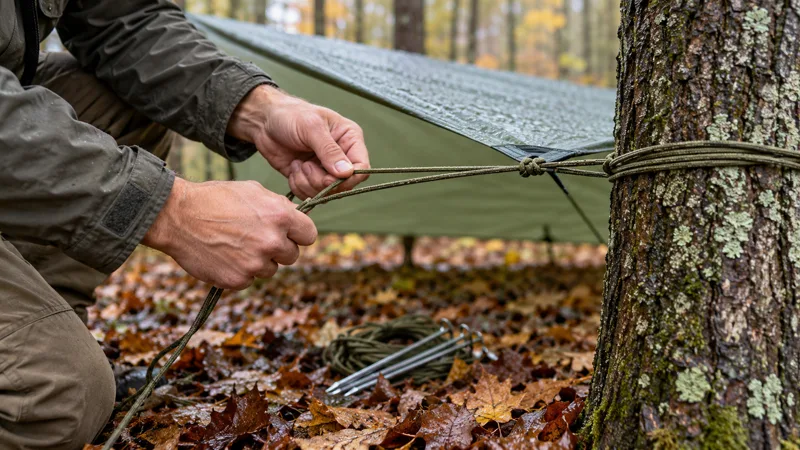
Complete Shelter & Tarp Techniques: learn to evaluate a setup
Complete Shelter & Tarp Techniques is listed for October 17–18, 2026, at Richfield, Ohio Joint Recreation District, 4374 Broadview Rd., OH 44286. The organizer's current event page confirms those dates and venue and describes practical shelter learning with minimal equipment. Consult Midwest Native Skills Institute for registration, current requirements, and any changes before traveling. This article is an independent guide to questions, observation, and practice; it does not claim that a particular shelter design, overnight format, or equipment package is included.
A tarp is deceptively simple. Folded in a bag, it looks like a rectangle of material and a collection of attachments. In use, it becomes part of a system involving the location, weather, supporting equipment, occupants, and the way it is maintained. The worthwhile learning goal is therefore not to memorize the greatest number of named configurations. It is to recognize what a setup is intended to do, which assumptions it depends upon, and when a different shelter or a different plan would be more appropriate.
Begin with the conditions a shelter must address
Before asking an instructor for a favorite design, describe the activity you actually plan to undertake. A short daytime pause, an overnight trip, and a demonstration in a managed teaching area have different requirements. State the number of occupants, their needs, the available equipment, and the expected duration. Ask which parts of that description would change the shelter choice. This creates a useful discussion about suitability rather than an abstract argument over which configuration is best in every circumstance.
Be honest about your experience. If you have never erected your tarp independently, say so. If you normally use a manufactured tent, explain what you hope to learn from a tarp class. The instructor can better address a specific gap than a vague claim of advanced ability. Do not assume that attending one weekend establishes competence for harsh conditions or remote winter travel. The experience should help identify what further supervised practice or specialized training is needed before a more demanding undertaking.
Study the site as part of the shelter
Ask how the instructor evaluates a proposed location and what would make them reject it. Terrain, access, overhead conditions, and current land manager rules belong in that conversation. Do not copy a class setup at another site merely because the shape looks familiar. The supporting assumptions may differ. A good learner records why the location was selected and which concerns were checked. That context is often more important than a close photograph of the finished tarp.
Follow venue instructions and respect the limits of allowed practice. A teaching area may permit an activity that is inappropriate elsewhere. Use current rules for the land where you later practice, including restrictions on altering vegetation or using attachment points. When uncertain, choose an established permitted activity or ask the responsible manager. The educational goal does not require leaving damage behind. Evaluating a shelter includes considering whether the location and materials are responsibly available to you.
Ask what failure would look like
Invite the instructor to describe early signs that a setup is no longer meeting its purpose. Ask what should be checked during use and when adjustment is appropriate. The point is to understand observation and judgment, not to seek permission to remain in a failing shelter. If a learning exercise becomes unsafe, stop and follow the instructor's direction. A decision to change plans is useful evidence of competence. It shows that the shelter is being evaluated rather than treated as a project that must be defended.
Keep the discussion specific to the actual materials. Different products have different intended uses and limits. Read manufacturer instructions and do not assume that an emergency sheet, ordinary utility tarp, and purpose made shelter can be treated interchangeably. Ask how the instructor identifies the limits of an item without destructive testing. A consumer review or impressive demonstration may omit those limits. Understanding them helps you avoid asking equipment to perform a job it was never designed to do.
Take photographs that explain, not just impress
If the organizer permits photography, capture the whole setup and the contextual details you are allowed to record. Add notes about its purpose, materials, and the instructor's explanation. A dramatic low angle image may be attractive while failing to show the features you need to remember. Do not include other participants without permission. Protect location information when the organizer asks you to. Your photographs are learning aids, not evidence that you can reconstruct a design safely from an image alone.
After the demonstration, try explaining the setup in your own words before checking your notes. Which detail do you immediately forget? Ask about it while the instructor is available. Label the photograph with the date and any limitation you discussed. If later practice reveals that your interpretation was wrong, add a correction rather than silently changing the record. This preserves the distinction between the original instruction and your developing understanding. Good notes make future practice more focused and honest.
Organize components as a working kit
Inventory the shelter components required for your actual equipment and approved activity. Check closures, attachments, and storage according to manufacturer guidance. Arrange the kit so that the necessary parts are easy to find together. Missing one small component can undermine an otherwise careful plan. A large collection of spare pieces may also create confusion if nobody knows their role. Ask the instructor which simple inspection routine suits your materials rather than assembling a universal list from unrelated products.
Practice finding and identifying the components at home under ordinary conditions. Another member of the group should be able to understand the organization. If equipment is shared, record who carries what and review the arrangement when the group changes. A kit is only complete when the required components are available to the people who need them. Do not rely on a partner's unspoken assumption that you packed the same item. A brief deliberate handoff can prevent that common mistake.
Understand the occupant's experience
A shelter that looks tidy from outside may be difficult for its intended occupants to use. Ask about access, space for necessary equipment, and whether everyone can move comfortably within the approved demonstration. Include the needs of a participant with limited mobility or another practical constraint. Do not assume that a design comfortable for one person works for a group. The useful question is how the shelter supports the actual occupants and what compromises would change its suitability.
Talk about how the group communicates concerns. A person who feels uncomfortable should be able to speak without fearing that they are spoiling the exercise. Assigning a familiar check in point can help. The instructor should handle safety decisions within the class, and participants should follow those directions. For later trips, develop an appropriate decision process before departure. A shelter is part of the wider trip plan, including alternatives and assistance arrangements, rather than a self contained solution to every outdoor problem.
Choose a modest first independent practice
After the class, practice only within your competence in a permitted, low consequence setting. Keep access to appropriate assistance and a suitable alternative. The first independent session should help you recall the process, not prove that you can tolerate difficult weather. Read your notes, inspect the equipment, and identify what you still cannot explain. If a step remains unclear, ask the instructor or obtain further qualified guidance. Uncertainty is a reason to narrow the activity, not to improvise a dramatic challenge.
Change one variable at a time so you can understand the result. A different product, group size, or site may alter several assumptions at once. Write down what changed and what you observed. Do not make claims about performance in conditions you did not encounter. A comfortable afternoon exercise demonstrates learning under those conditions; it does not certify the setup for a remote storm. This restraint makes your practice record useful instead of turning it into a collection of unsupported success stories.
Maintain the equipment after the lesson
Follow product instructions for cleaning, drying, inspection, and storage. Record damage or missing parts where the next user will see it. If an item needs repair or replacement, do not return it to the ready kit without a clear note. Shared equipment especially benefits from an agreed maintenance handoff. The person who uses the kit and the person who stores it may not be the same. A simple checklist prevents a problem discovered on one outing from being rediscovered on the next. Add the date of inspection so that the next person can distinguish a current check from an old reminder awaiting attention.
At the end of the learning process, ask whether you can explain the purpose, limitations, and inspection needs of the setup. Those answers matter more than the number of configurations you can name. Complete Shelter & Tarp Techniques can be a useful opportunity to build that understanding, but the current organizer's instructions remain the authority for the class itself. Arrive with a few concrete questions, keep your notes contextual, and leave with a realistic plan for supervised or modest practice appropriate to your ability.
Source and broader preparation
Read the official Complete Shelter & Tarp Techniques event page. The National Park Service Ten Essentials places shelter within wider trip preparation. Verify the class's current details before booking, and explore related Survival Skills articles.